A steady mount beats a big number on the box · review
Kosmos Fernrohr review
Kosmos's Fernrohr: a 30x lens telescope in a metal tube, sold as a children's experiment kit for the Moon, birds and squirrels, listed on Amazon.com with a German-language description.
Kosmos makes science kits, and the Fernrohr is one: a lens telescope the child assembles, with a metal tube. Its Amazon.com description is in German, a sign of the product’s origin.
Thirty times
The description gives one figure: 30x magnification. That is enough to explore the Moon’s cratered landscape, and by day to bring birds and squirrels close, which is how Kosmos describes it. It says the telescope is easy and precise to adjust for children.
What is not published in English
Aperture, contents, mount or tripod. The listing title calls it an experimentation kit, and that is what to expect: a learning object first.
Who it suits
A child of about eight who wants to understand how a telescope works and carry one on a walk. For a first telescope to use on the sky regularly, the kids’ telescopes shelf has better choices.
Price and availability
On November 7, 2026, Amazon.com listed it at about $44 from a third-party seller.
Figures as Keepa reported them on the day this page was last updated. Stock and pricing shift without warning.
Prices quoted in this text were read on November 7, 2026. The live price is at the top of the page.
Its two nearest scopes on price
Same aisle, closest price — what the same spend else shows.
Experiment kit: the child builds and adjusts the telescope, stated easy and precise to set
Supplied contents
Not listed in English · German description mentions a metal telescope tube
Amazon reference
B0DXLFFKDX
EAN
4002051676940
What observers ask about this one
Why is the description in German?
Kosmos is a German publisher of science kits, and this Amazon.com listing carries the original German text. The title calls it an experimentation kit; the description describes a 30x lens telescope with a metal tube.
What will a child see at 30x?
The Moon's craters and seas clearly, Jupiter's moons as points of light, and birds or squirrels in trees by day, as the description says.
Is it a real telescope?
It is a simple refractor, built as a learning project. For a first telescope to use every clear night, the [Explore One 50 mm](/reviews/kids-telescopes-explore-one-50/) or the [Bresser JUNIOR](/reviews/kids-telescopes-bresser/) do more.
Our score
7.2/ 10
More a learning object than an astronomical instrument, and honest about being exactly that.
The price on Amazon.com
This model is listed on Amazon.com, at ≈ $44 at the last reading. Listed is not the same as in stock: availability changes daily, and the buy box shows the live price.
Details checked on November 7, 2026.
This one and its buyer, among astronomy instruments
A child who wants something to carry on a walk and look at the Moon with
Sources
Specifications: the manufacturer sheet for telescopes and observing optics and the matching Amazon product page. Prices and availability: Keepa. Every figure on this page names its source.
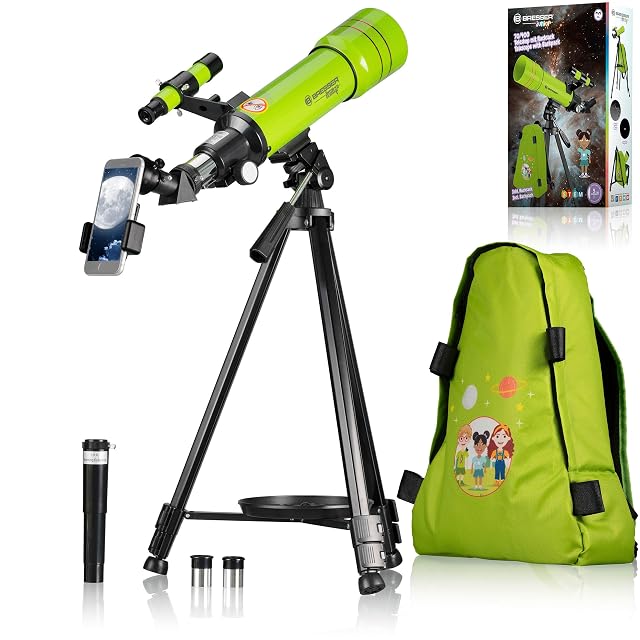
70 mm (2.76 in) lens · 400 mm (15.7 in) focal length · 20x to 100x · alt-azimuth tripod · backpack · from age 8
Bresser's JUNIOR 70/400 backpack set: a 70/400 refractor on an azimuthal mount and height-adjustable aluminum tripod, with H20, H12 and H6 eyepieces, a zenith prism, a 1.5x erecting lens, a 5x24 finder and a phone holder.
Best for: A child from about eight who will carry and set up the telescope with little help
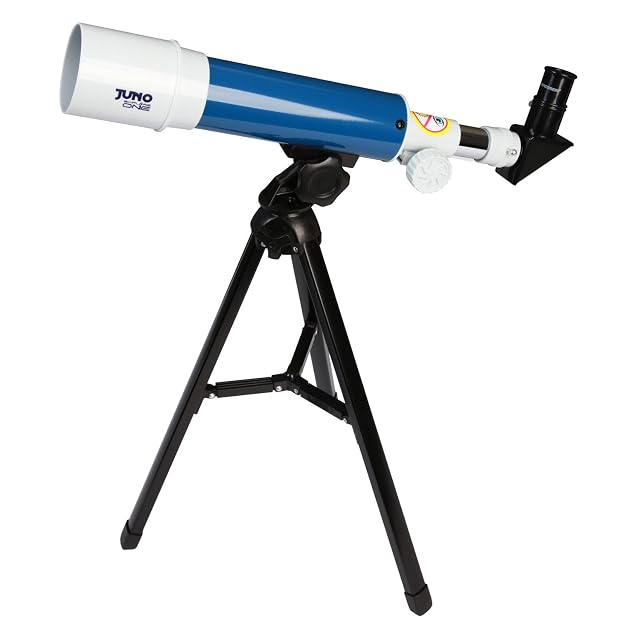
50 mm (1.97 in) · 18x and 28.8x · tabletop alt-azimuth tripod · star map and astronomy software
Explore One's 50 mm beginner telescope: two interchangeable eyepieces giving 18x and 28.8x, a tabletop alt-azimuth tripod, a star map and astronomy software, with US-based support.
Best for: A child's first telescope used from a table, where the Moon is the target and the star map is half the point
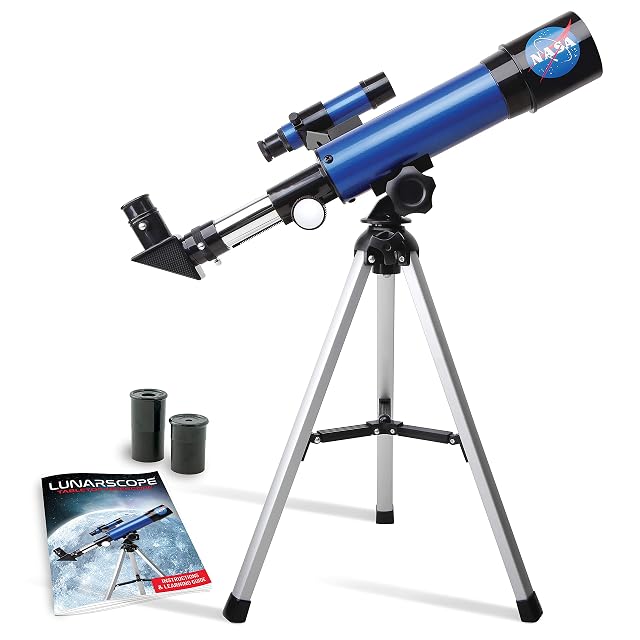
Low-power and high-power eyepieces · finder scope · tabletop tripod · no aperture or magnification published
Blue Marble's NASA Lunar Telescope, an Amazon exclusive for ages 8 to 12: a small telescope with a finder, low- and high-power eyepieces and a tabletop tripod, sold without any optical figures.
Best for: A child of eight to twelve whose interest is the Moon, bought on the strength of the name