Skip to content

The best equatorial mounts for 2026

An equatorial mount tilts one of its two axes until it points at the celestial pole, so that a single motor turning at one revolution a day cancels the rotation of the Earth. That is the whole idea, and it comes with the condition that the whole idea depends on: the mount only tracks if it is polar aligned. An equatorial head that has been set down without alignment is a worse alt-azimuth mount, and this is the single most common reason a first equatorial disappoints. The specification to read hardest is the payload rating. Makers publish it for visual use, and photography asks for a considerably wider margin, because a guiding error that is invisible at the eyepiece is a smeared star on a sensor. The rating also excludes the counterweights, and sometimes excludes the camera. Periodic error, when a maker publishes it, describes the repeating wobble that the worm gear introduces once per revolution; it is the figure that decides how long an unguided exposure can be. Then the parts that decide whether the mount is pleasant at one in the morning: whether a polar scope is fitted or optional, whether the latitude and azimuth adjusters move smoothly under load, what the tripod weighs, and how many separate pieces the whole thing becomes for the car. We compare payload rating, periodic error, drive and control, polar alignment provision, counterweight supply, tripod, heaviest single piece and supplied optics.
The instruments here, column by column

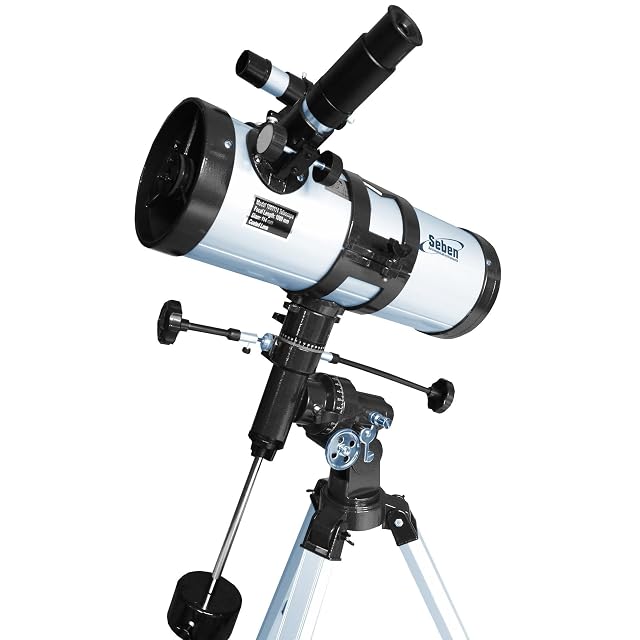
  1. Seben Star Sheriff 114/1000 EQ-3

    114 mm mirror · 1000 mm focal length · EQ-3 mount · 1.25 in focuser

    A 114/1000 Newtonian on an EQ-3 equatorial mount with a rack-and-pinion 1.25 in focuser, sold with an accessory pack and described by the maker as motor-upgradable.

    Best for: A first equatorial set with room to add a drive motor later

    ≈ €150

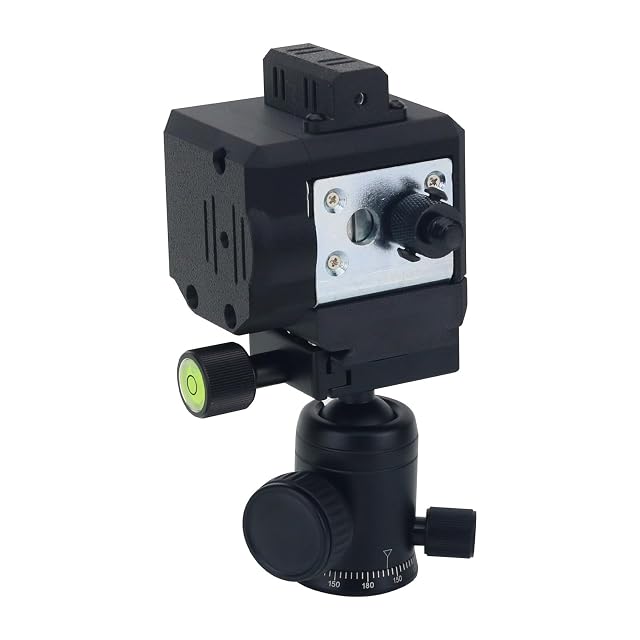
  2. TeSeek 99520

    Open-source tracker · ESP32-S dual core · 1/4 in output shaft

    A small equatorial tracking head built on an open-source design and an ESP32-S dual-core controller, offering sidereal, lunar and custom rates from a USB-C power bank.

    Best for: Wide-field camera tracking by somebody comfortable assembling their own chain of adapters

    ≈ €109

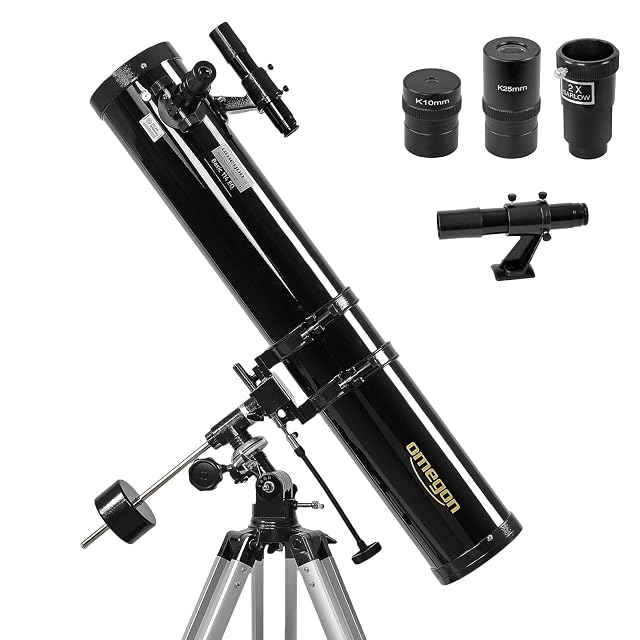
  3. Omegon N 114/900 EQ-1

    114 mm mirror · 900 mm focal length · EQ-1 mount

    A complete 114/900 Newtonian on an EQ-1 equatorial mount with two-axis slow motion, supplied with two eyepieces, a 6x30 finder and a 2x Barlow.

    Best for: A first equatorial telescope for the Moon and planets

    ≈ $399 / €239

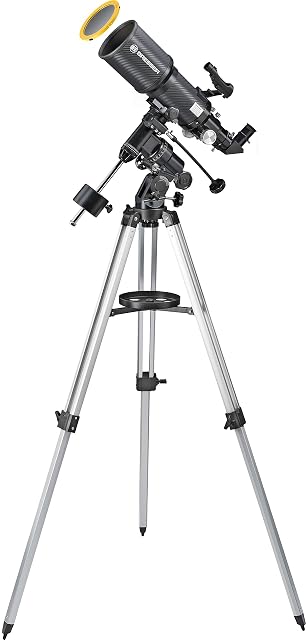
  4. Bresser Polaris 102/460 EQ3

    102 mm · 460 mm focal length · EQ-3 mount · objective solar filter supplied

    A 102/460 telescope on an EQ-3 equatorial mount, supplied with an objective solar filter for white-light observation, a 2 in focuser with a 1.25 in reducer and a smartphone adapter.

    Best for: Wide-field night use with a daytime solar option, on a mount that can carry both

    ≈ £255 / €249

Any figure written into the body of this page was true on the day it was written. The amount shown next to each instrument is requested from the retailer as the page loads, and it is that amount, not the text, that stands.