One axis against the turning sky — once it is aligned · review
Explore Scientific iEXOS-100-2 PMC-Eight review
Explore Scientific's iEXOS-100-2: a GoTo equatorial mount and tripod with clutched dual-axis worm gears on belt-driven stepper motors, the PMC-Eight controller, the ExploreStars app and a polar sight hole.
The iEXOS-100-2 is a computerized German equatorial mount with a tripod, sold for about $300 on November 7, 2026. It aligns, finds and tracks through Explore Scientific’s ExploreStars app on an Apple, Android or Windows tablet.
The polar sight hole
Instead of a polar scope, the right ascension axis has a sight hole bored through it, with a precise altitude control. Sight Polaris through the hole, adjust, and the mount is roughly polar-aligned. For short exposures and visual tracking that is quick and enough; for long exposures, a software polar-alignment routine refines it.
Belts and clutches
Both axes have clutched worm gears driven by quiet stepper motors through belts. The clutches let the tube be balanced and swung by hand, then locked for tracking. Belts are quieter than gear trains and tend to have less backlash.
Eight CPUs instead of a payload
Explore Scientific leads with its PMC-Eight controller and its eight independent processors. It does not publish a payload, a periodic-error figure, the counterweight supplied or the mount’s weight. For a mount, payload is the number that matters most; keep the load light until it is known.
Price and availability
On November 7, 2026, Amazon.com listed it at about $300 from a third-party seller.
Figures as Keepa reported them on the day this page was last updated. Stock and pricing shift without warning.
Prices quoted in this text were read on November 7, 2026. The live price is at the top of the page.
Its two nearest scopes on price
Same aisle, closest price — what the same spend else shows.
Polar sight hole through the RA axis, no polar scope needed for a quick alignment
Compromises
No payload figure
Counterweight and periodic error not published
Control by app only is described; no hand controller listed
Specifications
Payload rating
Not published in the Amazon.com listing.
Periodic error
Not published by the maker.
Drive
Clutched dual-axis worm gears with quiet stepper motor belt drives, stated
Control
PMC-Eight controller, described as eight independent CPUs · ExploreStars app for Apple, Android and Windows tablets
Polar alignment provision
Polar alignment sight hole through the RA axis and precise altitude control, for alignment without a polar scope, stated
Counterweight supply
Not published by the maker.
Tripod
Included, stated in the title
Heaviest single piece
Not published by the maker.
Supplied optics
None: this is a mount and tripod
Amazon reference
B07P5VWKPW
EAN
0811803030541
What observers ask about this one
What is a polar sight hole?
A hole bored along the right ascension axis. Looking through it at Polaris gives a rough polar alignment without a polar scope; the altitude control then fine-tunes the tilt.
What can it carry?
The listing does not say. Explore Scientific sells it for small refractors and camera setups; without a payload figure, keep the load light and test balance carefully.
What does PMC-Eight mean?
Explore Scientific's controller, which it says uses eight processors working independently on separate tasks. What matters in use is the ExploreStars app on a tablet that aligns and drives the mount.
The price on Amazon.com
This model is listed on Amazon.com, at ≈ $300 at the last reading. Listed is not the same as in stock: availability changes daily, and the buy box shows the live price.
Details checked on November 7, 2026.
This one and its buyer, among astronomy instruments
A small imaging setup that has to be polar-aligned quickly and driven from a tablet
Sources
Specifications: the manufacturer sheet for telescopes and observing optics and the matching Amazon product page. Prices and availability: Keepa. Every figure on this page names its source.
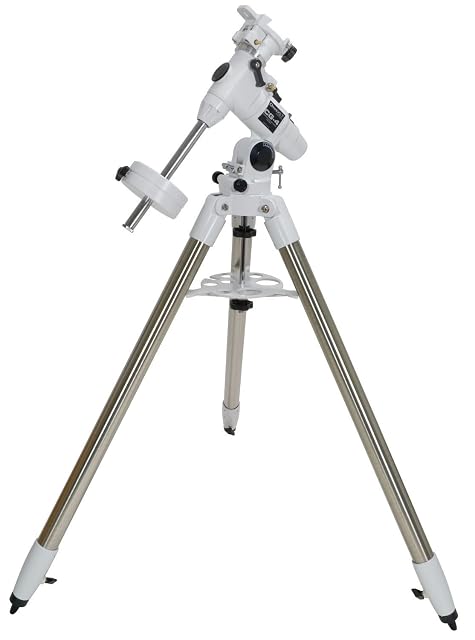
20 lb (9.07 kg) payload · 12.5 lb mount · 33 to 47 in · 1.75 in stainless steel legs · 7 lb and 4 lb counterweights
Celestron's CG-4: a manual German equatorial mount with slow-motion controls and ball bearings on both axes, a 20 lb payload, 7 lb and 4 lb counterweights and a stainless steel tripod with 1.75 in legs.
Best for: A tube of up to 20 lb, followed by hand on a tripod that does not shake
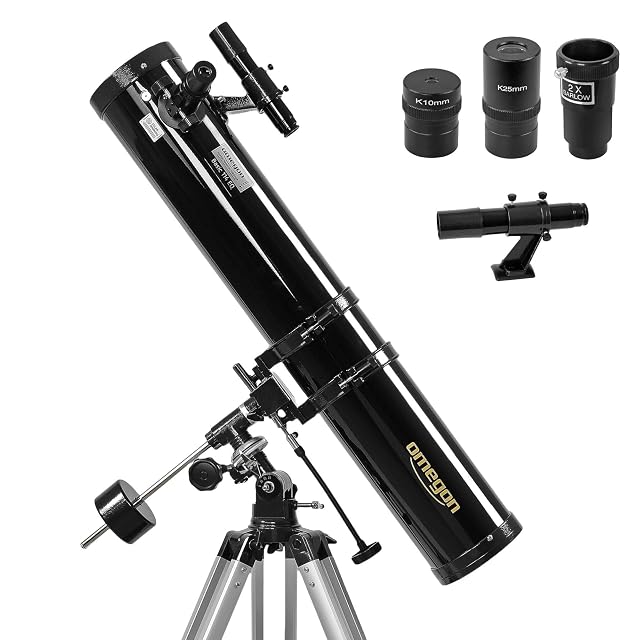
114 mm (4.49 in) mirror · 900 mm (35.4 in) focal length · f/7.9 · EQ-1 equatorial mount
Omegon's N 114/900 EQ-1: a 114/900 Newtonian on an EQ-1 equatorial mount with fine adjustment on both axes, a 1.25 in focuser, a finder with crosshairs and 25 mm and 10 mm eyepieces.
Best for: A first equatorial telescope for the Moon and planets
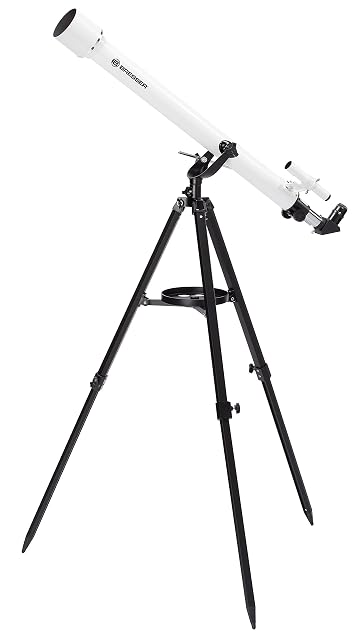
60 mm (2.36 in) lens · 900 mm (35.4 in) focal length · f/15 · alt-azimuth mount · 2.5 kg (5.5 lb) complete
A 60/900 achromatic refractor on a light alt-azimuth mount and aluminum tripod, sold complete with three 1.25 in eyepieces, a 1.25 in diagonal, a 1.5x erecting lens, a 5x24 finder and a phone holder, 2.5 kg (5.5 lb) in all.
Best for: The Moon, double stars and the bright planets from a balcony or a yard, with nothing to align