Up-down, left-right, and nothing to align · review
Bresser Classic 60/900 AZ review
A classic 60/900 refractor on an alt-azimuth mount, supplied with three 1.25 in eyepieces, a star diagonal, an erecting lens and a smartphone adapter, at 2.5 kg complete.
The bottom line A long, slow, classical refractor at a weight anyone can carry — and its advertised magnification is five times what it can use.
Fifteen times the aperture in focal length
Sixty millimetres at nine hundred is f/15. That ratio does three things: it all but removes the colour error an achromat would otherwise show, it lets simple eyepieces work at their best, and it produces high magnification without demanding very short eyepieces. The cost is a narrow field and a long tube.
Everything is 1.25 in
The eyepieces, the diagonal — the supplied-items list names the size explicitly. That single fact separates this from the cheap sets with 24.5 mm fittings: a better eyepiece, a Moon filter or a Barlow can all be added later.
The weight is the other headline
Two and a half kilograms for the whole thing. It is carried out assembled, set on a balcony, and put away again in a minute — which is the property that decides how many nights a telescope is actually used.
The magnification claim
Up to 338 times, from the 4 mm eyepiece with the erecting lens. A 60 mm aperture is conventionally held to about 120x at the outside. The 20 mm eyepiece, at 45x, is where this telescope is at its best.
Availability
German, Italian and Spanish Amazon stores ran from 122 € to 128 € on the day of the survey.
American and British Amazon stores list it in local currency, which the euro range above sets aside.
French Amazon store gave no result whatever, so the buy button there opens a search rather than an empty page.
Figures as Keepa reported them on the day this page was last updated. Stock and pricing shift without warning.
Prices quoted in this text were read on 17 September 2026. The live price is at the top of the page.
What it publishes, and what it withholds
Strengths
f/15 is the longest ratio on this page, and it suits the Moon and double stars
1.25 in fittings throughout, so every modern accessory fits
At 2.5 kg complete it is genuinely portable
Compromises
Sixty millimetres is a small aperture, and 338x is nowhere near achievable
A 900 mm tube on a 2.5 kg mount will move when touched
The 5x24 finder is the small kind
Specifications
Payload rating
Not published by the maker.
Slow-motion control
Not published by the maker.
Clutch
Not published by the maker.
Tension
Not published by the maker.
Dovetail fitting
1.25 in (31.7 mm), stated in the supplied-items list
Tripod construction
Alt-azimuth with aluminium tripod and accessory tray · 130 × 90 × 90 cm, 2.5 kg, as the maker publishes them
Setup time
Not published by the maker.
Supplied optics
Refractor · 60 mm (maker’s bullet) · 900 mm (maker’s bullet) · f/15, the quotient of the two figures above · 20 mm, 12.5 mm and 4 mm · 5x24 finder, 1.5x erecting lens, 1.25 in star diagonal, smartphone holder
Amazon reference
B06Y1T1GT6 (same reference on 5 Amazon marketplaces)
EAN
4007922039770
What observers ask about this one
Is f/15 old-fashioned?
It is classical, and it has real advantages: almost no false colour from an achromat, simple eyepieces performing at their best, and high magnification available without very short eyepieces. The trade is a narrow field and a long tube.
What can 60 mm show?
Lunar detail in quantity, Saturn’s rings as a shape, Jupiter’s belts on a good night, and a great many double stars. Faint objects are out of reach, and no eyepiece changes that.
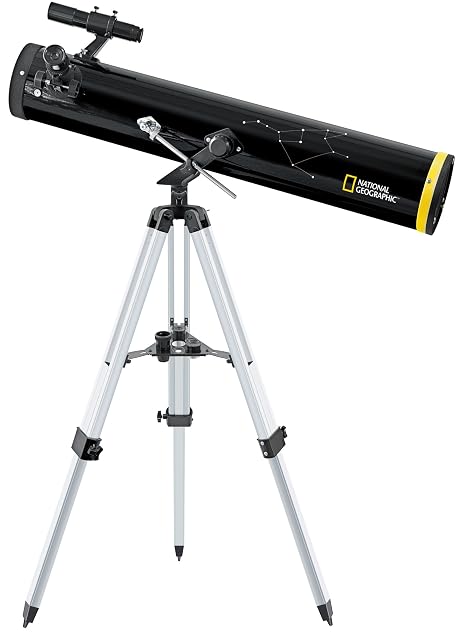
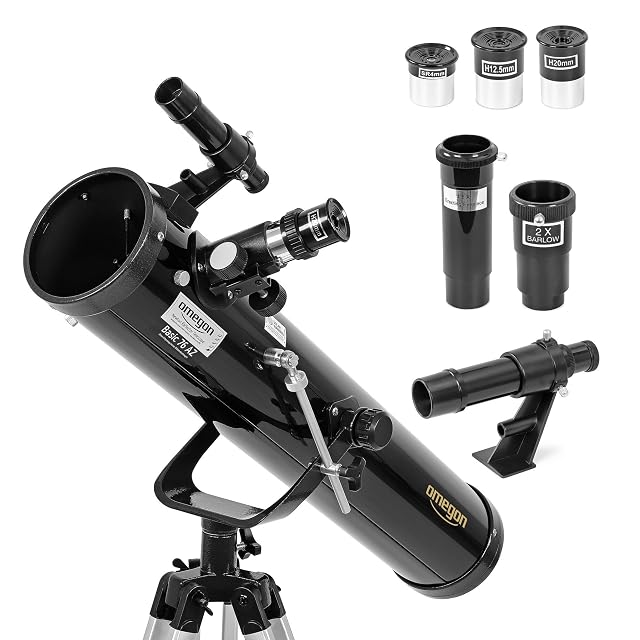
114 mm mirror · 900 mm focal length · alt-azimuth mount
A 114/900 Newtonian on a simple alt-azimuth mount, supplied with three eyepieces, a 6x30 finder and a 1.5x erecting lens, recommended by the maker from age eight.
Best for: A family telescope where nobody wants to learn polar alignment