A sealed tube, a lens at the front, and color to account for · review
Gskyer AZ90600 review
Gskyer's AZ90600: a 90/600 refractor with multi-coated green optics on an alt-azimuth mount and stainless steel tripod, with 25, 10 and 5 mm eyepieces, a 3x Barlow, a 6x30 finder and a 48-degree BAK7 erecting prism.
The AZ90600 is a 90 mm (3.5 in) refractor at 600 mm, f/6.7. Ninety millimeters gathers about 27% more light than an 80 mm, enough to show Saturn’s Cassini Division on a steady night and more detail in bright nebulae.
A full table
Gskyer publishes a specification table: 25, 10 and 5 mm eyepieces for 24x, 60x and 120x, a 3x Barlow, a 6x30 finder, a 48-degree erecting BAK7 prism, a hook dovetail plate, a 1.27-inch stainless steel tripod adjustable from about 31.5 to 49 inches, an angular field of 1°36’ and a resolution figure.
A mistake in the bullets
One bullet calls it a “reflecting telescope”. It is a refractor; the rest of the listing says so.
The 360x figure
Maximum magnification is given as 360x, the 5 mm in the 3x Barlow. A 90 mm aperture is good to about 180x; 120x is the realistic planetary power.
Day and night
The 48-degree erecting prism turns the image upright, so it doubles as a spotting scope.
Price and availability
On November 7, 2026, Amazon.com listed it at about $270 from a third-party seller.
Figures as Keepa reported them on the day this page was last updated. Stock and pricing shift without warning.
Prices quoted in this text were read on November 7, 2026. The live price is at the top of the page.
Its two nearest scopes on price
Same aisle, closest price — what the same spend else shows.
90 mm: the largest refractor aperture on this shelf
Full specification table, field of view and resolution included
6x30 finder and three eyepieces plus a Barlow
Compromises
A feature bullet calls it a reflecting telescope
Max magnification of 360x is far past what 90 mm can use
Heavy kit at 17.5 lb shipped
Specifications
Aperture
90 mm (3.5 in), stated
Focal length and ratio
600 mm (23.6 in) at f/6.7, stated
Lens design
Refractor, multi-coated green antireflection film
Glass type
Not published for the objective · BAK7 for the 48° erecting prism
Focuser
Not published by the maker.
Drawtube
Not published by the maker.
Tube weight
Not published · Amazon's item data gives 7.9 kg (17.5 lb) for the shipment
Supplied accessories
25, 10 and 5 mm eyepieces (24x, 60x, 120x) · 3x Barlow · 6x30 finder · 48° erecting BAK7 prism · AZ mount with hook dovetail plate · stainless steel tripod, about 31.5 to 49 in · astronomy software
Amazon reference
B00WCG3UOS
EAN
0712407692794
What observers ask about this one
Is it a refractor or a reflector?
A refractor. The title and the specification table say so; one bullet says "reflecting telescope" by mistake.
What is the 48-degree prism?
An erecting diagonal that tilts the eyepiece 48 degrees and turns the image upright, chosen for daytime viewing. Gskyer names its glass, BAK7.
How much power is useful?
About 180x on a good night, twice the aperture in millimeters. The 5 mm eyepiece (120x) is the planetary eyepiece; the 3x Barlow with it (360x) is not usable.
The price on Amazon.com
This model is listed on Amazon.com, at ≈ $270 at the last reading. Listed is not the same as in stock: availability changes daily, and the buy box shows the live price.
Details checked on November 7, 2026.
This one and its buyer, among astronomy instruments
The most aperture on this shelf, used on landscapes as readily as on the Moon
Eyepieces and parts stated to fit
Listed because the eyepiece or part names this scope.
Amazon reports what buyers took in the month before this page was last checked: at least 100.
The figure is a floor, rounded by Amazon, and read through Keepa — it says what buyers picked, not what a maker claims.
Sources
Specifications: the manufacturer sheet for telescopes and observing optics and the matching Amazon product page. Prices and availability: Keepa. Every figure on this page names its source.
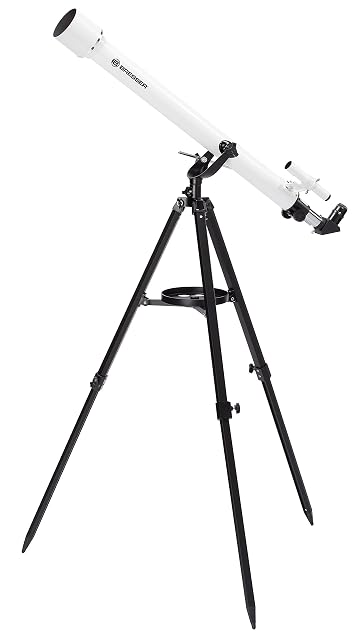
60 mm (2.36 in) lens · 900 mm (35.4 in) focal length · f/15 · alt-azimuth mount · 2.5 kg (5.5 lb) complete
A 60/900 achromatic refractor on a light alt-azimuth mount and aluminum tripod, sold complete with three 1.25 in eyepieces, a 1.25 in diagonal, a 1.5x erecting lens, a 5x24 finder and a phone holder, 2.5 kg (5.5 lb) in all.
Best for: The Moon, double stars and the bright planets from a balcony or a yard, with nothing to align
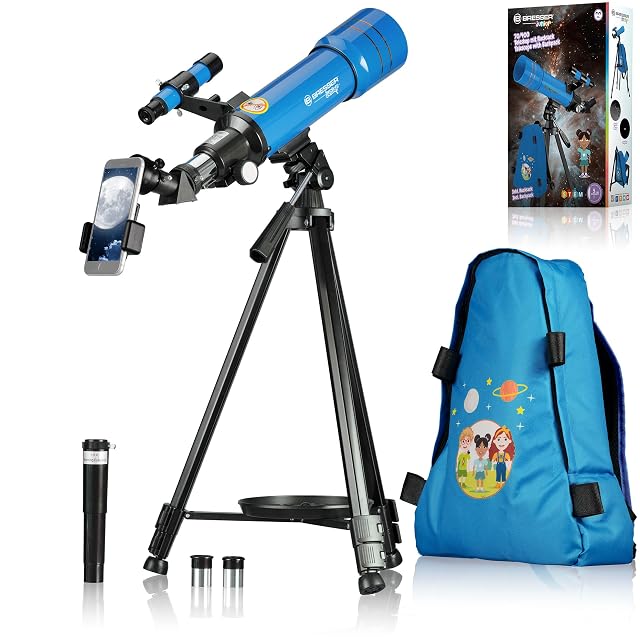
70 mm (2.76 in) · 400 mm (15.7 in) focal length · f/5.7 · 20x to 100x · backpack · from age 8
The blue version of Bresser's JUNIOR 70/400: a 70/400 refractor on an azimuthal mount and aluminum tripod, with H20, H12 and H6 eyepieces, a zenith prism, a 1.5x erecting lens, a 5x24 finder, a phone holder and a backpack.
Best for: A child from about eight who will carry the telescope themselves
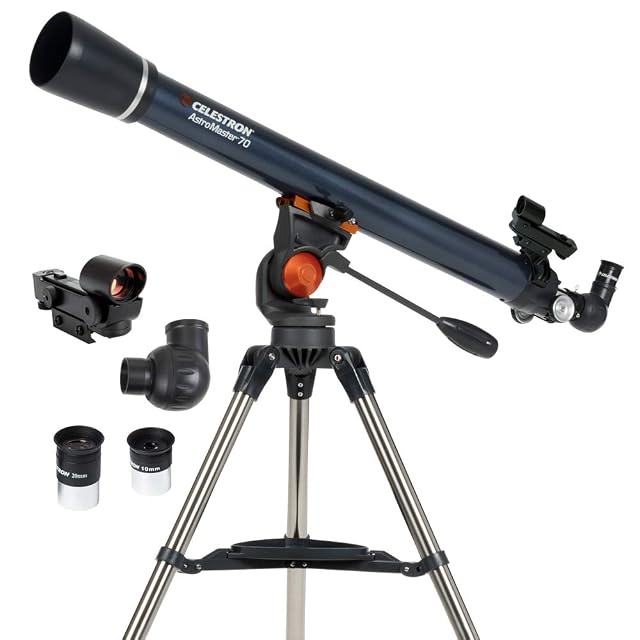
70 mm (2.8 in) fully coated achromat · panhandle alt-azimuth · 20 and 10 mm eyepieces · erect-image diagonal · StarPointer
Celestron's AstroMaster 70AZ: a fully coated 70 mm achromatic refractor on a panhandle alt-azimuth mount, with 20 mm and 10 mm eyepieces, an erect-image star diagonal and a StarPointer red-dot finder.
Best for: A first 70 mm used on landscapes as well as the Moon