Skip to content

The best color planetary filters for 2026

A colored filter on a planet does something simple and often misunderstood: by removing part of the spectrum it lowers the brightness of features that reflect that part, and a feature that was lost against a bright background becomes visible against a darker one. Nothing is added. The classification still uses Wratten numbers, a photographic system from long before the hobby adopted it, and those numbers are the only reliable way to compare across makers, since names like light blue are applied loosely. The pairings are well established: a blue filter raises the contrast of the belts of Jupiter and of the polar hazes, a red or orange one darkens the blue-gray regions of Mars and sharpens the boundary of the polar cap, a yellow one tames the glare of Saturn and helps the Cassini division stand out, and a light green one is often used on Jupiter for the Great Red Spot. How much of that is visible at all depends on the aperture, because every filter costs light, and a deep filter in a small telescope leaves too little to see. Filters are sold singly and in sets, and a set is almost always cheaper than three singles while containing at least one color that never gets used. Read the thread size, read whether the glass is dyed through or coated, and read the cell depth against short eyepiece barrels. We compare Wratten number, transmission, the features each color raises, aperture suitability, set contents and thread size.

The parts here, column by column

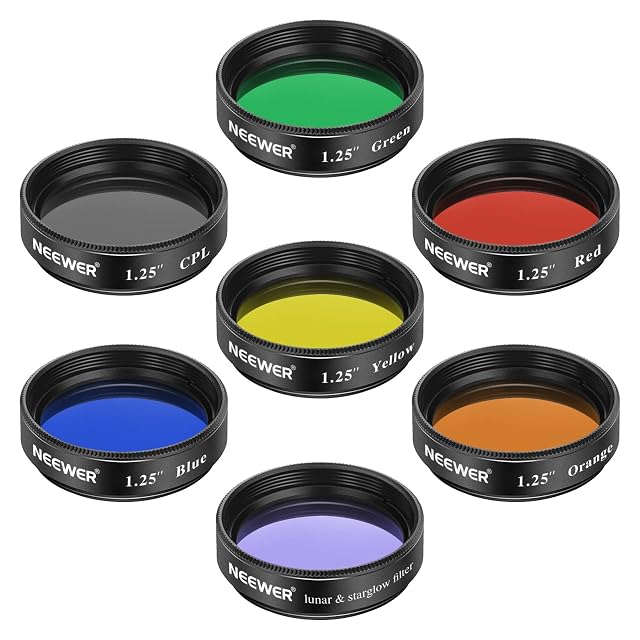
  1. Neewer set of seven 1.25 inch telescope filters in a case

    Neewer 1.25 in seven-filter set (10090864)

    Neewer's seven-piece 1.25-inch set: five color filters (red, orange, yellow, green, blue), a lunar and skyglow filter and a circular polarizer, with a sentence for what each color brings out.

    Wratten number
    Not published · filters named by color only
    Transmission
    Not published · the lunar and skyglow filter is described as multi-band, passing a high percentage of visible light
    The features each color raises
    Red: Mercury and Venus against a daytime sky · Orange: contrast and cloud penetration · Yellow: Mars's polar caps · Green: frost patches and surface fog · Blue: stated in the listing, cut off in the text
    Aperture suitability
    Not published by the maker.
    Set contents
    Red, orange, yellow, green and blue color filters · lunar and skyglow filter · CPL (circular polarizer)
    Thread size
    1.25 in standard filter thread
    Amazon reference
    B074CXG6SJ
    EAN
    0191073021785
    • Seven filters for about $23
    • Says what each color is for, planet by planet
    • No Wratten numbers, so colors cannot be compared with other sets

    Best for: A first set of planetary filters, bought to find out which color helps on which planet

    ≈ $23
    Check price on Amazon

Any figure written into the body of this page was true on the day it was written. The amount shown next to each instrument is requested from the retailer as the page loads, and it is that amount, not the text, that stands.