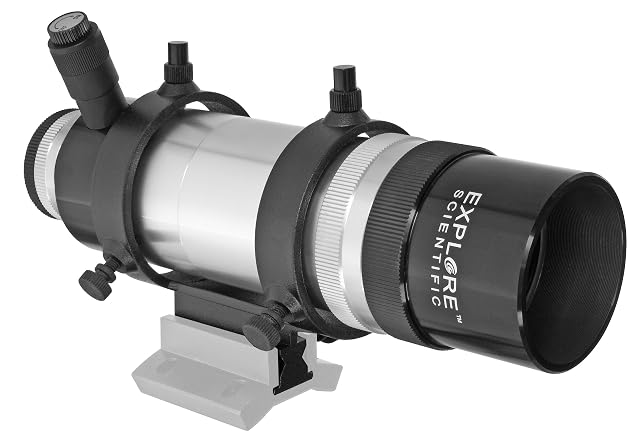
The bottom line The comfortable finder for a telescope that looks up — and the listing does not say which way the image comes out.
Why angled, and why 50 mm
Ninety degrees means looking down into the finder rather than along it, which is the only comfortable arrangement when the telescope is pointed near the zenith. Fifty millimetres of objective at nine times gives a 5.6 mm exit pupil and shows the brighter clusters and nebulae directly.
The alignment mechanism
Two screws and a spring. It is the oldest arrangement there is and the easiest to work in the dark: the spring provides the third point, so two adjustments do everything. Six-screw finders are more rigid and much harder to align with cold fingers.
The question left hanging
Image orientation. An angled finder may invert, mirror or correct the view depending on its prism. Knowing which — from one look at a recognisable shape — is what allows a star chart to be used with it.
Compatibility, in practice
“Fits most telescopes” is not a specification. Finder shoes differ between makers and sometimes within one maker’s range, so measuring the shoe on the telescope beats trusting the phrase.
Availability
German, French, Italian and Spanish Amazon stores ran from 95 € to 108 € on the day of the survey.
American and British Amazon stores list it in local currency, which the euro range above sets aside.
Figures as Keepa reported them on the day this page was last updated. Stock and pricing shift without warning.
Prices quoted in this text were read on 17 September 2026. The live price is at the top of the page.
What it publishes, and what it withholds
Strengths
Fifty millimetres of aperture shows the brighter deep-sky objects directly in the finder
A 90-degree angle removes the neck strain near the zenith entirely
Two screws and a spring is the simplest alignment mechanism to adjust in the dark
Compromises
An angled finder without an erecting prism reverses the view, which complicates chart matching
“Fits most telescopes” is not a shoe specification, and shoes are not standardised
No field of view figure is published
Specifications
Aperture
50 mm
Magnification
9x
True field of view
Not published by the maker.
Image orientation
Achromatic, multi-coated per the maker
Bracket fitting
Two screws and a spring · Fits most telescopes, as the maker words it
Reticle illumination and eye relief
5.6 mm — 50 divided by 9
Amazon reference
B01FA1NIJI (same reference on 6 Amazon marketplaces)
EAN
6970019295114
What observers ask about this one
Does the view come out the right way round?
The listing does not say. Angled finders vary: some invert, some mirror, some correct. Establishing which one yours does — once, on a known shape — is what makes a chart usable at the telescope.
How much difference does 50 mm make over 30 mm?
Nearly three times the light, which is arithmetic on the two areas. Brighter deep-sky objects become directly visible in the finder rather than merely inferred from the star pattern.
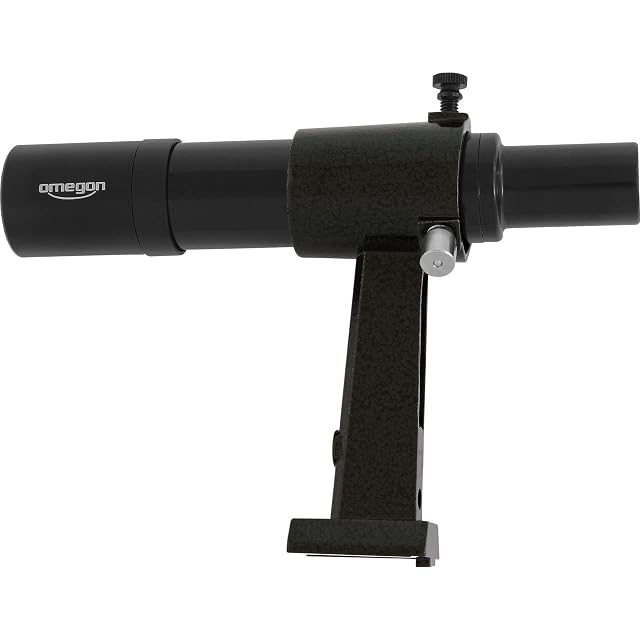
A straight-through 6x30 optical finder with a crosshair and a wide field, described by the maker as gathering eighteen times more light than the unaided eye.
Best for: Replacing a 5x24 finder on a small telescope with something that actually shows stars
9x · 50 mm · correct image · crosshair · rings included
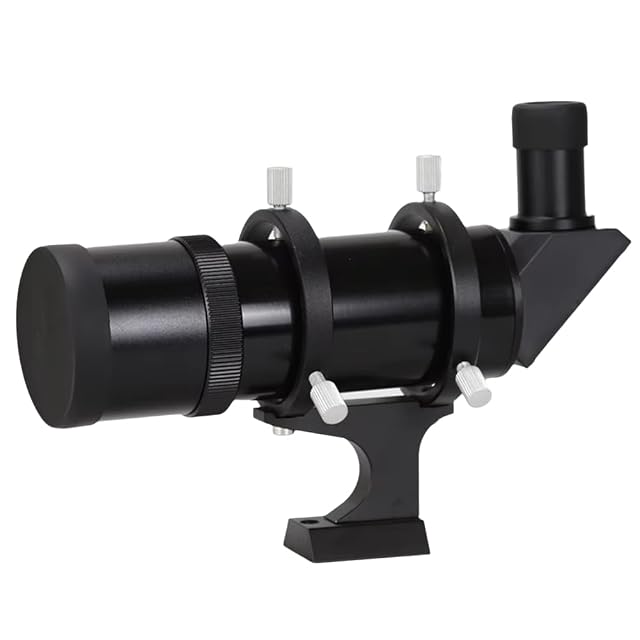
A 9x50 right-angle finder with a multi-coated achromatic objective, a prism that delivers a correctly oriented image and a crosshair eyepiece, supplied with clamping rings.
Best for: Anyone who wants the finder view to match the chart without mental gymnastics