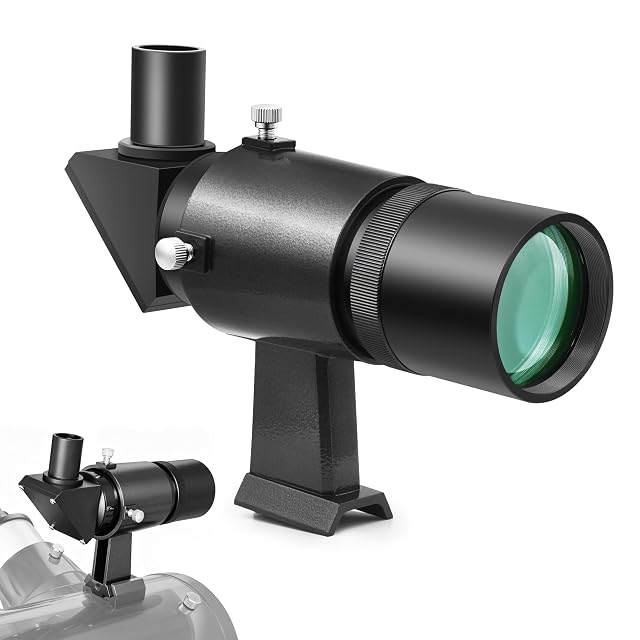
The bottom line The right two features for a serious finder, described in a listing that says almost nothing else.
Two features that matter
An illuminated reticle and an upright image. The first solves the problem of a crosshair being invisible against a dark sky; the second lets a chart be read directly. Together they describe a finder intended for real observing rather than for making up the numbers in a telescope’s accessory list.
The exit pupil is generous
Fifty millimetres at eight times gives 6.25 mm — larger than any other finder on this shelf. For a young dark-adapted eye that means the full aperture is used; for an older one, part of the cone falls outside the pupil.
What the listing walks past
Whether the body is straight or angled. Field of view. Whether the illumination can be dimmed — which matters, because a reticle that is too bright destroys the dark adaptation it was meant to preserve.
As an upgrade
Against the 5x24 finders supplied with inexpensive telescopes, an 8x50 with a lit reticle is a different instrument. It is also the single most effective purchase for anyone who cannot find things.
Availability
German, French, Italian and Spanish Amazon stores sat at about 146 € on the day of the survey.
British Amazon store lists it in local currency, which the euro range above sets aside.
American Amazon store gave no result whatever, so the buy button there opens a search rather than an empty page.
Figures as Keepa reported them on the day this page was last updated. Stock and pricing shift without warning.
Prices quoted in this text were read on 17 September 2026. The live price is at the top of the page.
What it publishes, and what it withholds
Strengths
An illuminated reticle is visible against a dark sky where a plain crosshair disappears
An upright image makes a printed chart directly usable
A 6.25 mm exit pupil is the largest of the finders here
Compromises
The listing runs to two lines of lower-case text and publishes nothing measurable
It does not say whether the body is straight or angled
No brightness control for the illumination is mentioned
Specifications
Aperture
50 mm
Magnification
8x
True field of view
The listing does not carry it
Image orientation
Upright, as the maker states it · Not described as straight or angled in the listing
Bracket fitting
Not published by the maker.
Reticle illumination and eye relief
6.25 mm — 50 divided by 8 · Illuminated
Amazon reference
B00B2L4LQA (same reference on 5 Amazon marketplaces)
EAN
4007922198729
What observers ask about this one
Why illuminate a reticle?
Against a genuinely dark sky a plain crosshair vanishes — there is nothing to see it against. A dim red reticle stays visible without destroying dark adaptation, which is exactly what is needed for centring a faint target.
Is a 6.25 mm exit pupil too large?
For a young eye, no. For an older one whose pupil no longer opens that wide, the outer part of the light cone falls on the iris rather than entering the eye — so some of the aperture is not used.
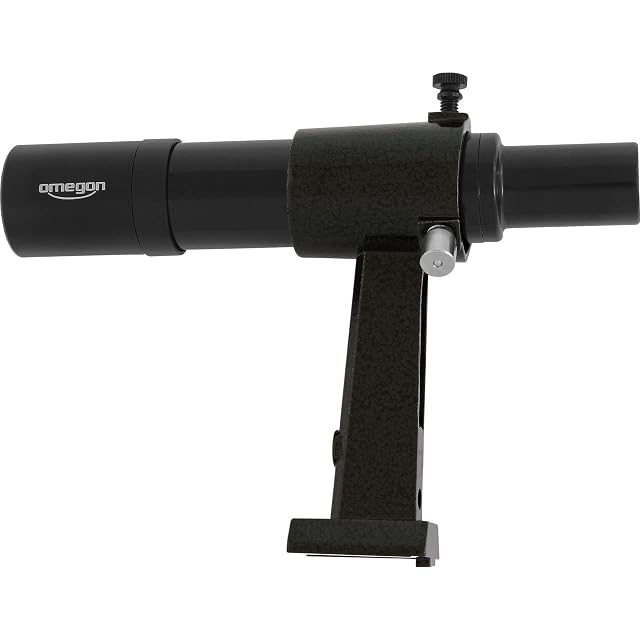
A straight-through 6x30 optical finder with a crosshair and a wide field, described by the maker as gathering eighteen times more light than the unaided eye.
Best for: Replacing a 5x24 finder on a small telescope with something that actually shows stars
9x · 50 mm · correct image · crosshair · rings included
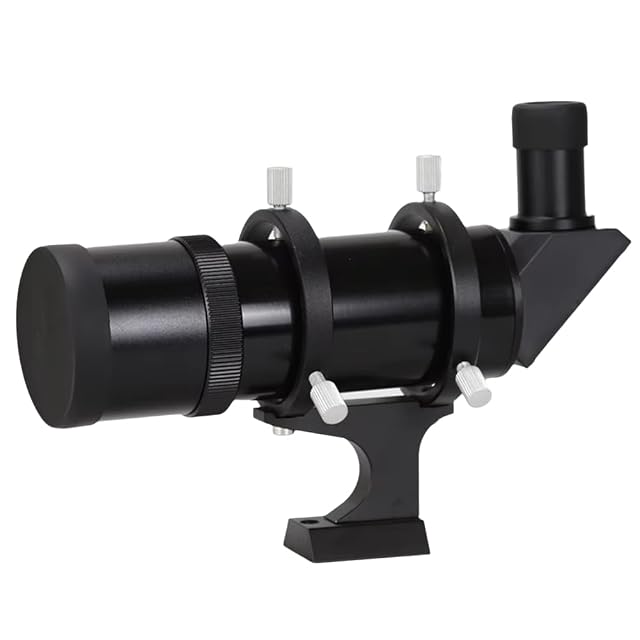
A 9x50 right-angle finder with a multi-coated achromatic objective, a prism that delivers a correctly oriented image and a crosshair eyepiece, supplied with clamping rings.
Best for: Anyone who wants the finder view to match the chart without mental gymnastics