A small tube whose only job is to watch one star · review
Astromania GS70 70 mm review
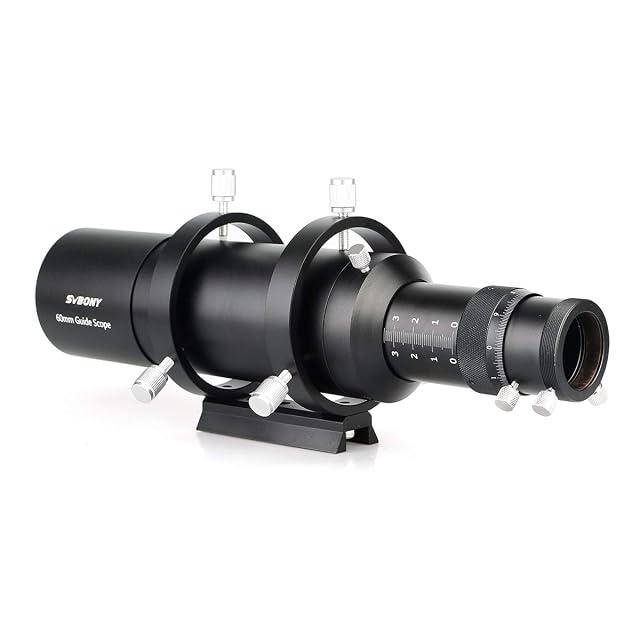
A 70/400 guide scope with a helical focuser offering 90 mm of range including 10 mm of micro-focus, supplied with tube rings, a Synta plate and an adjustable counterweight.
The bottom line The largest and most capable guide scope of the three here, and the one with the most to carry.
Seventy millimetres at four hundred
f/5.7, which is a longer focal ratio than a small guide scope and twice the focal length. For a main telescope of significant focal length that matters: a guide star’s movement has to be resolvable before it can be corrected.
The focuser, generously specified
Ninety millimetres of range with ten of micro-focus, a brass compression ring, two thumbscrews and a lockable draw tube. That range means back-focus problems mostly disappear, and the compression ring keeps the camera centred and unmarked.
The mounting kit is complete
Tube rings sized for the scope, a Synta-style plate and an adjustable counterweight to balance the whole assembly. Everything needed to put it on a main telescope is in the box.
The listing’s rough edges
The translation renders the counterweight as “Dovanygewicht” and the focuser as a “Wurmauszug”. Neither is a real term; both are clear enough in context, and they are noted here because the specification figures around them are the ones worth trusting.
Availability
German, French, Italian and Spanish Amazon stores ran from 189 € to 201 € on the day of the survey.
American and British Amazon stores list it in local currency, which the euro range above sets aside.
Figures as Keepa reported them on the day this page was last updated. Stock and pricing shift without warning.
Prices quoted in this text were read on 17 September 2026. The live price is at the top of the page.
What it publishes, and what it withholds
Strengths
Four hundred millimetres of focal length guides longer main telescopes than a 200 mm scope can
Ninety millimetres of focus range accommodates almost any camera back-focus requirement
The full mounting kit is included rather than assumed
Compromises
A 70 mm guide scope is heavy enough to affect the balance of a small mount
The listing’s translation is rough in places — “Dovanygewicht” for the counterweight, “Wurmauszug” for the focuser
Black anodised aluminium with milled knurled rings
Focuser type
Helical with a brass compression ring and two thumbscrews
Back focus
90 mm total, of which 10 mm is micro-focus, as the maker states it
Weight
Not published by the maker.
Amazon reference
B0799FK1RX (same reference on 6 Amazon marketplaces)
EAN
6971336223347
What observers ask about this one
Is a longer guide scope better?
For a long main telescope, generally yes: the guide scope has to see a star’s movement finely enough to correct the main one, and focal length is what provides that. The cost is weight and a larger flexure lever.
What is 90 mm of focus range for?
Different cameras place their sensors at different distances behind the fitting. A generous range means almost any of them can be brought to focus without extension tubes, which removes another joint from the chain.
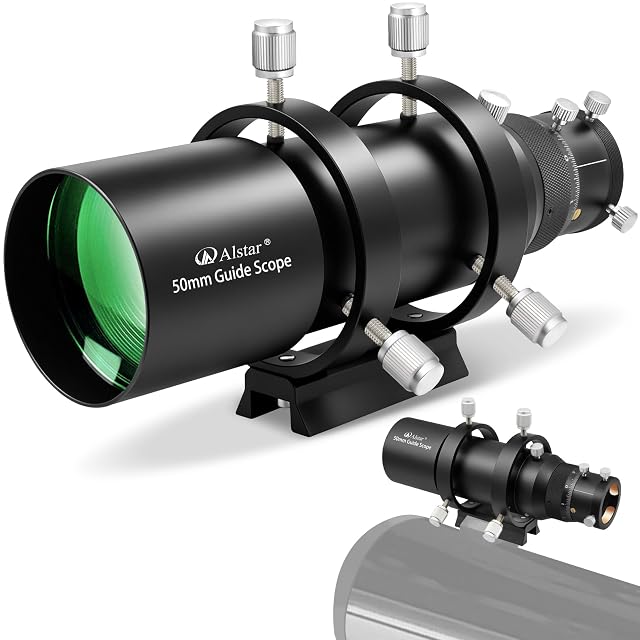
50 mm aperture · 200 mm focal length · helical focuser
A 50/200 guide scope with a brass compression-ring helical focuser, 40 mm of travel including 10 mm of fine focus, supplied with tube rings and a Synta-style dovetail plate.
Best for: Guiding a main telescope of moderate focal length, and doubling as a wide finder
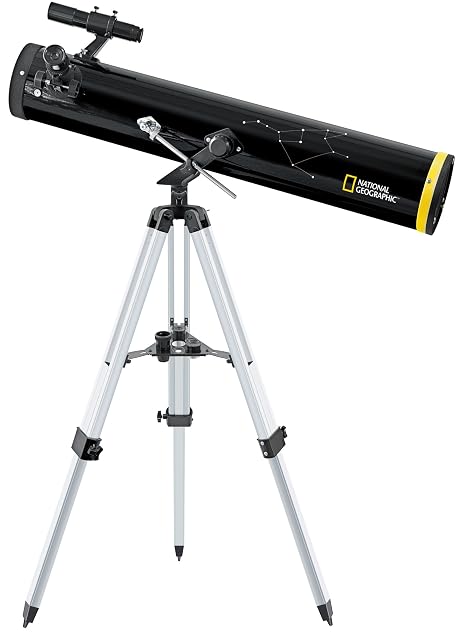
114 mm mirror · 900 mm focal length · alt-azimuth mount
A 114/900 Newtonian on a simple alt-azimuth mount, supplied with three eyepieces, a 6x30 finder and a 1.5x erecting lens, recommended by the maker from age eight.
Best for: A family telescope where nobody wants to learn polar alignment