A small tube whose only job is to watch one star · review
A ALSTAR Guide Scope 50 mm (GS50A) review
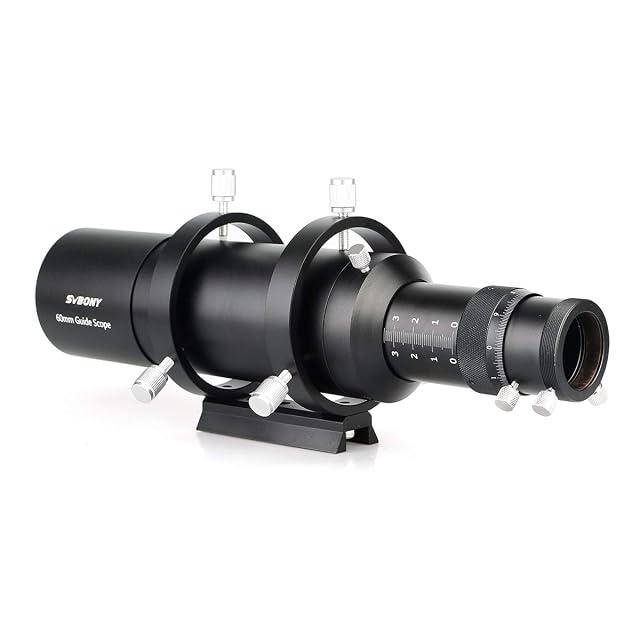
A 50/200 guide scope with a brass compression-ring helical focuser, 40 mm of travel including 10 mm of fine focus, supplied with tube rings and a Synta-style dovetail plate.
The bottom line A well-detailed small guide scope that publishes the one limit most of its rivals leave unsaid.
Fifty millimetres at two hundred
f/4, which is what a guide scope wants: bright, wide, and full of candidate guide stars. The maker makes exactly that argument, and adds the figure that matters — a main telescope up to 1500 mm of focal length.
The focuser is the part that fails on cheap guide scopes
Here it is helical, with a brass compression ring and two thumbscrews, 40 mm of travel with 10 mm of micro-focus, and a lockable draw tube. Every one of those details addresses the same problem: a guide camera that shifts during a run corrects the mount in the wrong direction.
What it mounts on
Tube rings and a Synta-style dovetail plate, with an adjustable counterweight to balance the assembly. That means it attaches to most telescopes without a further purchase, which is not true of every guide scope at this price.
The second job
With a 1.25 in eyepiece in place of the camera it becomes a wide, bright finder. That dual role is how most owners actually use one, and it is why the eyepiece fitting is worth having.
Availability
German Amazon store sat at about 107 € on the day of the survey.
American and British Amazon stores list it in local currency, which the euro range above sets aside.
Spanish Amazon store stood above 1.6× the cheapest country. A gap that size normally means stock forwarded from abroad rather than a seller on the ground, so that figure is left out of the range above.
French Amazon catalogue holds a record for it that nobody is selling.
Italian Amazon store gave no result whatever, so the buy button there opens a search rather than an empty page.
Figures as Keepa reported them on the day this page was last updated. Stock and pricing shift without warning.
Prices quoted in this text were read on 17 September 2026. The live price is at the top of the page.
What it publishes, and what it withholds
Strengths
Publishes the focal length it will guide up to, which is the figure that sizes a guide scope
A brass compression ring holds the camera without marking its barrel
Ten millimetres of dedicated fine focus is genuinely fine control
Compromises
A helical focuser has to be locked, or flexure creeps in during a long run
Fifty millimetres at f/4 gives a short focal length, which limits guiding precision on long main scopes
No weight figure is published, and weight matters on a guiding setup
Specifications
Aperture
50 mm (maker’s bullet)
Focal length
200 mm (maker’s bullet)
Mounting method
Tube rings and a Synta-style dovetail plate, with an adjustable counterweight
Flexure resistance
Black anodised aluminium
Focuser type
Helical, with a brass compression ring and two thumbscrews
Back focus
40 mm total, of which 10 mm is fine focus, as the maker states it
Weight
Not published by the maker.
Amazon reference
B074DQWJYW (same reference on 5 Amazon marketplaces)
EAN
6970019299839
What observers ask about this one
Why does the main scope’s focal length matter?
A guide scope has to resolve a star’s movement well enough to correct the main instrument. The longer the main focal length, the finer that movement is — which is why the maker states a ceiling of 1500 mm rather than claiming universality.
What is a compression ring for?
It grips the camera or eyepiece barrel evenly instead of pressing a single thumbscrew into it. The barrel is not marked and the optic stays centred, which on a guide camera keeps calibration stable.
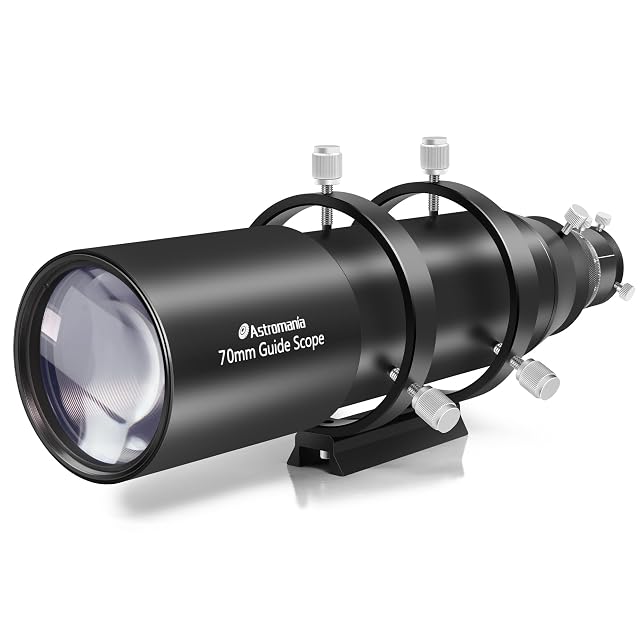
70 mm aperture · 400 mm focal length · 90 mm focus range
A 70/400 guide scope with a helical focuser offering 90 mm of range including 10 mm of micro-focus, supplied with tube rings, a Synta plate and an adjustable counterweight.
Best for: Guiding a longer main telescope, where a short guide scope would not resolve the correction
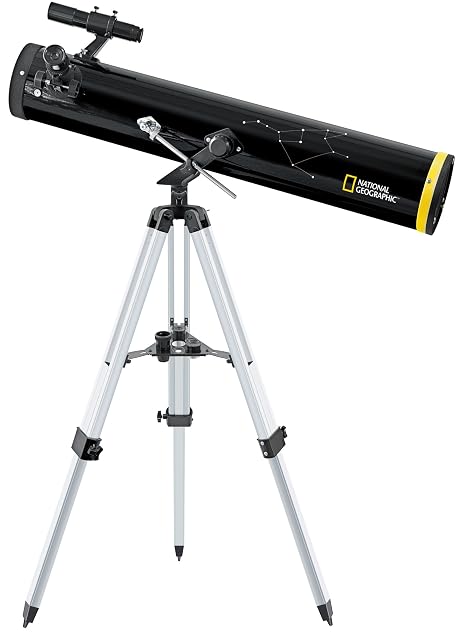
114 mm mirror · 900 mm focal length · alt-azimuth mount
A 114/900 Newtonian on a simple alt-azimuth mount, supplied with three eyepieces, a 6x30 finder and a 1.5x erecting lens, recommended by the maker from age eight.
Best for: A family telescope where nobody wants to learn polar alignment