The bottom line A guide scope built around two good mechanical decisions, with its focal length left to be worked out from an aside.
Two decisions that matter
A T-thread instead of a clamp, and a focuser that moves without rotating. Both attack the same enemy: any movement between the guide camera and the main telescope during an exposure sequence, which the guiding software cannot distinguish from the sky moving.
The figure that has to be inferred
Nowhere does the listing state a focal length. What it does say is that fitting a 25 mm eyepiece produces a 9.6x60 finder. Magnification is focal length divided by eyepiece focal length, so the maker’s own worked example points at 240 mm — and this page prints the example rather than a figure the maker never wrote.
The second job, taken seriously
The maker names both a plain 1.25 in eyepiece and an illuminated-reticle eyepiece as options for finder use. An illuminated crosshair turns a guide scope into a proper finder for centring faint objects.
What is not mentioned
Mounting rings, a dovetail, or focus travel. Attaching it to a main telescope is a separate problem this listing does not solve.
Availability
German, French, Italian and Spanish Amazon stores ran from 100 € to 115 € on the day of the survey.
American and British Amazon stores list it in local currency, which the euro range above sets aside.
Figures as Keepa reported them on the day this page was last updated. Stock and pricing shift without warning.
Prices quoted in this text were read on 17 September 2026. The live price is at the top of the page.
What it publishes, and what it withholds
Strengths
A male T-thread lets a guide camera screw on rather than clamp, which removes a flexure point
The non-rotating focuser keeps a guide camera’s orientation fixed while focusing
Doubles as a 9.6x60 finder with a 25 mm eyepiece, by the maker’s own arithmetic
Compromises
The focal length is never stated directly — it has to be inferred from the finder example
No focus travel figure is published
No mounting rings or dovetail are described as included
Specifications
Aperture
60 mm (from the title and bullets)
Focal length
Not stated directly; the maker notes that a 25 mm eyepiece makes it a 9.6x60 finder
Mounting method
Not published by the maker.
Flexure resistance
Not published by the maker.
Focuser type
Helical, non-rotating — the maker states that guide stars do not rotate · Male T-thread at the eyepiece collar
Back focus
Not published by the maker.
Weight
Not published by the maker.
Amazon reference
B07MPYC6HN (same reference on 6 Amazon marketplaces)
EAN
0794604984087
What observers ask about this one
What focal length is it?
The listing does not say. It states that a 25 mm eyepiece produces a 9.6x60 finder, and magnification is focal length divided by eyepiece focal length — so the maker’s own example implies 240 mm. This page reports the example rather than printing a figure the maker never published.
Why does a non-rotating focuser matter?
Because a guide camera’s calibration depends on its orientation relative to the mount’s axes. A focuser that twists the camera while focusing invalidates that calibration; a helical one that moves straight in and out does not.
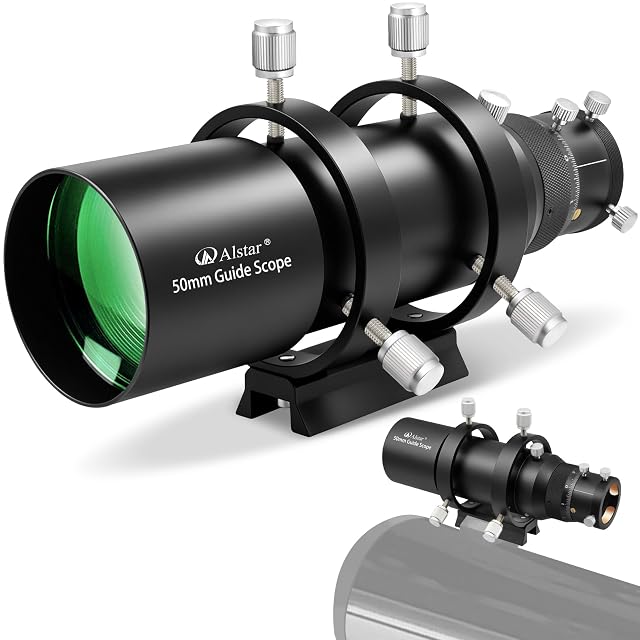
50 mm aperture · 200 mm focal length · helical focuser
A 50/200 guide scope with a brass compression-ring helical focuser, 40 mm of travel including 10 mm of fine focus, supplied with tube rings and a Synta-style dovetail plate.
Best for: Guiding a main telescope of moderate focal length, and doubling as a wide finder
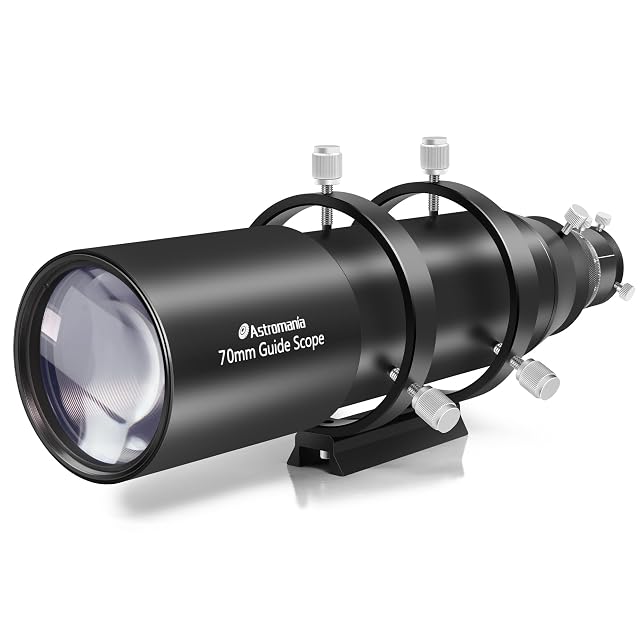
70 mm aperture · 400 mm focal length · 90 mm focus range
A 70/400 guide scope with a helical focuser offering 90 mm of range including 10 mm of micro-focus, supplied with tube rings, a Synta plate and an adjustable counterweight.
Best for: Guiding a longer main telescope, where a short guide scope would not resolve the correction
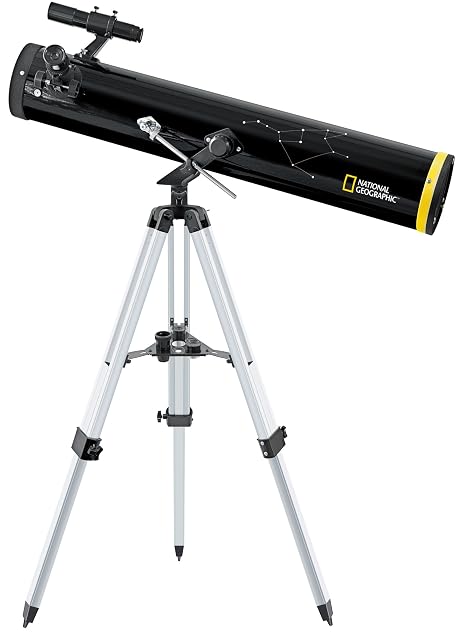
114 mm mirror · 900 mm focal length · alt-azimuth mount
A 114/900 Newtonian on a simple alt-azimuth mount, supplied with three eyepieces, a 6x30 finder and a 1.5x erecting lens, recommended by the maker from age eight.
Best for: A family telescope where nobody wants to learn polar alignment