Thousands of frames, and only the sharpest kept · review
Celestron NexImage 20 (93707) review
Celestron's NexImage 20: a color planetary camera with a 20 MP back-illuminated AR2020 CMOS (5240 × 3840, 1.4 µm pixels), region-of-interest cropping, USB-C, iCap software and autoguider support.
Celestron publishes the sensor in full: a 20 MP back-illuminated AR2020 CMOS, 5240 × 3840 pixels of 1.4 µm on a 7.3 × 5.4 mm chip. With those numbers, image scale on any telescope can be calculated before buying.
Region of interest
The camera can crop its sensor to a smaller region, raising the frame rate, shrinking files and speeding up stacking. For planets, which occupy a small part of the frame, that is the feature that matters most. The frame rate itself is not published.
Guiding too
On a guide scope, it works as an autoguider for deep-sky imaging.
Connection and software
USB-C, with a USB-A to USB-C cable and no separate power supply. iCap software controls gain, exposure, frame rate and white balance.
Against the SV205
SVBONY’s SV205 publishes 1.45 µm pixels and frame rates at about a quarter of the price; this one adds ROI, autoguiding and a back-illuminated 20 MP sensor.
Price and availability
On November 7, 2026, Amazon.com sold it directly at $449.95. Celestron states a 2-year US warranty.
Figures as Keepa reported them on the day this page was last updated. Stock and pricing shift without warning.
Prices quoted in this text were read on November 7, 2026. The live price is at the top of the page.
Its two nearest scopes on price
Same aisle, closest price — what the same spend else shows.
Yes: crops the sensor to raise frame rate, cut file size and speed stacking
Interface
USB-C, with a USB-A to USB-C cable · no extra power supply
Cooling
Not published by the maker.
Filter thread
Not published by the maker.
Eyepiece fitting
Not published in the listing.
Software support
iCap capture software: gain, exposure, frame rate, white balance
Amazon reference
B0FHX4ZM23
EAN
0050234937078
What observers ask about this one
What focal length suits 1.4 µm pixels?
A common rule for planetary imaging is a focal ratio of about 3 to 5 times the pixel size in microns: f/4 to f/7 here. Most Schmidt-Cassegrains at f/10 already oversample; a fast refractor or reflector may need a Barlow.
What is ROI for?
Planets are small. Cropping the sensor to the area around the planet raises the frame rate and shrinks the files, so more frames can be stacked.
Can it photograph the Sun?
Only with a proper full-aperture solar filter on the telescope, as Celestron says.
The price on Amazon.com
This model is listed on Amazon.com, at ≈ $450 at the last reading. Listed is not the same as in stock: availability changes daily, and the buy box shows the live price.
Details checked on November 7, 2026.
This one and its buyer, among astronomy instruments
Lunar and planetary video from a long-focal-length telescope, with the arithmetic done in advance
Sources
Specifications: the manufacturer sheet for telescopes and observing optics and the matching Amazon product page. Prices and availability: Keepa. Every figure on this page names its source.
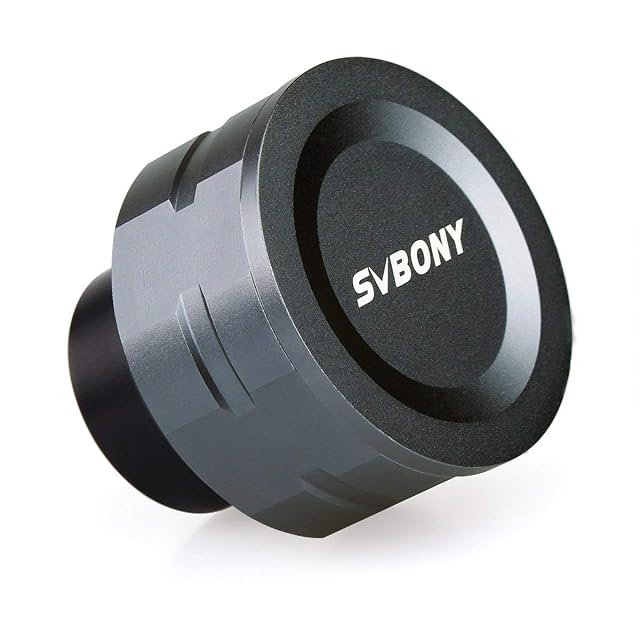
IMX307 color, 1/2.8 in · 1920 × 1080 at up to 30 fps · 1.25 in · M28.5 × 0.6 filter thread · software named per system
SVBONY's SV105: a plug-and-play 1.25-inch color eyepiece camera with a 1/2.8-inch IMX307 sensor, up to 30 fps at 1920 × 1080, a filter thread and capture software named for each operating system.
Best for: Lunar and planetary video on a laptop, for someone who wants to know which program to download before buying
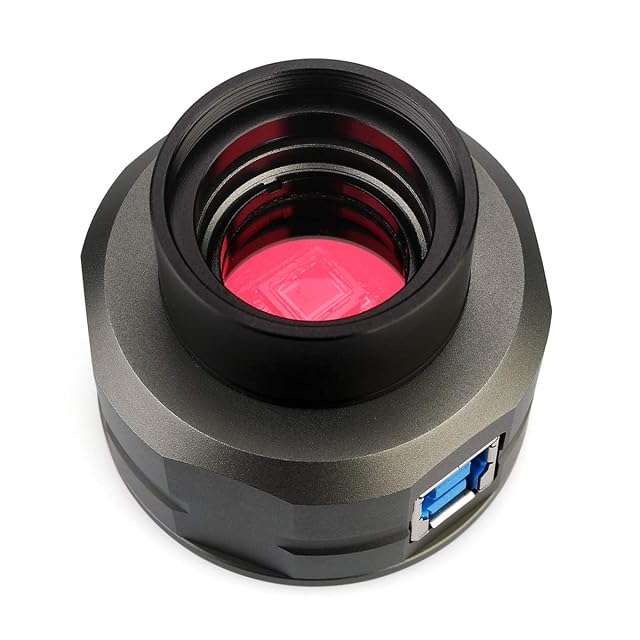
7.05 MP IMX415 color, 1/2.8 in · 1.45 µm pixels · 1080p at 30 fps, 3264 × 2160 at 15 fps · USB 3.0 · 1.25 in
SVBONY's SV205: a 1.25-inch color planetary camera with a 7.05 MP Sony IMX415 sensor and 1.45 µm pixels, 30 fps at 1920 × 1080 in MJPG or 15 fps at 3264 × 2160 uncompressed, over USB 3.0.
Best for: Lunar and planetary video through a 1.25 in focuser, on a Windows, Linux or macOS laptop
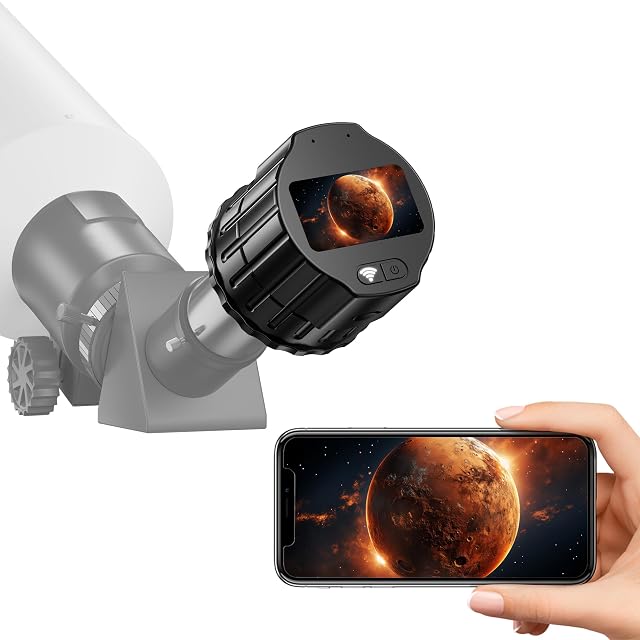
1.5 in IPS screen · 1080p video, 2 MP photos · 1000 mAh for up to 3 hours · 64 GB card included · Wi-Fi to 49 ft · fits 28–50 mm
A Wi-Fi electronic eyepiece with a 1.5-inch IPS screen, 1080p video and 2 MP photos, a 1000 mAh battery for up to 3 hours, a 64 GB card and a clamp for 28 to 50 mm eyepieces.
Best for: Recording what an eyepiece already shows, on any instrument, with the runtime and the card known in advance