The bottom line A long-ratio 70 mm on a mount a beginner can actually aim, sold with its figures stated plainly rather than inflated.
Aperture and focal length, kept apart
Seventy millimetres of objective and seven hundred millimetres of focal length. The first is how much light arrives; the second decides framing and, with whichever eyepiece is fitted, magnification. The quotient is f/10, which is long for a beginner’s refractor and the reason this one is better on the Moon than on a wide star field.
The mount is the half people forget
An AZ-2 alt-azimuth on an aluminium tripod. It moves in the four directions a person expects, which is the whole argument for this kind of mount at the start: nothing has to be aligned before the first object is found. The maker also states that the tripod locks at several heights, which decides whether the eyepiece can be reached from a chair.
What the 140x figure is
It is the focal length divided by the shortest supplied eyepiece. It describes an eyepiece, not this tube, and it moves the moment a different eyepiece is fitted. The two figures worth carrying are the ones above.
The achromat’s own limit
A two-element objective brings colours to slightly different focus, and at f/10 the effect is modest but present on Venus, Jupiter and a bright lunar limb. The listing does not quantify it, and no page here will invent a number for it.
Availability
German, French, Italian and Spanish Amazon stores ran from 90 € to 117 € on the day of the survey.
British Amazon store lists it in local currency, which the euro range above sets aside.
American Amazon catalogue holds a record for it that nobody is selling.
Figures as Keepa reported them on the day this page was last updated. Stock and pricing shift without warning.
Prices quoted in this text were read on 17 September 2026. The live price is at the top of the page.
What it publishes, and what it withholds
Strengths
f/10 is a long ratio for a 70 mm, which suits the Moon and the brighter planets
Alt-azimuth motion is the easiest kind to learn: up, down, left, right
Tripod height locks at several positions, so a seated observer can use it
Compromises
An achromat at f/10 still shows colour on the brightest targets, and the listing does not say how much
The AZ-2 has no slow-motion on both axes described beyond the four directions
The maker prints a 140x maximum, which is an eyepiece result and not a property of the tube
Specifications
Aperture
70 mm (maker’s bullet)
Focal length and ratio
700 mm (maker’s bullet) · f/10, the quotient of the two figures above
Lens design
Achromatic refractor
Glass type
Not published by the maker.
Focuser
Not published by the maker.
Drawtube
Not published by the maker.
Tube weight
Not published by the maker.
Supplied accessories
Not published by the maker.
Amazon reference
B004EVVYTW (same reference on 6 Amazon marketplaces)
EAN
4049467206439
What observers ask about this one
Why does the maker compare it to a 60 mm?
Because light grasp goes with the square of the aperture, so a 70 mm collects about 36 % more than a 60 mm — the figure the bullet quotes. It is arithmetic on the two apertures, not a measurement of this telescope.
Is 140x usable?
That depends on the night and on the eyepiece, not on the telescope. The tube’s own optical ceiling is conventionally put near twice the aperture in millimetres, and the atmosphere is usually lower still.
A 70/400 refractor sold with two eyepieces, a 5x Barlow, a phone adapter and a stainless-steel tripod — and a listing whose own bullets contradict its title.
Best for: A buyer who will check the tube’s printed figures before ordering anything else for it
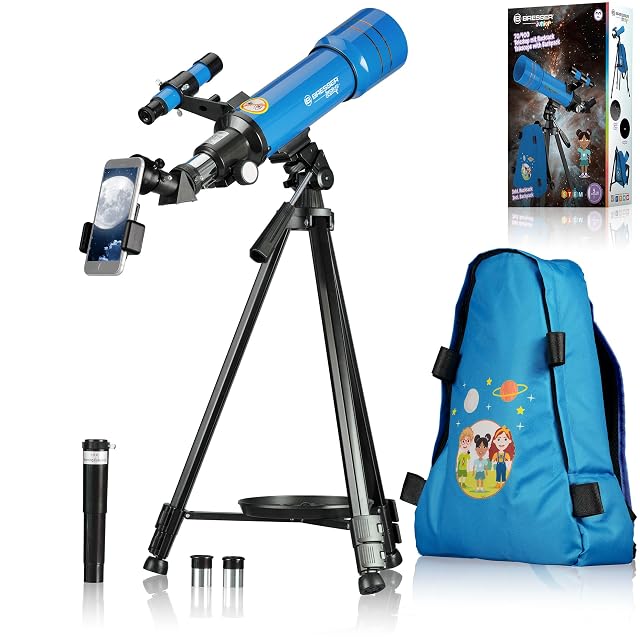
A 70/400 refractor sold as a first instrument for children from eight, supplied in a backpack with three eyepieces, a star diagonal and an erecting lens.
Best for: A child from about eight who will carry the telescope themselves