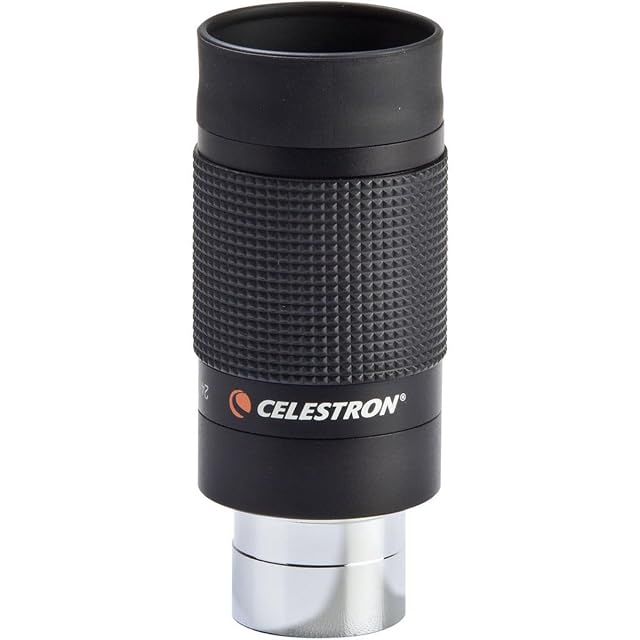
Skip to content

Alstar 8–24 mm stepless zoom review

Eight to twenty-four millimeters with eye relief published at both ends — 15 to 18 mm (0.59 to 0.71 in), which is what makes a zoom usable with spectacles.

Fifteen to eighteen millimeters, across the range

The figure that justifies a zoom.

A fixed 8 mm (0.31 in) Plössl has roughly six millimeters of eye relief, which is a squint and impossible with spectacles. A zoom that holds fifteen at its 8 mm (0.31 in) end is doing what no fixed eyepiece of that focal length does.

Two listings on this shelf of six publish the figure at both ends. This is one; the Astromania beside it publishes 16 to 33 mm (0.63 to 1.30 in).

The other four publish nothing, or one number.

Stepless, which cuts both ways

Every intermediate focal length is available, and none of them can be found twice.

A clicked zoom — the published Celestron on the European half of this shelf is one — has defined stops, so a setting can be returned to in the dark by counting.

A stepless zoom sweeps. It is the better action for hunting a comfortable magnification and the worse one for repeating it.

And no field at either end

The gap on this page.

A zoom gives away apparent field at its long end: the eyepiece is designed around its short focal length and the field narrows as the focal length grows. The Astromania on this shelf publishes exactly that — 30 degrees at 21 mm (0.83 in), 47 at 7 — and it is the only listing on either half of this shelf to do so.

Without the pair of numbers, the most important compromise in the design is unpublished.

The eyecup, with both jobs named

Folded for spectacles, up for the naked eye, and stray glare blocked either way.

It is the practical half of the eye relief claim, and three listings on the eyepiece shelves of this catalog name it for the same reason.

Seventy-eight dollars

The most expensive American zoom here, against fifty-two for the Astromania and twenty-five for a listing whose own bullets describe a fixed 32 mm (1.26 in) Plössl.

On the European half of this shelf the top price is nearly four hundred, and its published page says the entire advertisement for it is the accessory list.

Availability

American Amazon store sat at about $78 on the day of the survey.

Figures as Keepa reported them on the day this page was last updated. Stock and pricing shift without warning.

Prices quoted in this text were read on October 7, 2026. The live price is at the top of the page.
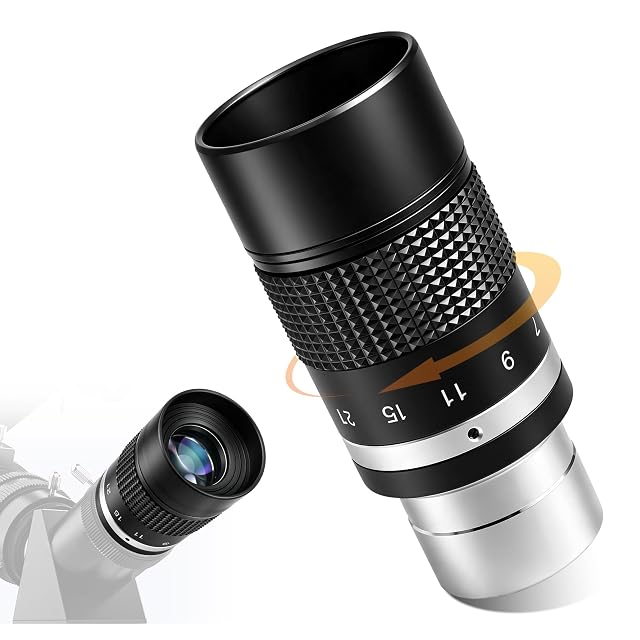
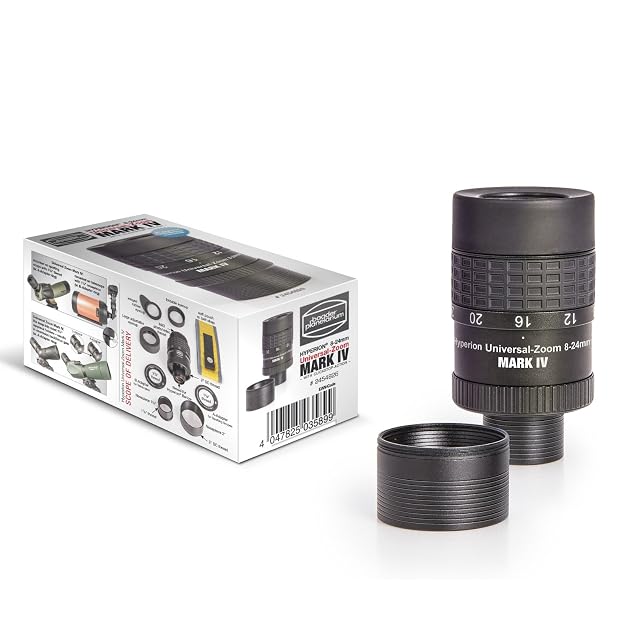
Its two nearest scopes on price

Same aisle, closest price — what the same spend else shows.

What it publishes, and what it withholds

Strengths

  • Eye relief published across the whole range, which only two listings on this shelf do
  • Fifteen to eighteen millimeters is enough for spectacles at every focal length
  • Stepless rather than clicked, so any intermediate magnification is available
  • A foldable eyecup, with both of its jobs named: glare and glasses

Compromises

  • No apparent field at either end, which is where a zoom gives most away
  • No coatings published at all
  • No parfocality statement, so refocusing between focal lengths is unknown
  • The most expensive American zoom on this shelf

Specifications

Focal length range8 to 24 mm (0.31 to 0.94 in), stated stepless and adjusted by a twist of the zoom housing
Apparent field at both endsNot published by the maker.
Eye relief15 to 18 mm (0.59 to 0.71 in), published across the range — stated to accommodate spectacle wearers
ParfocalityNot published by the maker.
ActionStepless, by a smooth twist of the zoom housing, with continuous precise control stated
StopsNone published — the action is stated stepless
Barrel size1.25 in
CoatingsNot published by the maker.
BodyA foldable rubber eyecup, stated to block stray glare and to help spectacle wearers
Amazon referenceB074DSH8WV
EAN6970019299976

What observers ask about this one

Why is eye relief at both ends the figure to want?

Because a zoom changes its eye relief as it changes focal length, and the short end is where it collapses. A fixed 8 mm (0.31 in) Plössl has about 6 mm (0.24 in) of eye relief, which is unusable with spectacles; a zoom that keeps 15 mm (0.59 in) at 8 mm (0.31 in) is doing something a fixed eyepiece of that focal length cannot. This listing publishes 15 to 18 mm (0.59 to 0.71 in) across the range, and the Astromania on this shelf publishes 16 to 33. Those two are the only listings on either half of this shelf to publish the figure at both ends, and it is the single best reason to buy a zoom at all.

What does stepless change?

It removes the clicks and it removes the certainty. A clicked zoom has defined positions — the published European Celestron on this shelf is one — so a particular magnification can be returned to in the dark by counting. A stepless zoom gives every intermediate focal length and no way to find the same one twice. Which is better depends on whether the observer wants to sweep smoothly or to come back to a known setting, and neither listing argues the point.

What is parfocality, and why does its absence matter?

A parfocal zoom stays in focus as the focal length changes; a non-parfocal one has to be refocused at every setting. On a planet at high magnification that is a real nuisance, because refocusing moves the whole image and the planet has drifted by the time it is sharp again. None of the three American listings on this shelf publishes a parfocality statement. The published Baader on the European half is the one sold as a system rather than a part, and its page makes the point that extensive accessories are the whole advertisement.

The price on Amazon.com

This model is listed on Amazon.com, at ≈ $78 at the last reading. Listed is not the same as in stock: availability changes daily, and the buy box shows the live price.

Details checked on October 7, 2026.

This one and its buyer, among astronomy instruments

A spectacle wearer who wants one eyepiece instead of four, with eye relief guaranteed at every setting

Sources

Specifications: the manufacturer sheet for telescopes and observing optics and the matching Amazon product page. Prices and availability: Keepa. Every figure on this page names its source.

The way we judge these astronomy instruments