One barrel across a range, with a field that narrows · review
Celestron 8-24 mm zoom (93230) review
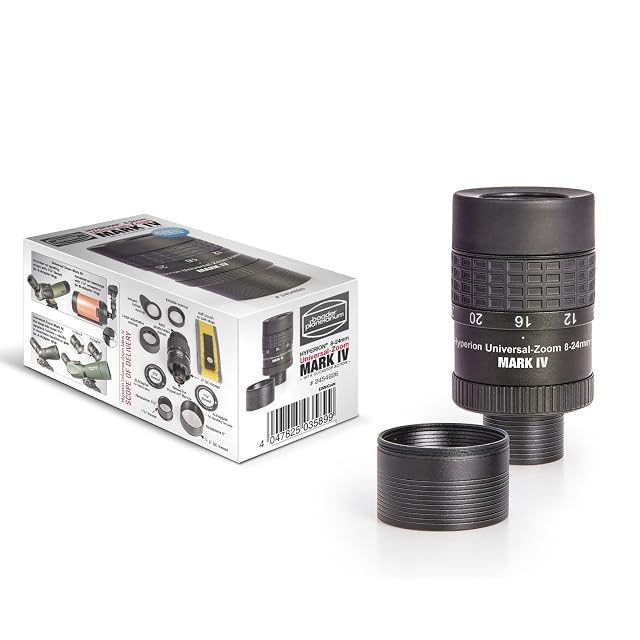
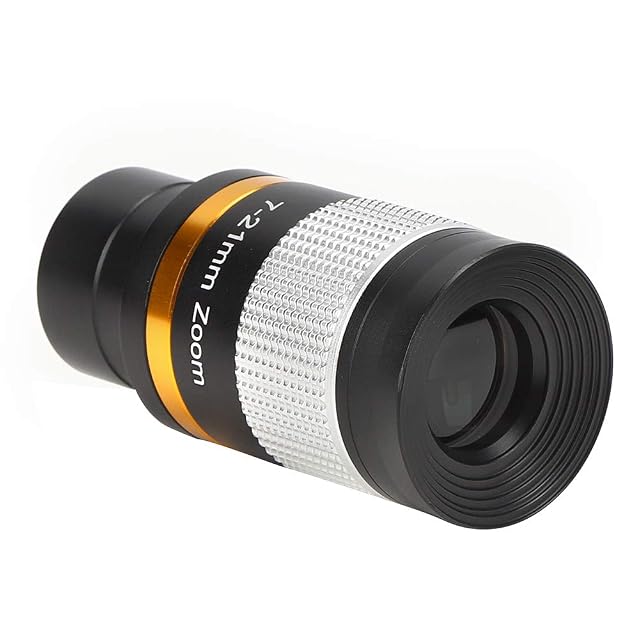
An 8–24 mm zoom eyepiece in a 1.25 in barrel, multi-coated, with a fold-down eyecup and an apparent field running from 40 to 60 degrees across the range.
The bottom line An honest zoom that publishes its weakest figure alongside its strongest.
The disclosure that matters
Forty to sixty degrees across the range. Every zoom eyepiece narrows its field at the long end, and most listings quote only the wide figure. Publishing both is what lets a buyer compare it with a fixed eyepiece honestly.
What it replaces
Three or four fixed eyepieces, and every swap between them. On a cold night, with gloves, near a mount that shifts when touched, not changing the eyepiece is worth more than the last few per cent of sharpness.
What it costs
More glass in the path, and a narrower field at 24 mm than a plain Plössl of the same focal length. Those are the structural trades of the design rather than faults of this example.
Eight to twenty-four in practice
On a 1500 mm Maksutov that is 62x to 187x — almost the whole useful range of the instrument in one eyepiece. On a short refractor it is a much smaller span, which is why zooms suit long focal lengths best.
Availability
German Amazon store sat at about 126 € on the day of the survey.
British Amazon store lists it in local currency, which the euro range above sets aside.
American, French, Italian and Spanish Amazon catalogues hold a record for it that nobody is selling.
Figures as Keepa reported them on the day this page was last updated. Stock and pricing shift without warning.
Prices quoted in this text were read on 17 September 2026. The live price is at the top of the page.
What it publishes, and what it withholds
Strengths
Publishing the field at both ends of the range is exactly the right disclosure for a zoom
One eyepiece covers what three Plössls would, with nothing to swap in the dark
A 1.25 in barrel fits every modern telescope
Compromises
Forty degrees at the long end is narrower than a plain 24 mm Plössl would give
A zoom has more elements and more surfaces than a fixed eyepiece at the same price
No eye relief figure is published at either end
Specifications
Focal length range
8 mm to 24 mm, continuously variable
Apparent field at both ends
40 to 60 degrees across the range, as the maker states it
Eye relief
Fold-down, for use with or without spectacles
Parfocality
Not published by the maker.
Action
Not published by the maker.
Stops
Not published by the maker.
Barrel size
1.25 in
Coatings
Multi-coated on every lens surface, per the maker
Body
Not published by the maker.
Amazon reference
DE B0007UQNV8 · US B07MCGD3FR · GB B07MCGD3FR · FR B07MCGD3FR · IT B07MCGD3FR · ES B07MCGD3FR
EAN
0050234932301
What observers ask about this one
Why is the field narrower at long focal length?
That is how most zoom designs behave: the field stop is fixed, so as the focal length increases the apparent field shrinks. Forty degrees at 24 mm is noticeably tighter than the fifty a Plössl gives.
Does a zoom replace a set?
It replaces the convenience of a set. A good fixed eyepiece at a given focal length will generally outperform a zoom at the same setting, and the zoom will be used far more often.
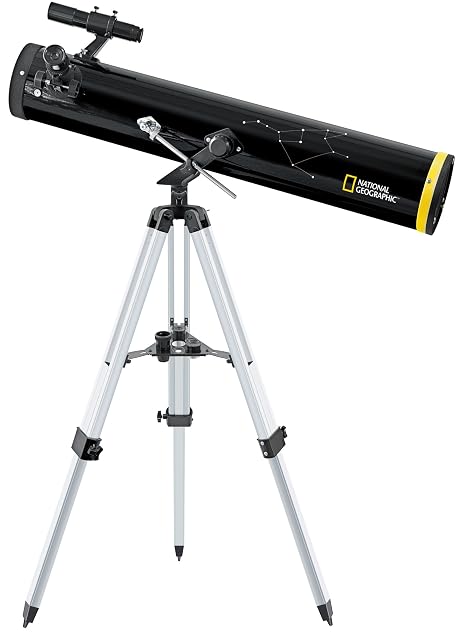
114 mm mirror · 900 mm focal length · alt-azimuth mount
A 114/900 Newtonian on a simple alt-azimuth mount, supplied with three eyepieces, a 6x30 finder and a 1.5x erecting lens, recommended by the maker from age eight.
Best for: A family telescope where nobody wants to learn polar alignment