Skip to content

Celestron Heavy-Duty Alt-Azimuth Tripod (93607) review

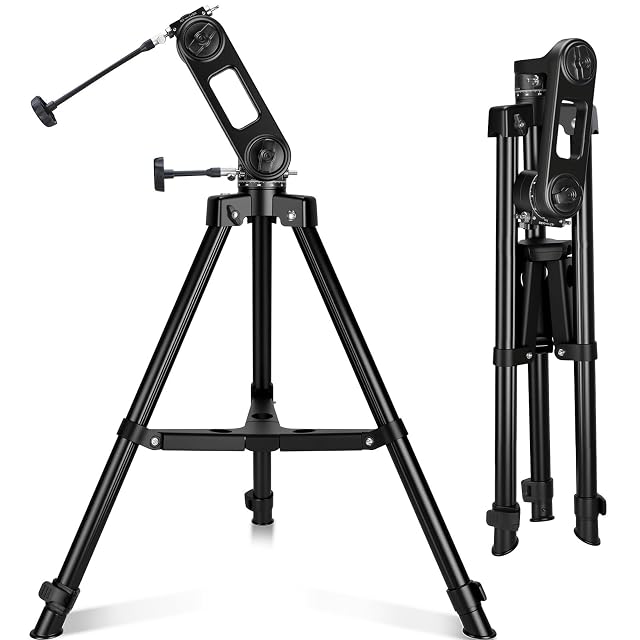
A metal alt-azimuth head on two-section aluminum legs, with slow-motion controls on both axes and a slotted 1/4-20 plate for balancing a spotting scope, binocular or small telescope.

A tripod for spotting scopes and giant binoculars

Celestron sells the 93607 for hands-free viewing with giant binoculars, a spotting scope, a camera or a small telescope. The head ends in a 1/4-20 threaded plate, the standard camera fitting, and that decides what it carries well.

Spotting scopes, binocular L-adapters and cameras screw straight on. A telescope tube with a Vixen-style dovetail bar needs a dovetail saddle with a 1/4-20 foot, bought separately.

The slot is the good part

The plate has a slot cut in it so the optic can slide forward and aft before it is tightened.

That is balance. An optic fixed at one point is nose-heavy or tail-heavy; the altitude axis then creeps one way and resists the other, and every nudge overshoots. Sliding the load until it sits over the axis fixes it.

Two ways to move it

For large moves, the listing describes a friction clutch on the altitude axis that holds the head wherever it is pushed, and an azimuth lock that is loosened to turn it through 360 degrees.

For small ones there are two slow-motion handles. At 40x and above that is the difference between centering a target and chasing it.

Thirty-two to forty-five inches

The aluminum legs are two-section, published at 32 inches minimum and 45 inches maximum. A center brace stiffens them when open and carries a metal accessory tray.

Forty-five inches suits a seated observer with a straight-through spotting scope, or a standing one with an angled eyepiece. Thirty-two inches puts giant binoculars pointed upward at a comfortable height from a chair.

What is not published

No payload figure, no head weight and no tension adjustment. “Heavy-duty” is the name, not a number. A 15x70 or 20x80 binocular, or an 80 mm spotting scope, is the load it is plainly built around; a long telescope on one screw is asking more of it.

Price and availability

On November 7, 2026, Amazon.com sold it directly at $114.95. Celestron states a 2-year US warranty.

Figures as Keepa reported them on the day this page was last updated. Stock and pricing shift without warning.

Prices quoted in this text were read on November 7, 2026. The live price is at the top of the page.
Its two nearest scopes on price

Same aisle, closest price — what the same spend else shows.

What it publishes, and what it withholds

Strengths

  • Slow-motion control on both axes, so a target can be kept centered at high power
  • A slotted plate lets a scope be balanced fore and aft over the axis
  • Height published as two figures, 32 to 45 inches, with a metal tray on the leg brace

Compromises

  • No dovetail saddle: most telescope tubes need an adapter that is not in the box
  • No payload figure behind the heavy-duty name
  • A single 1/4-20 screw lets a long tube pivot if it is not tightened hard

Specifications

Payload ratingNot published by the maker · Stated for spotting scopes, binoculars, cameras, small telescopes and giant binoculars
Slow-motion controlTwo slow-motion control handles for small adjustments on slow-moving targets, stated
ClutchFriction clutch on the altitude axis holds the head where it is moved, stated · Azimuth lock that is loosened to turn the head through 360°
TensionNot published by the maker.
Dovetail fittingNone · 1/4-20 threaded mounting plate with a slot for fore-and-aft balance · A dovetail saddle is needed for most telescope tubes and is not supplied
Tripod constructionTwo-section aluminum legs, 32 in minimum and 45 in maximum height · Center leg brace with a metal accessory tray · Metal head
Setup timeNot published by the maker.
Supplied opticsNone: this is a mount and tripod · 2-year US warranty stated
Amazon referenceB0007UQNY0
EAN0050234936071

What observers ask about this one

Will a telescope fit it?

Only with an adapter. The head ends in a 1/4-20 threaded plate, the camera fitting. Most telescope tubes attach by a Vixen-style dovetail bar, which needs a dovetail saddle with a 1/4-20 foot. Spotting scopes, binocular adapters and cameras screw straight on, and those are the loads the listing names first.

What is the slot for?

Balance. An optic screwed on at one point is nose-heavy or tail-heavy, so the altitude axis creeps in one direction and resists in the other. Sliding it along the slot until it sits over the axis removes that, which is what a long dovetail bar does on a telescope mount.

How do the slow-motion controls work with the clutch?

The listing describes two ways to move it. For large moves in altitude, the head is pushed and a friction clutch holds it; for azimuth, a lock is loosened and the head turns freely through 360 degrees. The slow-motion handles then make the small corrections that keep a planet or a distant boat in the field.

The price on Amazon.com

This model is listed on Amazon.com, at ≈ $115 at the last reading. Listed is not the same as in stock: availability changes daily, and the buy box shows the live price.

Details checked on November 7, 2026.

This one and its buyer, among astronomy instruments

Giant binoculars or a spotting scope that needs geared movement rather than a dovetail

The astronomy instruments guides that feature it

What buyers actually choose

Amazon reports what buyers took in the month before this page was last checked: at least 50.

The figure is a floor, rounded by Amazon, and read through Keepa — it says what buyers picked, not what a maker claims.

Sources

Specifications: the manufacturer sheet for telescopes and observing optics and the matching Amazon product page. Prices and availability: Keepa. Every figure on this page names its source.

The way we judge these astronomy instruments