Up-down, left-right, and nothing to align · review
Celticbird Heavy-duty AZ mount (Tri-az) review
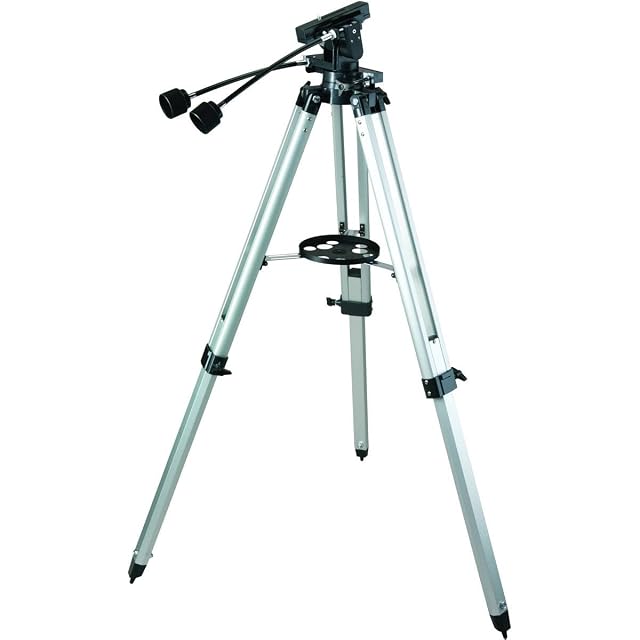
An all-metal alt-azimuth mount and tripod with 126:1 worm-gear slow motion on both axes and altitude and azimuth scales, sold for 130/650 reflectors and 90/1000 refractors.
The listing publishes the reduction ratio of its slow-motion drives: 126:1, on both axes, through metal worm gears.
One turn of a knob moves the axis by under three degrees. At 150x a planet crosses the field in well under a minute; a geared drive at this ratio lets it be kept centered with small, regular turns instead of shoves.
Scales for phone coordinates
Both axes carry printed scales. The maker pitches them at smartphone star-finding apps, which give the altitude and azimuth of any target at the current time.
Level the tripod, set the azimuth scale on a known direction, dial in the two numbers, and the target should be in or near a low-power eyepiece. It is a manual version of what a GoTo mount does with motors.
Metal where it counts
The head is a one-piece die-cast aluminum body, the gears are metal, and the legs are 32 mm (1.26 in) anodized aluminum. One-piece castings flex less than bolted assemblies, and metal gears do not wear a flat spot the way plastic ones can.
What it is sized for
The maker names its loads: 130/650 Newtonians and 90/1000 refractors. Those are the two most common upgrade tubes from a first kit, and both are usually sold on lighter mounts than this.
What it does not publish is a payload in pounds or kilograms, or the type of dovetail saddle. Check the bar on your tube before ordering.
Price and availability
On November 7, 2026, Amazon.com had no seller offering it; Keepa recorded new offers around $130 over the previous six months. The button opens the live listing.
Figures as Keepa reported them on the day this page was last updated. Stock and pricing shift without warning.
Prices quoted in this text were read on November 7, 2026. The live price is at the top of the page.
What it publishes, and what it withholds
Strengths
A gear ratio is published, 126:1 on both axes, where most alt-azimuth heads publish nothing
Altitude and azimuth scales let a phone app's coordinates be dialed in
Metal throughout: die-cast head, metal worm gears, 32 mm legs
Compromises
No payload figure, only the tube sizes it is meant for
The dovetail saddle type is not stated
Amazon.com showed no offer on November 7, 2026
Specifications
Payload rating
Not published by the maker · Stated for larger optical tubes such as 130/650 Newtonians and 90/1000 refractors
Slow-motion control
Dual worm-gear slow motion with a 126:1 reduction ratio, stated
Clutch
Not published by the maker.
Tension
Not published by the maker.
Dovetail fitting
Not published by the maker.
Tripod construction
One-piece die-cast aluminum mount body · Full-metal worm-gear transmission · 32 mm (1.26 in) anodized aluminum tripod legs
Setup time
Not published by the maker · English instruction manual included
Supplied optics
None: this is a mount and tripod · Built-in ALT/AZ scales stated to work with smartphone star-finding apps
Amazon reference
B0H5BYSTWF
EAN
0782570643008
What observers ask about this one
What does 126:1 mean in use?
One full turn of the slow-motion knob moves the axis by 1/126 of a turn, under three degrees. That is fine enough to keep a planet centered at 150x with small, steady turns, which is what a geared alt-azimuth head is for.
How do the scales help find things?
A star-finding app on a phone shows the altitude and azimuth of a target at the current time. With the mount leveled and the azimuth scale set on a known direction, those two numbers can be set on the scales and the target lands in or near a low-power eyepiece.
Will it carry my telescope?
The maker names 130/650 Newtonians and 90/1000 refractors as the intended loads and publishes no weight limit. Those tubes typically weigh 3 to 5 kg (7 to 11 lb). Check how your tube attaches as well, since the saddle type is not stated.
The price on Amazon.com
This model is listed on Amazon.com, with no price read at the last reading. Listed is not the same as in stock: availability changes daily, and the buy box shows the live price.
Details checked on November 7, 2026.
This one and its buyer, among astronomy instruments
A 130/650 reflector or 90/1000 refractor that needs geared movement and setting scales
Specifications: the manufacturer sheet for telescopes and observing optics and the matching Amazon product page. Prices and availability: Keepa. Every figure on this page names its source.
32 to 45 in height · two slow-motion controls · slotted 1/4-20 plate · aluminum legs · no dovetail
A metal alt-azimuth head on two-section aluminum legs, with slow-motion controls on both axes and a slotted 1/4-20 plate for balancing a spotting scope, binocular or small telescope.
Best for: Giant binoculars or a spotting scope that needs geared movement rather than a dovetail
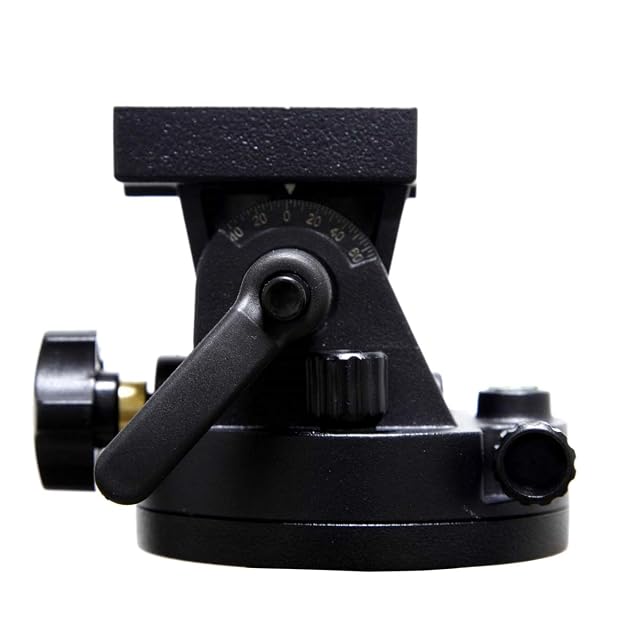
−30° to +65° latitude · ±5° azimuth · Φ80 mm (3.15 in) base · Vixen bar · built-in bubble level
An all-metal alt-azimuth base for iOptron's SkyTracker Pro and SkyGuider Pro, with −30° to 65° of latitude so the load can sit on either side, ±5° of azimuth and a bubble level.
Best for: Polar-aligning a small camera tracker without moving the tripod legs
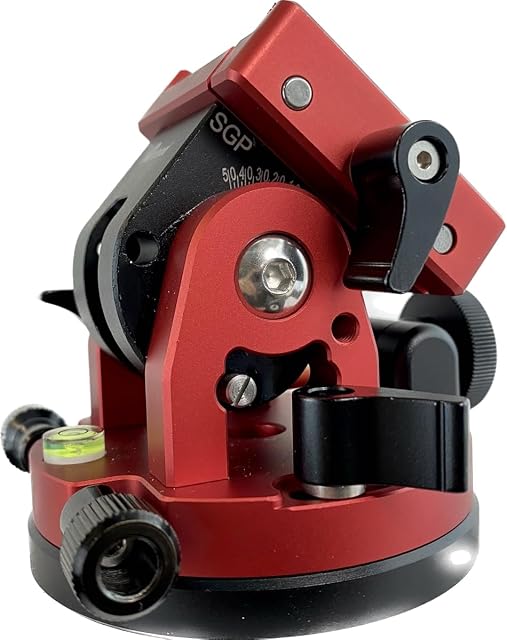
0° to 90° latitude · ±5° azimuth · CNC-machined metal · Φ80 mm (3.15 in) base · Vixen bar · 3/8 in tripod thread
A red CNC-machined alt-azimuth base for iOptron's SkyTracker Pro, SkyGuider Pro and SkyHunter, with 0° to 90° of latitude, ±5° of azimuth, a bubble level and a Vixen-type dovetail clamp.
Best for: Polar-aligning a small camera tracker at any latitude, on a photo tripod