The most aperture per dollar, and an alignment to keep · review
National Geographic 114/900 AZ review
A 114/900 Newtonian reflector on a simple alt-azimuth mount and aluminum tripod, supplied with 25, 9 and 4 mm eyepieces, a 6x30 finder, a 1.5x erecting lens and a 3x Barlow.
A 114 mm (4.49 in) mirror collects about 3.6 times the light of a 60 mm lens. That is the difference between seeing the bright globular clusters and nebulae as smudges and not seeing them at all.
At 900 mm of focal length the ratio is f/7.9: slow enough that simple eyepieces stay sharp to the edge, and long enough that the 9 mm eyepiece already gives a 100x view of Saturn.
The eyepieces, the Barlow and the 675x
The box holds 25 mm, 9 mm and 4 mm eyepieces, a 1.5x erecting lens and a 3x Barlow.
With this tube they give 36x, 100x and 225x on their own. The Barlow triples each one, and 225x tripled is the 675x on the listing. A 114 mm aperture is conventionally good to about 230x on an excellent night, so the 4 mm eyepiece is already at the limit and the Barlow takes it far past it.
The 25 mm and the 9 mm are the eyepieces that matter. The erecting lens turns the image the right way up for daytime use, at the price of some sharpness.
A properly sized finder
The finder is a 6x30, a real optical finder with a 30 mm objective. On a 900 mm telescope with a narrow field, a usable finder decides whether a target is found in ten seconds or ten minutes. Many kits at this size ship a 5x24.
The mount’s honest limit
The mount is a plain alt-azimuth head on an aluminum tripod. The maker publishes no slow-motion controls and no payload figure.
A long tube on a light head amplifies every touch. Nudge rather than push, and let the view settle before judging it.
Price and availability
On November 7, 2026, Amazon.com had no seller offering it; Keepa recorded third-party offers around $368 over the previous six months. The button opens the live listing.
Figures as Keepa reported them on the day this page was last updated. Stock and pricing shift without warning.
Prices quoted in this text were read on November 7, 2026. The live price is at the top of the page.
What it publishes, and what it withholds
Strengths
114 mm of aperture at f/7.9: enough light for bright clusters and nebulae, and an easy ratio for eyepieces
An alt-azimuth mount has nothing to align, which suits a family telescope
A real 6x30 optical finder rather than the 5x24 of cheaper kits
Compromises
The 675x top figure is arithmetic: a 114 mm mirror tops out near 230x
A 900 mm tube on a light alt-azimuth head swings a long way when touched, and no slow-motion controls are published
Amazon.com showed no offer on November 7, 2026
Specifications
Aperture
114 mm (4.49 in), stated in the listing
Focal length and ratio
900 mm (35.4 in) · f/7.9, the quotient of the two published figures
Optical design
Newtonian reflector, stated
Mirror coating
Not published by the maker.
Secondary obstruction
Not published by the maker.
Focuser type
Not published by the maker.
Collimation access
Not published by the maker.
Tube length
Not published by the maker.
Mount supplied
Alt-azimuth mount on an aluminum tripod
Supplied accessories
Eyepieces of 25 mm, 9 mm and 4 mm · 6x30 finder · 1.5x erecting lens · 3x Barlow lens · magnification range stated as 36x to 675x
Amazon reference
B009X5QPM0
EAN
4007922201528
What observers ask about this one
Where does 675x come from?
From the 4 mm eyepiece (900 / 4 = 225x) multiplied by the 3x Barlow lens in the box. The conventional ceiling for a 114 mm aperture is about twice its diameter in millimeters, roughly 230x on an excellent night. The useful range of this kit is 36x with the 25 mm eyepiece and 100x with the 9 mm.
Is an alt-azimuth mount a disadvantage?
For looking, rarely. The mount moves up-down and left-right, so a planet drifts diagonally and needs two small corrections instead of one. In exchange there is nothing to set up: level the tripod and point. For long-exposure photography it is the wrong mount, but this kit is not sold for that.
Will it need collimation?
Every Newtonian does from time to time, because its two mirrors can shift in transport. The listing does not describe the adjustment screws; a [collimation guide](/guides/when-the-image-is-soft/) explains how to check it with nothing more than a capped eyepiece tube.
Our score
8.4/ 10
A capable 4.5-inch mirror on the simplest kind of mount, advertised with a top magnification about two and a half times what it can use.
The price on Amazon.com
This model is listed on Amazon.com, with no price read at the last reading. Listed is not the same as in stock: availability changes daily, and the buy box shows the live price.
Details checked on November 7, 2026.
This one and its buyer, among astronomy instruments
A family telescope for planets and bright deep-sky objects, where nobody wants to learn polar alignment
Specifications: the manufacturer sheet for telescopes and observing optics and the matching Amazon product page. Prices and availability: Keepa. Every figure on this page names its source.
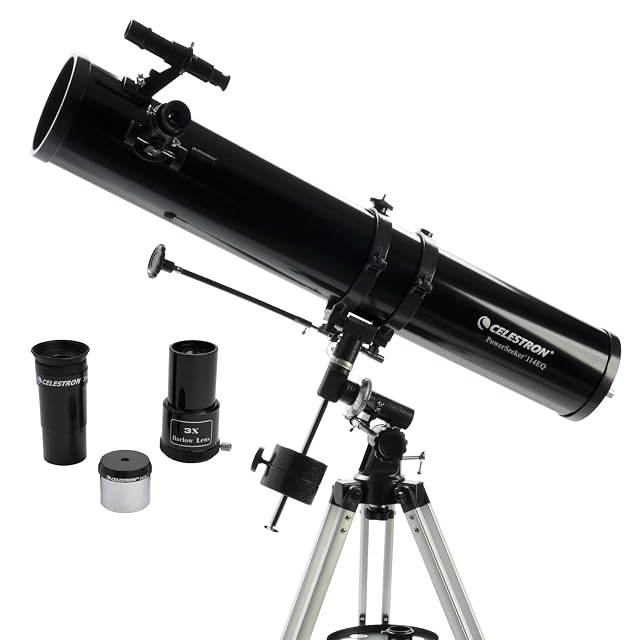
114 mm (4.5 in) Newtonian · German equatorial with slow-motion altitude rod · 20 mm and 4 mm eyepieces · 3x Barlow
Celestron's PowerSeeker 114EQ: a 114 mm Newtonian on a manual German equatorial mount with a slow-motion altitude rod, supplied with 20 mm and 4 mm eyepieces and a 3x Barlow.
Best for: A first equatorial reflector bought on price
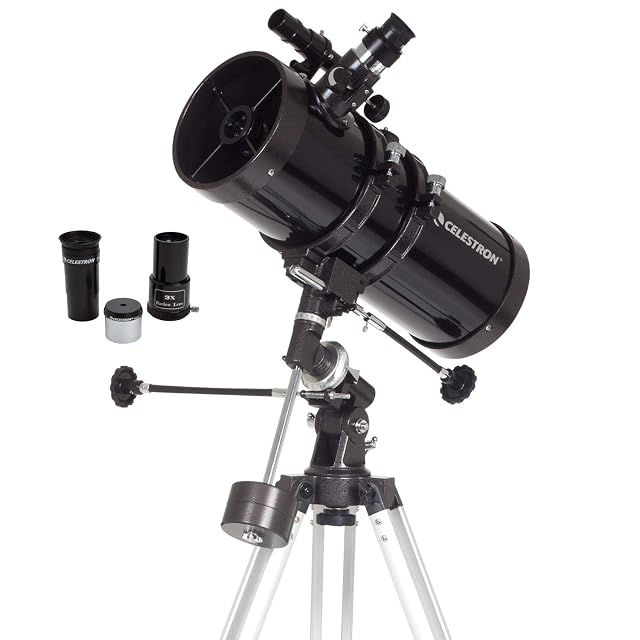
127 mm (5 in) Newtonian · German equatorial with slow-motion altitude rod · 20 mm and 4 mm eyepieces · 3x Barlow
Celestron's PowerSeeker 127EQ: a 127 mm Newtonian on a manual German equatorial mount with a slow-motion altitude rod, supplied with 20 mm and 4 mm eyepieces and a 3x Barlow.
Best for: The most aperture on this shelf for about $200
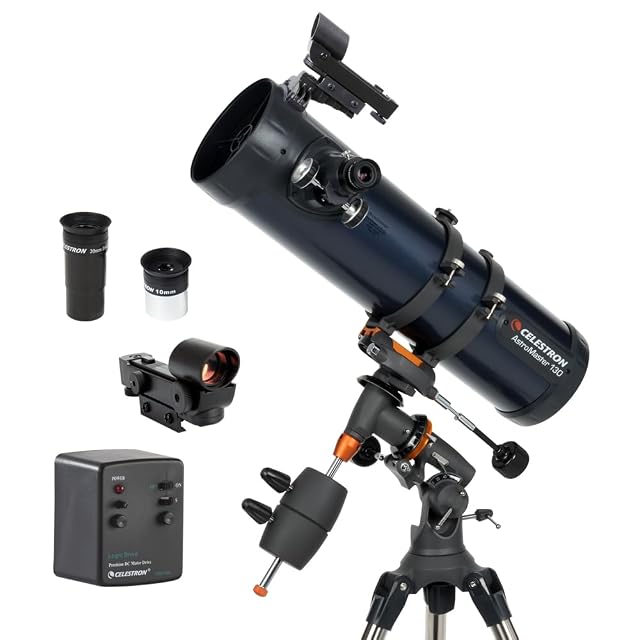
130 mm (5.1 in) Newtonian · RA motor drive included · aluminum and SiO2 coatings · slow motion on both axes
Celestron's AstroMaster 130EQ-MD: a 130 mm Newtonian with aluminum and SiO2 coatings on a German equatorial mount with slow motion on both axes and an RA motor drive for automatic tracking.
Best for: Long sessions at high power on the Moon and planets, without nudging