The most aperture per dollar, and an alignment to keep · review
Celestron PowerSeeker 114EQ (21045) review
Celestron's PowerSeeker 114EQ: a 114 mm Newtonian on a manual German equatorial mount with a slow-motion altitude rod, supplied with 20 mm and 4 mm eyepieces and a 3x Barlow.
The PowerSeeker 114EQ is a 114 mm (4.5 in) Newtonian on a manual German equatorial mount. Celestron says it shows planets, lunar craters, distant stars and the Orion Nebula, which is fair for the aperture.
The mount
The listing names a slow-motion altitude rod for following objects as they drift. Once the mount is polar-aligned, that is enough to keep a planet in view. It is compact and assembles without tools.
Eyepieces and the Barlow
A 20 mm and a 4 mm, with a 3x Barlow to triple each. The 20 mm in the Barlow is the useful planetary combination. The 4 mm, and above all the 4 mm in the Barlow, go beyond the roughly 230x a 114 mm aperture supports.
What is missing
The focal length, the coatings and the focuser type.
The 4 mm eyepiece with the 3x Barlow far exceeds what 114 mm can use
Only one slow-motion control named
Specifications
Aperture
114 mm (4.5 in), stated
Focal length and ratio
Not published in the Amazon.com listing.
Optical design
Newtonian reflector
Mirror coating
Not published in this listing.
Secondary obstruction
Not published by the maker.
Focuser type
Not published by the maker.
Collimation access
Not published by the maker.
Tube length
Not published · described as compact and lightweight
Mount supplied
Manual German equatorial with a slow-motion altitude rod · no tools needed
Supplied accessories
20 mm and 4 mm eyepieces · 3x Barlow lens · astronomy software download
Amazon reference
B0000Y8C2Y
EAN
0050234210454
What observers ask about this one
Is the 3x Barlow useful?
With the 20 mm eyepiece, yes: it gives the equivalent of a 6.7 mm, a planetary power. With the 4 mm it gives an equivalent 1.3 mm, far past the roughly 230x a 114 mm aperture can show.
Which eyepiece will I use most?
The 20 mm, for finding and for the Moon, and the 20 mm in the Barlow for planets. A 10 mm eyepiece would fill the gap.
AstroMaster or PowerSeeker?
The [AstroMaster 114EQ](/reviews/reflector-telescopes-celestron-114eq-family/) names its coatings and has slow motion on both axes, for $140 more on November 7, 2026.
The price on Amazon.com
This model is listed on Amazon.com, at ≈ $180 at the last reading. Listed is not the same as in stock: availability changes daily, and the buy box shows the live price.
Details checked on November 7, 2026.
This one and its buyer, among astronomy instruments
A first equatorial reflector bought on price
Sources
Specifications: the manufacturer sheet for telescopes and observing optics and the matching Amazon product page. Prices and availability: Keepa. Every figure on this page names its source.
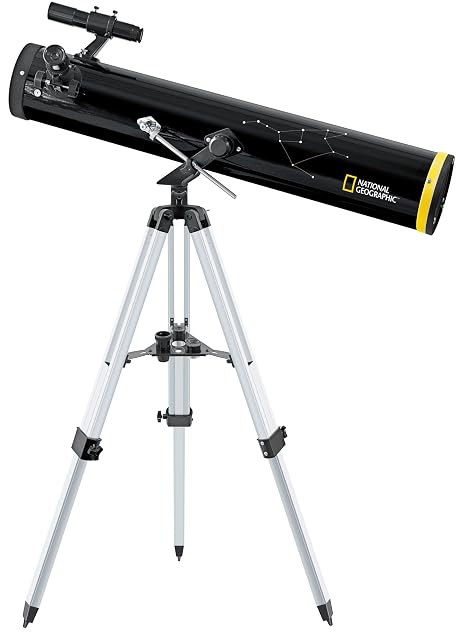
114 mm (4.49 in) mirror · 900 mm (35.4 in) focal length · f/7.9 · alt-azimuth mount
A 114/900 Newtonian reflector on a simple alt-azimuth mount and aluminum tripod, supplied with 25, 9 and 4 mm eyepieces, a 6x30 finder, a 1.5x erecting lens and a 3x Barlow.
Best for: A family telescope for planets and bright deep-sky objects, where nobody wants to learn polar alignment
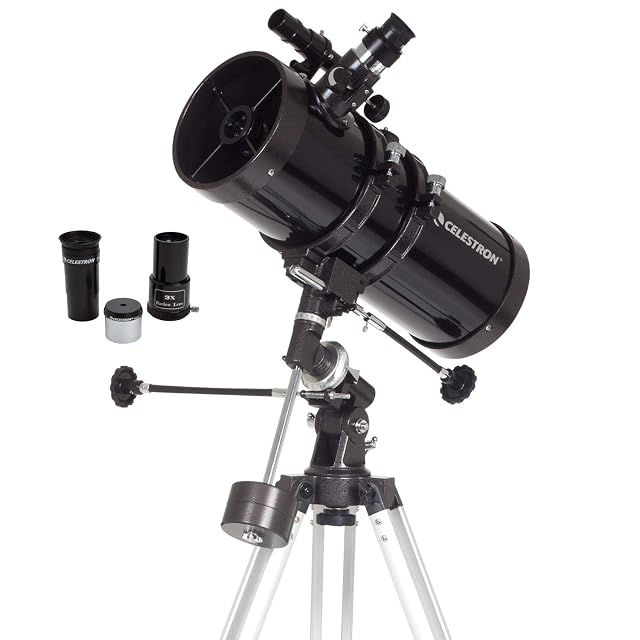
127 mm (5 in) Newtonian · German equatorial with slow-motion altitude rod · 20 mm and 4 mm eyepieces · 3x Barlow
Celestron's PowerSeeker 127EQ: a 127 mm Newtonian on a manual German equatorial mount with a slow-motion altitude rod, supplied with 20 mm and 4 mm eyepieces and a 3x Barlow.
Best for: The most aperture on this shelf for about $200
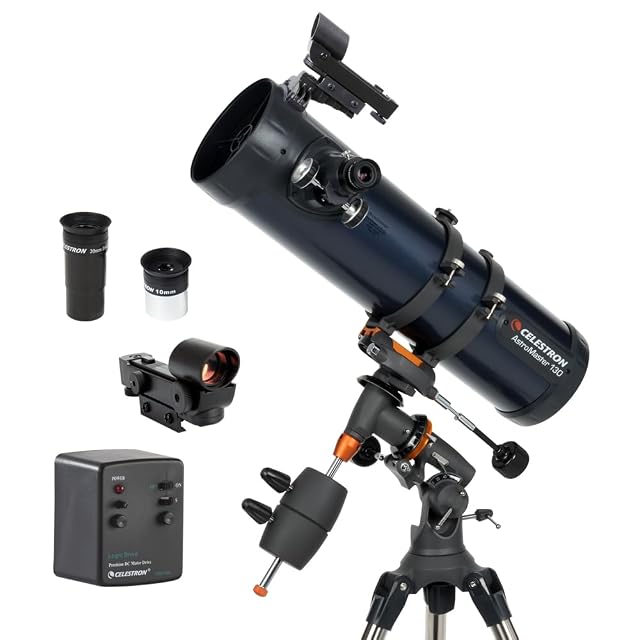
130 mm (5.1 in) Newtonian · RA motor drive included · aluminum and SiO2 coatings · slow motion on both axes
Celestron's AstroMaster 130EQ-MD: a 130 mm Newtonian with aluminum and SiO2 coatings on a German equatorial mount with slow motion on both axes and an RA motor drive for automatic tracking.
Best for: Long sessions at high power on the Moon and planets, without nudging