The most aperture per euro, and an alignment to keep · review
SOLOMARK 130EQ review
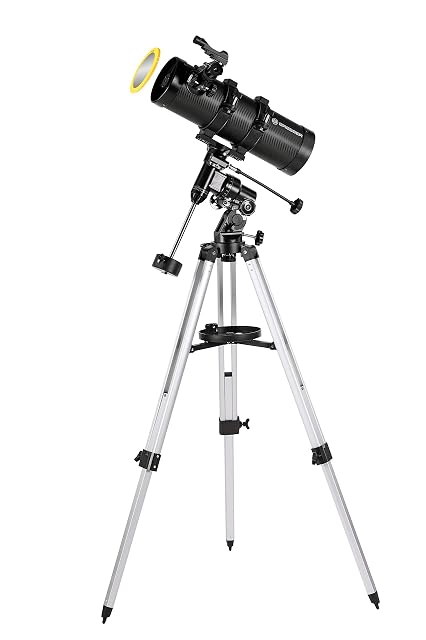
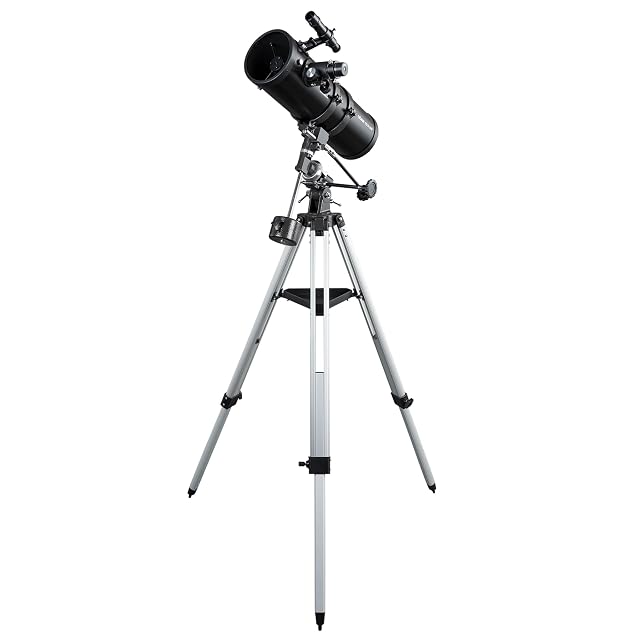
A 130 mm Newtonian on a German equatorial mount with slow-motion controls, supplied with two eyepieces, a 1.5x erecting Barlow, a 13 % transmission Moon filter and a phone adapter.
The bottom line A generously equipped 130 mm let down on paper by the one figure the listing forgets to print.
What is given, and what is left blank
The aperture is 130 mm, stated twice. The focal length appears nowhere in the listing. That is an unusual omission, and it matters: without it the focal ratio cannot be worked out, no magnification can be calculated, and the exit pupil of any candidate eyepiece is unknown. The figure will be on the tube; it is not in the advertising.
The mount is the grown-up part
A German equatorial with setting circles and flexible slow-motion cables on both axes. Aligned on the pole, it follows a target with one control. Unaligned, it is an awkward alt-azimuth. That routine is the price of admission, and it is the same routine on every mount of this kind.
The filter is specified properly
Thirteen per cent transmission, written as a number. Most Moon filters on this shelf are sold under a word. A percentage can be compared between makers; a word cannot.
The finish is not a specification
The bullets describe a carbon-fibre coating on the tube. That is cosmetic and structural, and it tells the reader nothing about the mirror underneath — which is the part that decides what the telescope shows.
Availability
German, French, Italian and Spanish Amazon stores sat at about 270 € on the day of the survey.
American and British Amazon stores list it in local currency, which the euro range above sets aside.
Figures as Keepa reported them on the day this page was last updated. Stock and pricing shift without warning.
Prices quoted in this text were read on 17 September 2026. The live price is at the top of the page.
What it publishes, and what it withholds
Strengths
130 mm is the size at which deep-sky objects start to show structure rather than presence
The Moon filter is specified by transmission — 13 % — rather than by a colour word
Flexible slow-motion cables on both axes make fine pointing possible by hand
Compromises
The listing never states the focal length, so no magnification can be calculated from it
A German equatorial needs polar alignment before its one-axis tracking is worth anything
The carbon-fibre finish described in the bullets says nothing about the optics
Specifications
Aperture
130 mm (title and bullet agree)
Focal length and ratio
The listing does not carry it
Optical design
Newtonian reflector, fully coated per the maker
Mirror coating
Not published by the maker.
Secondary obstruction
Not published by the maker.
Focuser type
Not published by the maker.
Tube length
Not published by the maker.
Collimation access
Not published by the maker.
Mount supplied
German equatorial with setting circles and flexible slow-motion cables
Supplied accessories
Adjustable aluminium alloy, with accessory tray · 1.25 in, 13 % transmission, as the maker states it · Two eyepieces, 1.5x erecting Barlow, phone adapter
Amazon reference
B087CRF6CT (same reference on 6 Amazon marketplaces)
EAN
0703501411404
What observers ask about this one
Why does the missing focal length matter?
Because magnification is focal length divided by eyepiece focal length. Without it, no eyepiece decision can be made on paper — the figure has to come from the tube or the manual.
What does a 13 % Moon filter do?
It passes 13 % of the light, which is a stated number rather than a name. A bright Moon at low power is uncomfortable; this cuts it to a level the eye can hold, and it is one of the few filter figures published plainly on this shelf.
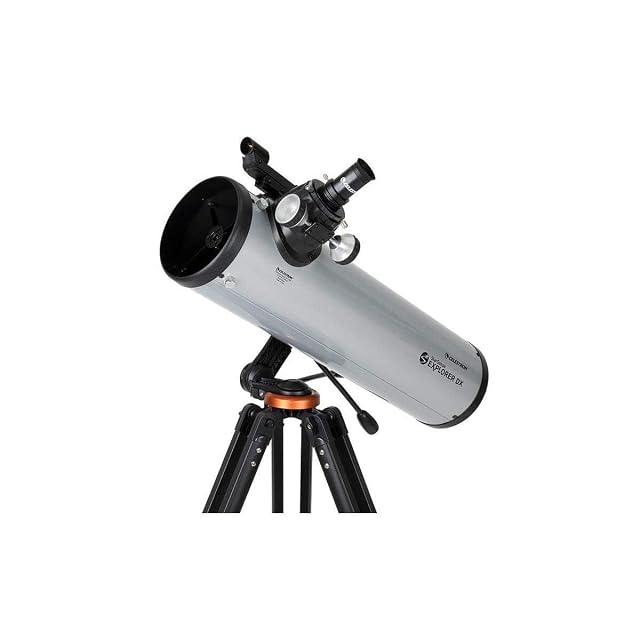
A 130 mm Newtonian on a manual alt-azimuth mount whose dock and app read the star field through the phone camera and steer the observer to a target with on-screen arrows.
Best for: A beginner who wants to see things this month rather than learn to star-hop first