The most aperture per dollar, and an alignment to keep · review
Celestron AstroMaster 114EQ (31042) review
Celestron's AstroMaster 114EQ: a 114 mm Newtonian with aluminum and SiO2 coatings on a manual German equatorial mount with two slow-motion knobs, a 20 mm erect-image eyepiece, a 10 mm eyepiece and a StarPointer finder.
The AstroMaster 114EQ is a 114 mm (4.5 in) Newtonian. Celestron names the mirror coatings, aluminum with an SiO2 overcoat, and gives the mount two slow-motion knobs, one for each axis. Those two details are what this page has over the PowerSeeker 114EQ.
The mount
A manual German equatorial. Once its polar axis points north, the right-ascension knob alone follows a planet as the Earth turns. The tripod adjusts for standing or seated observers and sets up without tools.
Eyepieces
A 20 mm with a built-in erect-image corrector, which also makes the telescope usable for daytime views, and a 10 mm. A StarPointer red-dot finder aims it. The focal length is not in the listing, so the magnifications cannot be calculated from it.
What it shows
Celestron lists Saturn’s rings, Jupiter’s moons, lunar craters and the Andromeda Galaxy. That is fair for 114 mm.
Price and availability
On November 7, 2026, Amazon.com sold it directly at $319.99. Celestron states a 2-year US warranty.
Figures as Keepa reported them on the day this page was last updated. Stock and pricing shift without warning.
Prices quoted in this text were read on November 7, 2026. The live price is at the top of the page.
Its two nearest scopes on price
Same aisle, closest price — what the same spend else shows.
Aluminum and SiO2 (silicon dioxide overcoat), stated
Secondary obstruction
Not published by the maker.
Focuser type
Not published by the maker.
Collimation access
Not published by the maker.
Tube length
Not published by the maker.
Mount supplied
Manual German equatorial · slow-motion knobs for right ascension and declination · adjustable tripod, no tools needed
Supplied accessories
20 mm eyepiece with built-in erect-image corrector · 10 mm eyepiece · StarPointer red-dot finder · astronomy software download
Amazon reference
B000MLL6R8
EAN
050234310420
What observers ask about this one
What can it show?
Celestron names Saturn's rings, Jupiter's moons, lunar craters and the Andromeda Galaxy. A 114 mm mirror also shows the brighter globular clusters and the Orion Nebula well.
How does it differ from the PowerSeeker 114EQ?
Slow motion on both axes against one named on the PowerSeeker, named coatings, and an erect-image eyepiece. The PowerSeeker adds a 4 mm eyepiece and a 3x Barlow, which overshoot what 114 mm can use.
Is an equatorial mount hard to learn?
It takes one evening. Point the polar axis north and tilt it to your latitude; then one knob follows a planet across the sky.
The price on Amazon.com
This model is listed on Amazon.com, at ≈ $320 at the last reading. Listed is not the same as in stock: availability changes daily, and the buy box shows the live price.
Details checked on November 7, 2026.
This one and its buyer, among astronomy instruments
A 114 mm whose mount can be aimed properly, for a family that will use it from a chair or standing
Eyepieces and parts stated to fit
Listed because the eyepiece or part names this scope.
Specifications: the manufacturer sheet for telescopes and observing optics and the matching Amazon product page. Prices and availability: Keepa. Every figure on this page names its source.
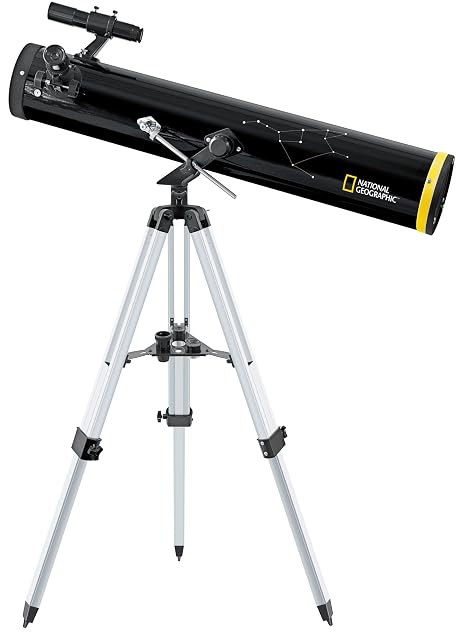
114 mm (4.49 in) mirror · 900 mm (35.4 in) focal length · f/7.9 · alt-azimuth mount
A 114/900 Newtonian reflector on a simple alt-azimuth mount and aluminum tripod, supplied with 25, 9 and 4 mm eyepieces, a 6x30 finder, a 1.5x erecting lens and a 3x Barlow.
Best for: A family telescope for planets and bright deep-sky objects, where nobody wants to learn polar alignment
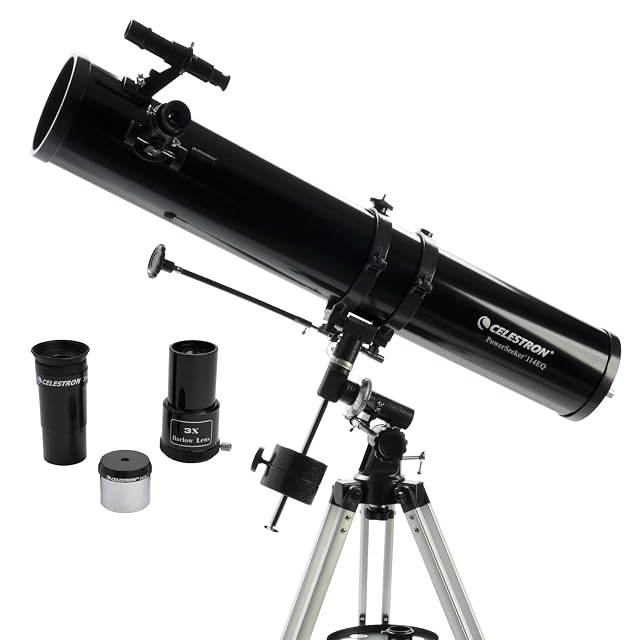
114 mm (4.5 in) Newtonian · German equatorial with slow-motion altitude rod · 20 mm and 4 mm eyepieces · 3x Barlow
Celestron's PowerSeeker 114EQ: a 114 mm Newtonian on a manual German equatorial mount with a slow-motion altitude rod, supplied with 20 mm and 4 mm eyepieces and a 3x Barlow.
Best for: A first equatorial reflector bought on price
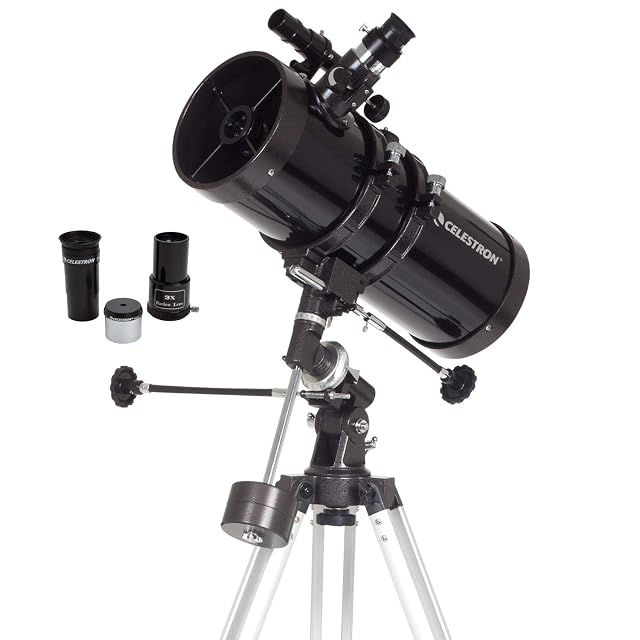
127 mm (5 in) Newtonian · German equatorial with slow-motion altitude rod · 20 mm and 4 mm eyepieces · 3x Barlow
Celestron's PowerSeeker 127EQ: a 127 mm Newtonian on a manual German equatorial mount with a slow-motion altitude rod, supplied with 20 mm and 4 mm eyepieces and a 3x Barlow.
Best for: The most aperture on this shelf for about $200