Skip to content

The numbers that mean something, and the ones that do not

A telescope listing contains two kinds of number: the ones fixed by physics and the ones written by marketing. Telling them apart takes about a minute and saves the commonest bad purchase on this site.

Aperture, and nothing else, sets the ceiling

Light collected goes with the square of the diameter. It is the one figure that cannot be improved by anything bought afterwards, and it is often printed smaller than the magnification claim.

Focal length turns eyepieces into magnifications

Telescope focal length divided by eyepiece focal length. Without the first figure, no eyepiece can be matched to the instrument — which is why a listing that omits it is a real problem, and several on this site do.

Eyepiece diameter decides what comes next

A 1.25 in focuser opens the whole accessory catalogue. A 24.5 mm one closes it. It costs nothing to check and it is the difference between a telescope that grows and one that does not.

The words that carry no specification

Professional, HD, high-definition, astronomical-grade. None corresponds to a measurement. Where a listing leads with them and omits the focal length, this site says so on the page.

The five, and the reason for the order

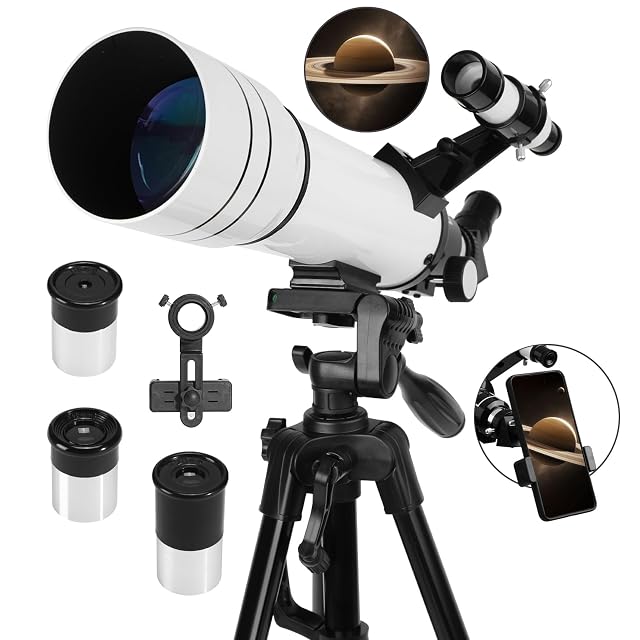
  1. BOSSDUN TW18

    70 mm aperture · 400 mm focal length in the title

    A 70/400 refractor sold with two eyepieces, a 5x Barlow, a phone adapter and a stainless-steel tripod — and a listing whose own bullets contradict its title.

    Best for: A buyer who will check the tube’s printed figures before ordering anything else for it

    ≈ £79 / €70
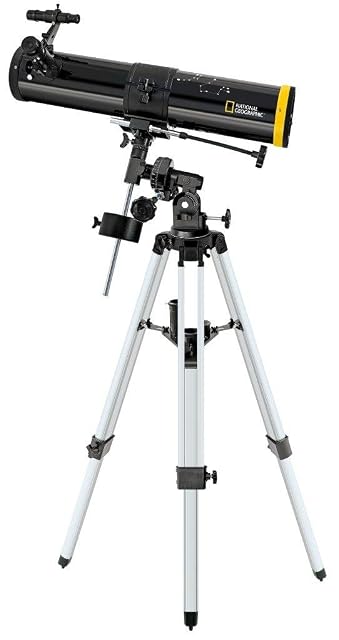
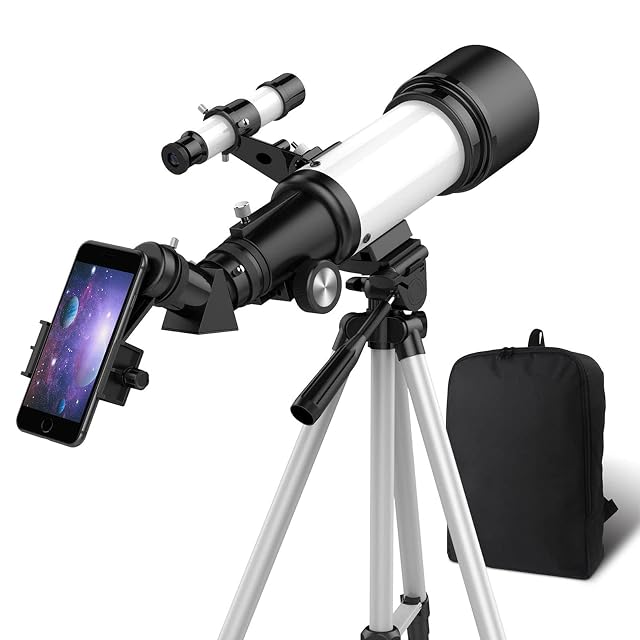
  2. OYS TEL-01

    70 mm aperture · 400 mm focal length

    A 70/400 refractor on an alt-azimuth mount with two 1.25 in eyepieces, an erecting prism, a phone adapter and a carry bag.

    Best for: A first 70 mm where the eyepiece fitting and the focal ratio are both stated plainly

    ≈ €60

What gets asked before buying

Why is maximum magnification meaningless?

Because any telescope can reach any magnification with a short enough eyepiece. Beyond roughly twice the aperture in millimetres, the image is larger and no more detailed — so 675x on a 70 mm tube describes a calculation, not a capability.

What should be read first?

Aperture, then focal length, then eyepiece diameter. Those three decide what is collected, what magnification an eyepiece gives, and what else will fit.

What if the listing contradicts itself?

Several on this site do — a title and a bullet giving different focal lengths, a mass and a package weight that cannot both be right. Where that happens, this site prints both and resolves neither.

Any figure written into the body of this page was true on the day it was written. The amount shown next to each instrument is requested from the retailer as the page loads, and it is that amount, not the text, that stands.

The tool we use ourselves

Chosen your instrument? Now do not pay over the odds.

Telescopes and mounts are discounted over and over through the year — hardest of all in the weeks before Christmas, which is exactly when most of them are bought — and a struck-through figure on its own says nothing whatever about what the same model was charged at four weeks ago. UniverTrack keeps a week-by-week record for each retailer, so a discount is measured against a figure somebody genuinely paid instead of one invented for the sale — and it says when the moment to buy has genuinely arrived.

Real price historyBuy-now alertsAI buying assistant
Try free for 14 days →
No commitment · Cancel in one click · 5 languages