A sealed tube, a lens at the front, and colour to account for · review
SOLOMARK 80900 review
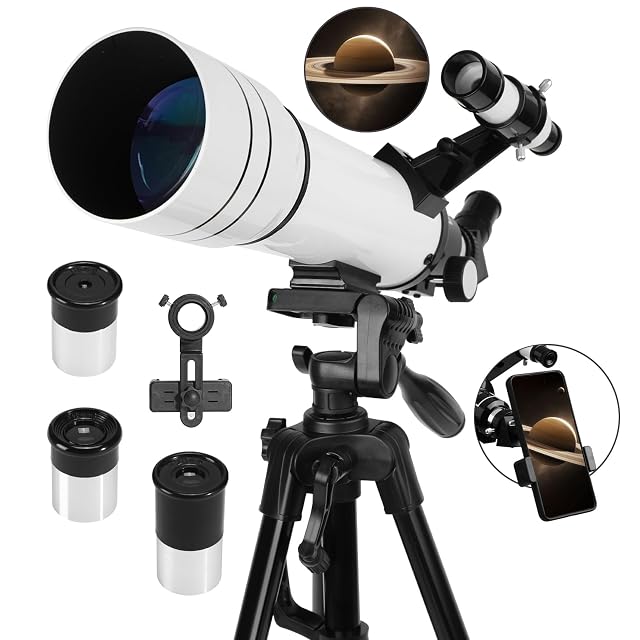
An 80/900 refractor on an alt-azimuth head with setting scales, supplied with two wide-angle eyepieces, an erecting diagonal, a phone adapter and a carry bag.
The bottom line The long-focal-length choice of this group, with the tripod rather than the objective as the part to watch.
An unusually long ratio for the price class
Eighty millimetres of aperture against nine hundred millimetres of focal length gives f/11.3. That matters in two ways: simple eyepieces behave better at long ratios, and the same eyepiece gives more magnification here than in a shorter tube. The trade is framing — a wide star field will not fit.
The head has scales, which is rarer than it sounds
The maker describes altitude and azimuth scales on the mount. They do not make it a GoTo, and they do make it possible to write down where something was and come back to it, which is the beginning of an observing routine.
What the 45x and 90x figures are
They are 900 divided by 20 and by 10 — the two supplied eyepieces. They describe eyepieces. The two figures that describe this telescope are its aperture and its focal length, and they are at the top of this page.
The part the listing does not describe
Tripod damping. A 900 mm tube is a lever, and how long the view shakes after a touch decides how usable high magnification is. No figure is published for it, and this page will not estimate one.
Availability
German, French, Italian and Spanish Amazon stores ran from 150 € to 160 € on the day of the survey.
American and British Amazon stores list it in local currency, which the euro range above sets aside.
Figures as Keepa reported them on the day this page was last updated. Stock and pricing shift without warning.
Prices quoted in this text were read on 17 September 2026. The live price is at the top of the page.
What it publishes, and what it withholds
Strengths
80 mm is a real step up from the 70 mm class that fills this shelf
f/11.3 is long enough that a simple eyepiece still performs well
Altitude and azimuth scales on the head make returning to a position repeatable
Compromises
A 900 mm tube on an alt-azimuth head is long, and long tubes amplify every wobble
The maker quotes 45x and 90x from the two eyepieces — those are eyepiece results, not tube figures
The bag holds the set but the listing gives no tripod damping figure of any kind
Specifications
Aperture
80 mm (title and bullet agree)
Focal length and ratio
900 mm (from the title) · f/11.3, the quotient of the two figures above
Lens design
Refractor, coated objective per the maker’s bullet
Glass type
Not published by the maker.
Focuser
Not published by the maker.
Drawtube
Not published by the maker.
Tube weight
Not published by the maker.
Supplied accessories
20 mm and 10 mm wide-angle, per the maker · Erecting diagonal, phone adapter, carry bag
Amazon reference
B0CHR81WJ1 (same reference on 6 Amazon marketplaces)
EAN
0727380311808
What observers ask about this one
Is 80 mm noticeably better than 70 mm?
It collects about 30 % more light, which is arithmetic on the two apertures. Whether that shows depends far more on the sky and on the eyepiece than on the difference itself.
What does the erecting diagonal change?
It delivers an upright, correctly handed image, which is what makes daytime use comfortable. For the sky, orientation matters only for matching a chart.
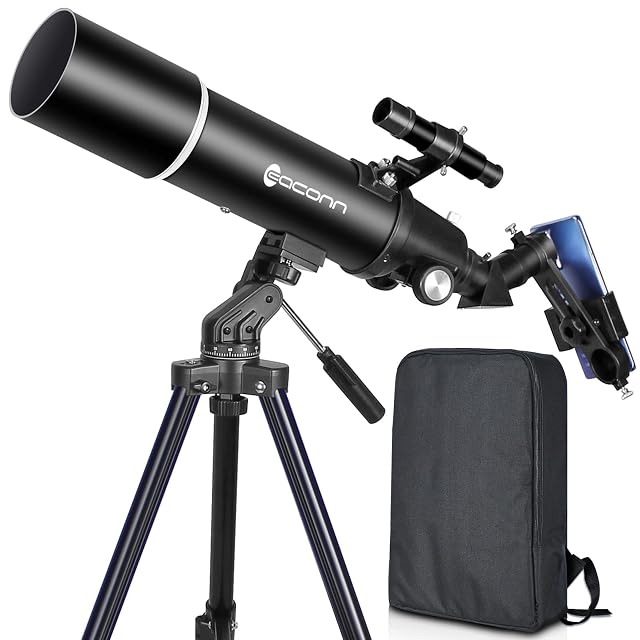
A 70/400 refractor sold with two eyepieces, a 5x Barlow, a phone adapter and a stainless-steel tripod — and a listing whose own bullets contradict its title.
Best for: A buyer who will check the tube’s printed figures before ordering anything else for it
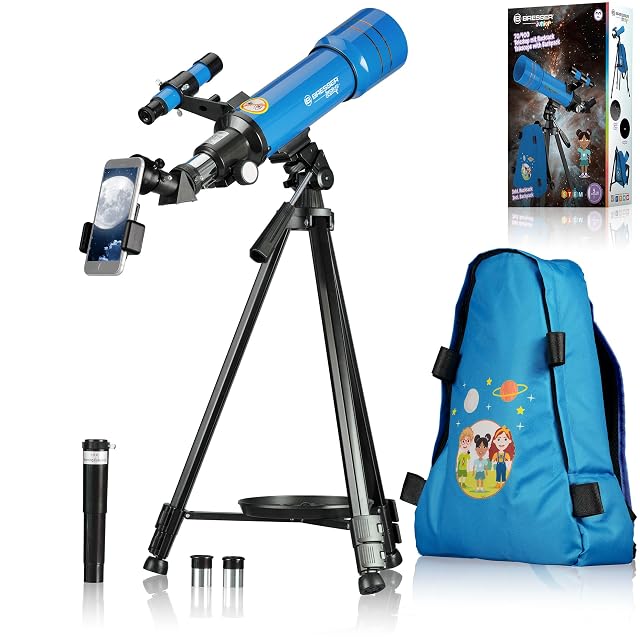
A 70/400 refractor sold as a first instrument for children from eight, supplied in a backpack with three eyepieces, a star diagonal and an erecting lens.
Best for: A child from about eight who will carry the telescope themselves