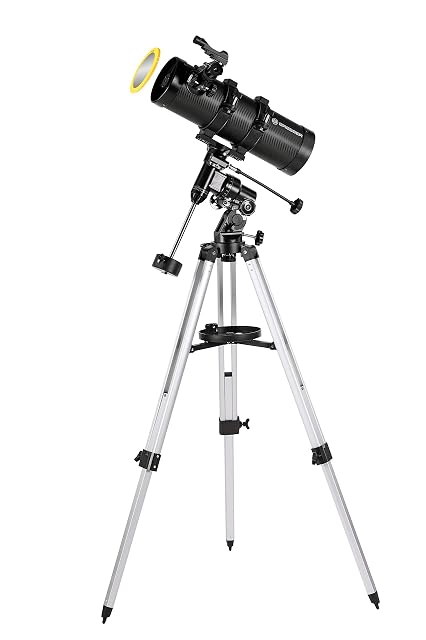
The bottom line A light, complete and honestly dimensioned starter set, sold with a magnification headline its mirror cannot support.
A small mirror with a long ratio
Seventy-six millimetres of aperture and seven hundred of focal length gives f/9.2. The aperture is modest, and the ratio is forgiving — which is a sensible pairing, because it means the simple supplied eyepieces are working in conditions that suit them.
The figures the maker does publish
Seventy-four by twenty-three by fifteen centimetres, and 6.2 kg. Those two lines are worth more to a buyer than most of the rest of the listing, because they answer the question that decides whether a telescope gets used: can it be picked up and carried out in one go.
Where 233x comes from, and why to ignore it
The shortest supplied eyepiece with the 3x Barlow. On a 76 mm mirror that is far past the aperture’s resolving limit; the image grows, dims and softens. The 25 mm eyepiece is where this telescope looks its best.
The equatorial mount, used simply
The maker says it aligns on Polaris, which is the rough polar alignment that visual observing needs. Done that way it takes a minute and turns tracking into one slow-motion control — the entire benefit, without the precision that photography would demand.
Availability
German, French, Italian and Spanish Amazon stores sat at about 166 € on the day of the survey.
British Amazon store lists it in local currency, which the euro range above sets aside.
American Amazon catalogue holds a record for it that nobody is selling.
Figures as Keepa reported them on the day this page was last updated. Stock and pricing shift without warning.
Prices quoted in this text were read on 17 September 2026. The live price is at the top of the page.
What it publishes, and what it withholds
Strengths
The maker publishes dimensions and weight, which almost nobody at this price does
Three eyepieces and two amplifying elements cover a wide range out of the box
At 6.2 kg complete, one person carries the whole thing assembled
Compromises
76 mm is a small mirror, and the 233x the maker quotes is far beyond what it can resolve
The smartphone holder is for the Moon; nothing fainter will register through it
No transmission figure is given for the Moon filter
Specifications
Aperture
76 mm (from the title and bullet)
Focal length and ratio
700 mm (maker’s bullet) · f/9.2, the quotient of the two figures above
Optical design
Newtonian reflector
Mirror coating
Not published by the maker.
Secondary obstruction
Not published by the maker.
Focuser type
Not published by the maker.
Tube length
74 x 23 x 15 cm, 6.2 kg, as the maker publishes them
Collimation access
Not published by the maker.
Mount supplied
Equatorial, alignable on Polaris per the maker
Supplied accessories
25 mm, 12.5 mm and 9 mm · 1.5x erecting lens, 3x Barlow, Moon filter, finder, smartphone holder
Amazon reference
B007WRY9SI (same reference on 6 Amazon marketplaces)
EAN
4007922201368
What observers ask about this one
What can a 76 mm actually show?
Lunar craters in quantity, the phases of Venus, Jupiter’s four bright moons and Saturn’s rings as a shape. Deep-sky objects appear as faint patches under a dark sky and mostly not at all under a bright one.
Why publish weight?
Because it predicts use. A 6.2 kg telescope goes outside on a weeknight; a 15 kg one waits for a weekend, and the difference shows in how many nights it is actually used.
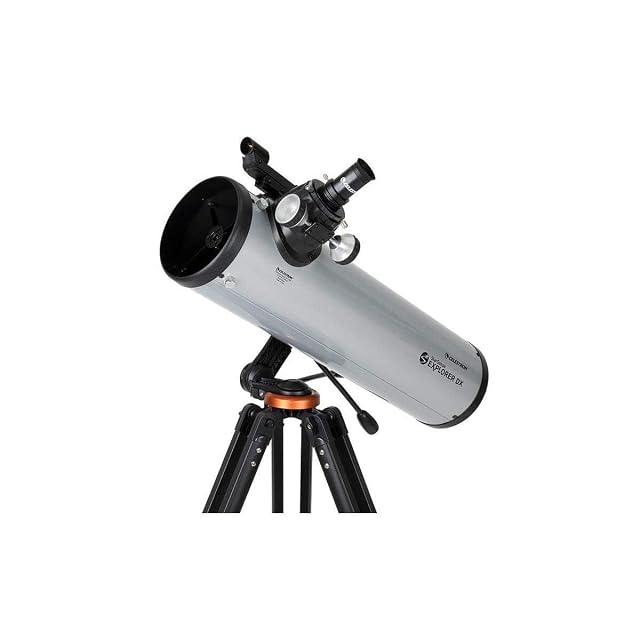
A 130 mm Newtonian on a manual alt-azimuth mount whose dock and app read the star field through the phone camera and steer the observer to a target with on-screen arrows.
Best for: A beginner who wants to see things this month rather than learn to star-hop first