Skip to content

Three eyepieces, and why not five

Most eyepiece sets contain duplicates once a Barlow is counted. Three well-spaced focal lengths cover more sky than five badly spaced ones, and the spacing is arithmetic rather than opinion: each should give roughly half the field of the one before.

The spacing rule

Aim for roughly a factor of two between neighbours: something like 25 mm, 12 mm and 6 mm. Closer than that and two eyepieces show the same view; further apart and there is a gap where the seeing would have allowed more magnification.

Where the top end stops

Useful magnification runs out at roughly twice the aperture in millimetres, and the atmosphere usually stops it sooner. An eyepiece that exceeds that on a given telescope is not a higher power — it is the same detail, larger and dimmer.

What a set really contains

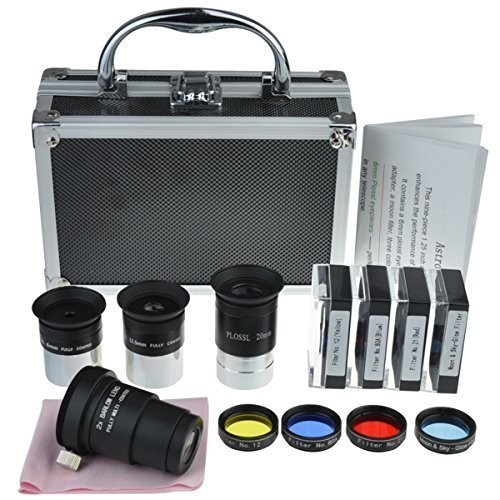
Count the useful focal lengths, not the pieces. A fifteen-piece set whose Barlow duplicates two of its own eyepieces leaves the observer with fewer distinct magnifications than three separate eyepieces would.

Apparent field is the other half

Two eyepieces of the same focal length can show different amounts of sky, because apparent field differs. The true field is apparent field divided by magnification — which is why a 60-degree eyepiece frames noticeably more than a 50-degree one at the same power.

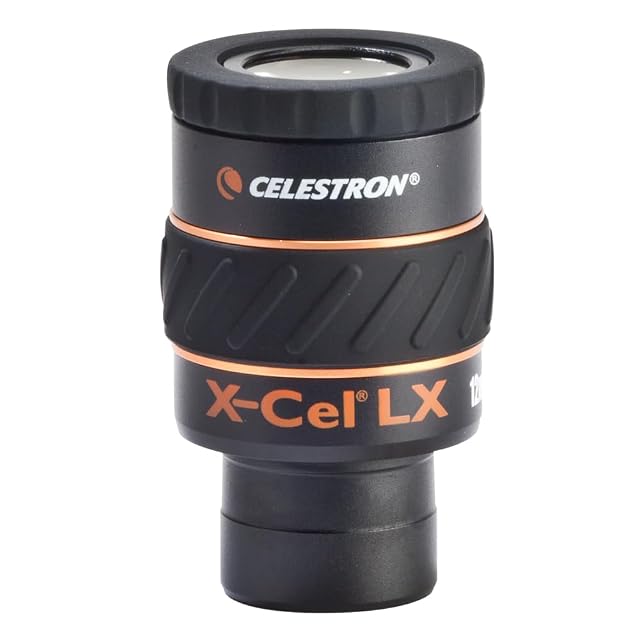
The five, and the reason for the order

What gets asked before buying

How do I work out the magnification?

Telescope focal length divided by eyepiece focal length. A 650 mm telescope with a 25 mm eyepiece gives 26x; with a 10 mm it gives 65x. The telescope’s aperture sets how far up that can usefully go.

Does a Barlow replace an eyepiece?

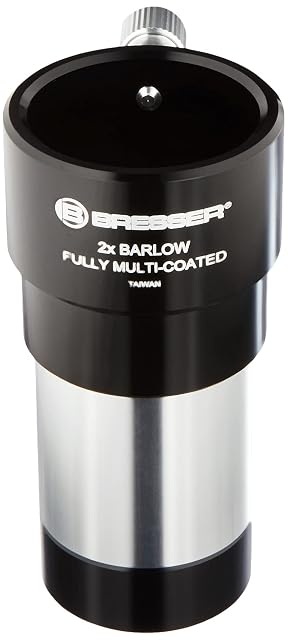
It doubles or triples the magnification of every eyepiece used with it, so a 2x Barlow turns a 25 mm into the equivalent of a 12.5 mm. That is exactly why a set containing both a 25 mm, a 12.5 mm and a 2x Barlow has a duplicate in it.

Is a zoom a substitute for three eyepieces?

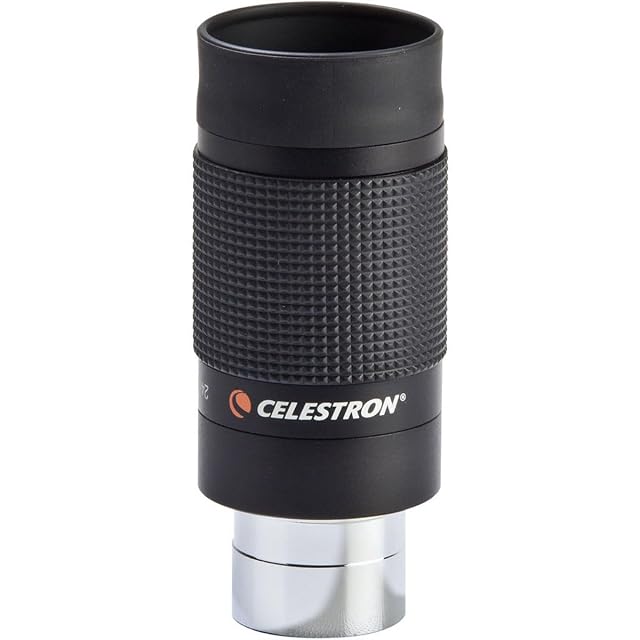
It covers the range with one item and usually gives a narrower apparent field at the long end. For a travel kit that is a good trade; at a fixed observing site it is a compromise.

Any figure written into the body of this page was true on the day it was written. The amount shown next to each instrument is requested from the retailer as the page loads, and it is that amount, not the text, that stands.

The tool we use ourselves

Chosen your instrument? Now do not pay over the odds.

Telescopes and mounts are discounted over and over through the year — hardest of all in the weeks before Christmas, which is exactly when most of them are bought — and a struck-through figure on its own says nothing whatever about what the same model was charged at four weeks ago. UniverTrack keeps a week-by-week record for each retailer, so a discount is measured against a figure somebody genuinely paid instead of one invented for the sale — and it says when the moment to buy has genuinely arrived.

Real price historyBuy-now alertsAI buying assistant
Try free for 14 days →
No commitment · Cancel in one click · 5 languages