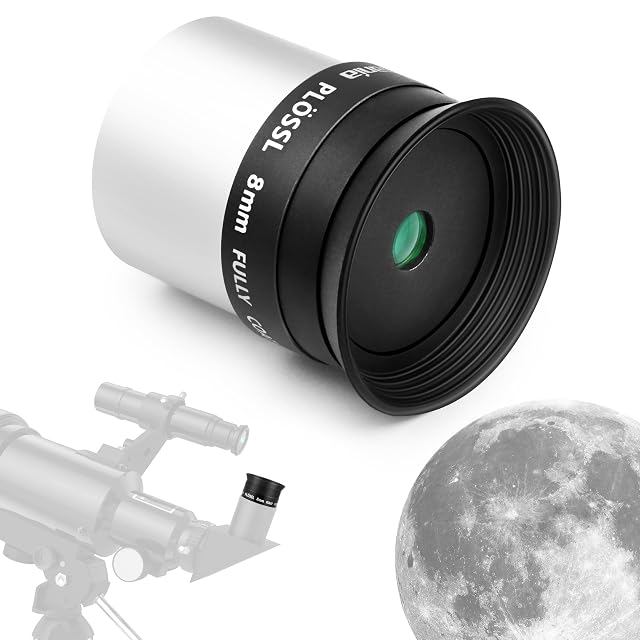
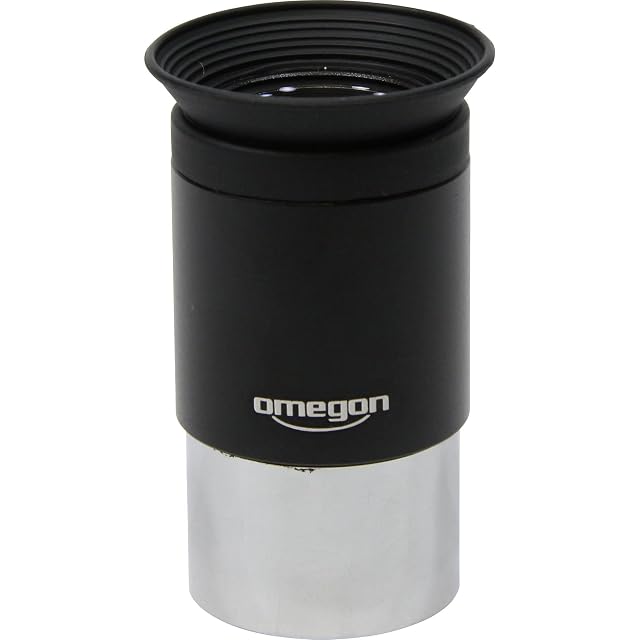
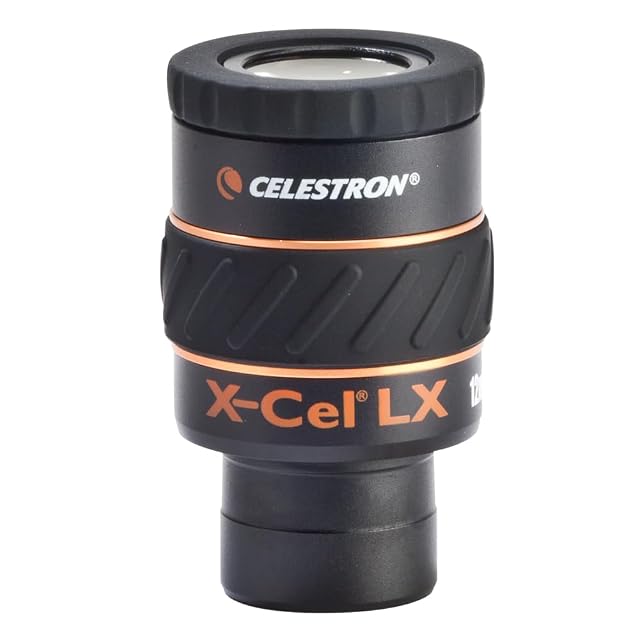
The bottom line The best-documented Plössl on this shelf, missing only the field figure that would complete it.
A specification with numbers in it
Thirty-seven by thirty-seven by forty-five millimetres, sixty-five grams, four elements in two groups, full multi-coating, a 1.25 in barrel with a filter thread. That is a real description, and it is unusual: most eyepiece listings publish a focal length and a barrel size and stop.
What four elements in two groups means
Two cemented pairs. Cementing removes two air-to-glass surfaces compared with four separated elements, which is why the classic Plössl is contrasty. The coating claim then applies to fewer surfaces, each of which matters more.
The one missing figure
Apparent field. It decides how much sky is visible at a given magnification, and it is the number that separates a Plössl from a wide-field design. It does not appear.
Eye relief, claimed not measured
The maker describes a large eye relief and does not quantify it. On a 10 mm Plössl the geometry puts it at a few millimetres, and a fold-back eyecup manages the problem rather than removing it.
Availability
French and Italian Amazon stores ran from 25 € to 28 € on the day of the survey.
American and British Amazon stores list it in local currency, which the euro range above sets aside.
German Amazon store stood above 1.6× the cheapest country. A gap that size normally means stock forwarded from abroad rather than a seller on the ground, so that figure is left out of the range above.
Spanish Amazon store gave no result whatever, so the buy button there opens a search rather than an empty page.
Figures as Keepa reported them on the day this page was last updated. Stock and pricing shift without warning.
Prices quoted in this text were read on 17 September 2026. The live price is at the top of the page.
What it publishes, and what it withholds
Strengths
Dimensions and weight are both published, which almost no eyepiece listing does
Four elements in two groups is stated precisely rather than as “four lenses”
A storage pack is supplied, which keeps the glass clean between sessions
Compromises
The apparent field is never given
The maker claims large eye relief without a figure
A 10 mm Plössl is at the point where eye relief becomes tight whatever the eyecup
Specifications
Focal length
10 mm
Apparent field
The listing does not carry it
Eye relief
Fold-back rubber, described as suitable for spectacle wearers
Barrel size
1.25 in (31.7 mm) with a filter thread
Optical design
Plössl — four elements in two groups, as the maker states it
Coatings
Full multi-coating, as the maker states it
Weight
37 × 37 × 45 mm, as the maker publishes them · 65 g, as the maker publishes it
Supplied accessories
Rubber eyecup and a twist pack for storage
Amazon reference
B06ZZWVKMT (same reference on 5 Amazon marketplaces)
EAN
4007922042183
What observers ask about this one
Why does 65 g matter?
On a small mount, a heavy eyepiece shifts the balance and can make the tube drift. Sixty-five grams is light, and publishing it lets the effect be judged before buying.
What does “four elements in two groups” add over “four lenses”?
It says how they are arranged — two cemented pairs, which is the classic Plössl. That determines the number of air-to-glass surfaces, and therefore how much the coating claim is worth.