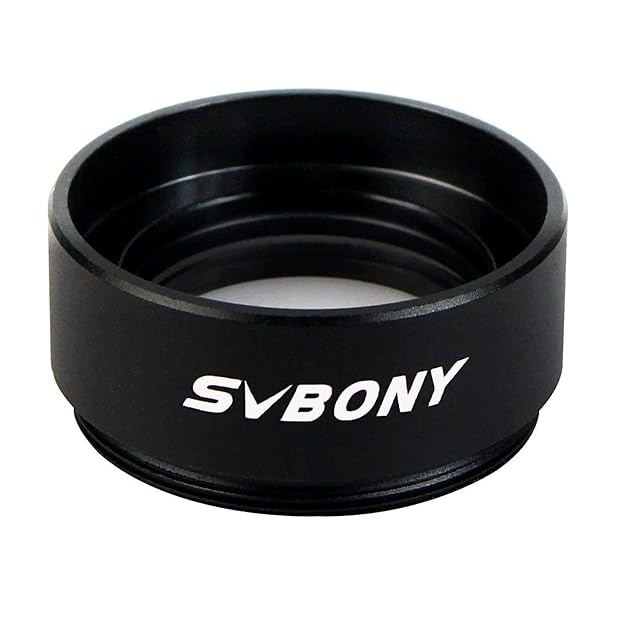
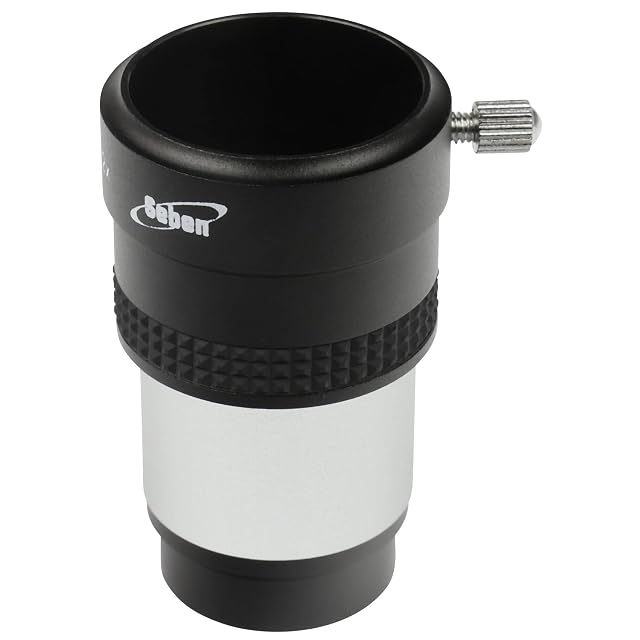
The bottom line The most seriously specified Barlow here, and the longest and heaviest — which a small focuser will notice.
Four elements, and what they buy
Most inexpensive Barlows use two. Four controls the aberrations that a doubled beam introduces at the edge of a wide field, which is what makes a Barlow usable with a wide-field eyepiece rather than only with a Plössl.
The published figures
Eighty millimetres long, 31.8 mm across, 80 g. That length is worth noticing: a Barlow extends the distance from the focuser to the eyepiece, and a telescope with limited focuser travel may not reach focus with a long one fitted.
The photographic note
Doubling the focal length quadruples the exposure needed. The maker raises this, which is more than most Barlow listings do, and it is the arithmetic that decides whether a Barlow belongs in an imaging train at all.
The coating, read exactly
“Fully coated” — one layer on each surface. With four elements there are more surfaces than in a two-element Barlow, so the label carries more weight here than it would elsewhere.
Availability
German, French and Italian Amazon stores ran from 31 € to 41 € on the day of the survey.
American and British Amazon stores list it in local currency, which the euro range above sets aside.
Spanish Amazon catalogue holds a record for it that nobody is selling.
Figures as Keepa reported them on the day this page was last updated. Stock and pricing shift without warning.
Prices quoted in this text were read on 17 September 2026. The live price is at the top of the page.
What it publishes, and what it withholds
Strengths
Four elements is a serious Barlow design, and it is stated outright
Dimensions and weight are both published
The maker names the effect on exposure time for photographic use
Compromises
At 80 mm long it adds real length and 80 g to the focuser
“Fully coated” is one layer per surface, and four elements means eight surfaces
No apparent field or spacing note is given
Specifications
Amplification factor
2x — it doubles the telescope’s effective focal length
Element count
Four elements, fully coated per the maker
Barrel size
1.25 in (31.7 mm)
Camera thread
Not published by the maker.
Effect on eye relief
Not published by the maker.
Coatings
Not published by the maker.
Body
80 × 31.8 mm, as the maker publishes them
Weight
80 g, as the maker publishes it
Amazon reference
DE B00462T81U · US B00462T81U · GB B005I7HT9A · FR B005I7HT9A · IT B005I7HT9A · ES B005I7HT9A
EAN
4007922201078
What observers ask about this one
Why does the element count matter in a Barlow?
A two-element Barlow corrects colour; a four-element design also controls the aberrations that show at the edge of a wide field. The cost is more air-to-glass surfaces, which is where the coating label becomes relevant.
What does it do to exposure time?
Doubling the focal length at the same aperture quadruples the exposure needed for a given brightness. The maker mentions the effect; the arithmetic is the square of the factor.
0.5x focal reducer · 1.25 in · sold under the name “Barlow”
A 0.5x focal reducer in an anodised aluminium 1.25 in barrel, sold under the name “Barlow lens” while its own description correctly calls it a reducer.
Best for: Widening the field on a long-focal-length telescope, or shortening exposures on a camera
114 mm mirror · 900 mm focal length · alt-azimuth mount
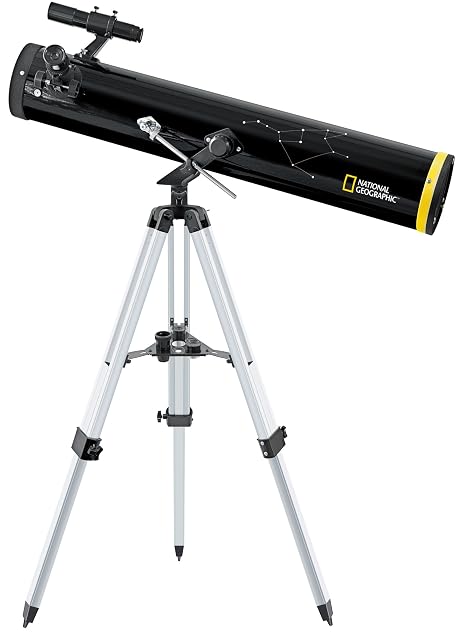
A 114/900 Newtonian on a simple alt-azimuth mount, supplied with three eyepieces, a 6x30 finder and a 1.5x erecting lens, recommended by the maker from age eight.
Best for: A family telescope where nobody wants to learn polar alignment