It multiplies the focal length, and the eye relief survives · review
Astromania 3x with T-thread review
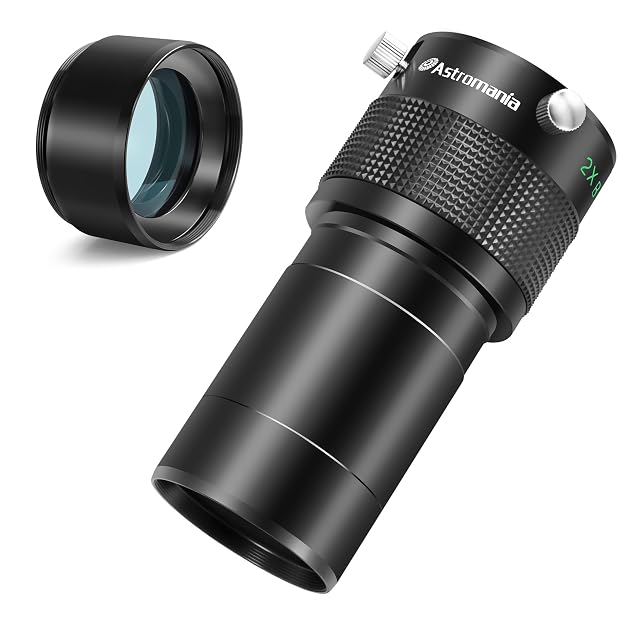
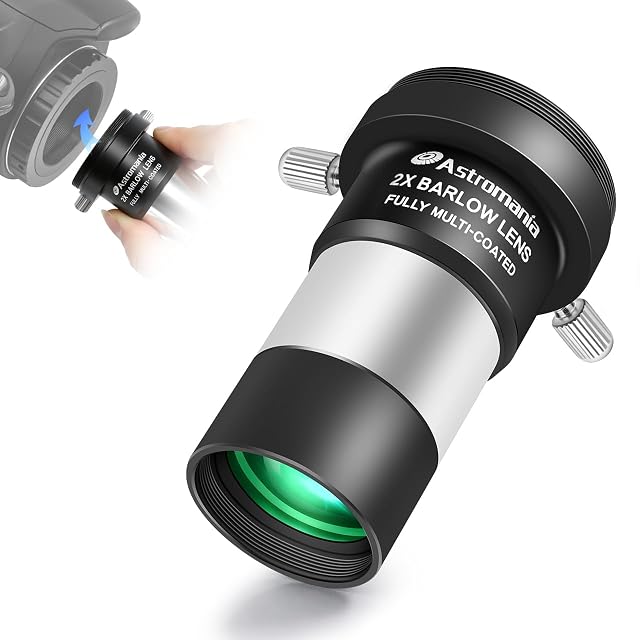
A short 1.25-inch 3x Barlow in CNC-machined aluminum with apochromatic glass, multi-coated optics, a 1.25-inch filter thread and an M42 × 0.75 thread that takes a camera T-ring.
Astromania states the problem plainly: on many telescopes, a camera on a T-adapter cannot reach focus. The sensor sits farther back than an eyepiece would, and the focuser runs out of inward travel. A Barlow pushes the focal point outward, and the camera reaches it.
This 3x does that job with an M42 × 0.75 male thread at the top, the T-thread every camera T-ring screws onto.
Three times, on which telescope
Triple magnification is a lot. On a 400 or 500 mm focal-length telescope it is just right for planets: a 10 mm eyepiece goes from 40x to 120x. On a 900 or 1000 mm telescope it pushes most eyepieces past what the aperture can resolve.
The Celestron X-Cel LX 3x makes the same point in its listing: 3x is for fast, short telescopes.
The build
All-metal, CNC-machined aluminum, black anodized, with two large locking thumbscrews and a 1.25-inch filter thread. The glass is described as apochromatic and multi-coated; no element count is given.
A copy error
One bullet says the lens “doubles the power” of an eyepiece. That sentence belongs to the 2x version; this is the 3x.
Price and availability
On November 7, 2026, Amazon.com listed it at about $24 from a third-party seller.
Figures as Keepa reported them on the day this page was last updated. Stock and pricing shift without warning.
Prices quoted in this text were read on November 7, 2026. The live price is at the top of the page.
Its two nearest scopes on price
Same aisle, closest price — what the same spend else shows.
M42 × 0.75 thread, so it also works as a T-adapter for a camera
Filter thread and two locking thumbscrews
Inexpensive for a metal 3x
Compromises
Element count not published
3x takes most eyepieces past the useful limit of a small long-focus telescope
One bullet says it doubles power, contradicting the 3x in the title
Specifications
Amplification factor
3x, stated (one bullet says it doubles the eyepiece's power, a copy error from the 2x version)
Element count
Not published by the maker · apochromatic glass stated
Barrel size
1.25 in, for 1.25 in eyepieces from most brands
Camera thread
M42 × 0.75 male thread, takes a DSLR or mirrorless T-ring (sold separately)
Effect on eye relief
Not published by the maker.
Coatings
Multi-coated optics with an antireflective internal finish, stated
Body
All-metal, CNC-machined aluminum, black anodized · two large locking thumbscrews · 1.25 in filter thread
Weight
Not published in the listing text · Amazon's item data gives 115 g (4.1 oz)
Amazon reference
B0140UAEBA
EAN
6970019290386
What observers ask about this one
Is 3x too much?
It depends on the telescope. On a 400 mm focal-length scope, a 10 mm eyepiece gives 40x alone and 120x with this Barlow, a useful planetary power. On a 900 mm scope the same eyepiece goes from 90x to 270x, which a 4-inch aperture cannot use. 3x suits short, fast telescopes.
Why would a camera need a Barlow to focus?
A camera's sensor sits farther back than an eyepiece's focal point. On many telescopes the focuser cannot rack in far enough to bring that sensor to focus. A Barlow moves the focal point outward, which is the problem the listing says this part solves.
What else do I need for a camera?
A T-ring for your camera mount (Canon EF, Nikon F, Sony E and so on). It screws onto the M42 × 0.75 thread at the top of the Barlow.
The price on Amazon.com
This model is listed on Amazon.com, at ≈ $24 at the last reading. Listed is not the same as in stock: availability changes daily, and the buy box shows the live price.
Details checked on November 7, 2026.
This one and its buyer, among astronomy instruments
A short-focus telescope that needs planetary magnification, or a camera that cannot otherwise reach focus
Sources
Specifications: the manufacturer sheet for telescopes and observing optics and the matching Amazon product page. Prices and availability: Keepa. Every figure on this page names its source.
2x Barlow · 1.25 in · apochromatic glass · M42 × 0.75 male thread · 1.25 in filter thread
A short 1.25-inch 2x Barlow in CNC-machined aluminum with apochromatic glass, multi-coating, a filter thread and an M42 × 0.75 thread for a camera T-ring.
Best for: A first Barlow that will also carry a camera, on a telescope that struggles to reach focus
2x Barlow · 1.25 in (31.8 mm) · two-lens design · for observing and photography
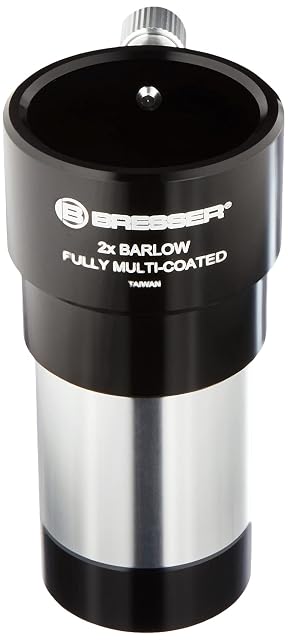
Bresser's 2x Barlow in a 1.25-inch (31.8 mm) barrel, described on Amazon.com as a two-lens design for observing and photography, with a black lens cell and silver barrel.
Best for: An owner of Bresser eyepieces who wants a matching 2x and accepts a thin specification