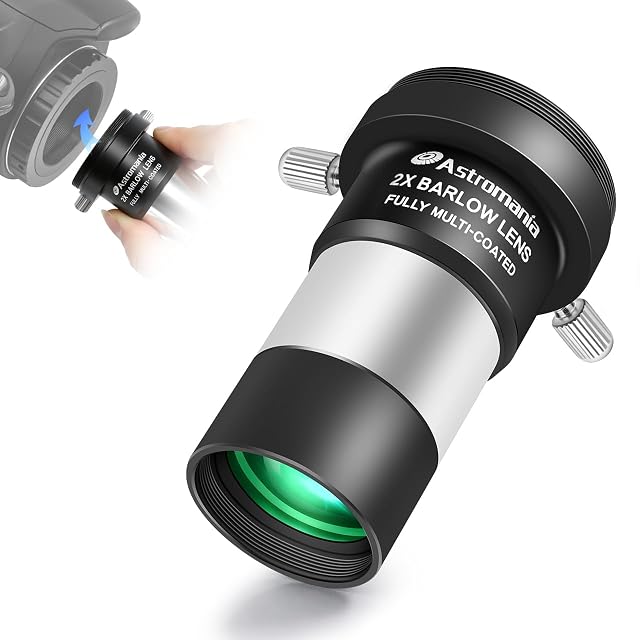
A Barlow sits between the focuser and the eyepiece and doubles the telescope’s focal length. A 1.25-inch Barlow only takes 1.25-inch eyepieces. Owners of 2-inch focusers who buy wide-field 2-inch eyepieces need a 2-inch Barlow, and this is one.
An adapter from 2 to 1.25 inch is in the box, so smaller eyepieces can be doubled too.
ED glass, named but not detailed
Astromania states ED (extra-low-dispersion) glass and multi-coating on all lens surfaces. ED glass keeps the colors focused together, which shows as less purple fringe on the Moon’s limb and bright planets. The listing does not give the element count or the glass type.
A filter thread on the barrel
The lower barrel and the adapter both carry a 2-inch filter thread. A Moon, UHC or O-III filter screwed there filters every eyepiece placed in the Barlow, instead of being moved from one eyepiece to the next.
For cameras
The listing pitches it for planetary imaging, where extra focal length makes small planets larger on the sensor, and says it shows no shadowing on small camera chips.
What to check
Amazon’s item data gives 325 g (11.5 oz). On a light single-speed focuser with a heavy 2-inch eyepiece in it, that load is noticeable.
Price and availability
On November 7, 2026, Amazon.com listed it at about $63 from a third-party seller.
Figures as Keepa reported them on the day this page was last updated. Stock and pricing shift without warning.
Prices quoted in this text were read on November 7, 2026. The live price is at the top of the page.
Its two nearest scopes on price
Same aisle, closest price — what the same spend else shows.
Takes 2-inch eyepieces, and 1.25-inch ones through the included adapter
ED glass and multi-coating, both stated
2-inch filter thread on the barrel, so one filter serves every eyepiece
Compromises
Element count and length not published
Needs a 2-inch focuser or diagonal
Heavier than a 1.25-inch Barlow, which a light focuser feels
Specifications
Amplification factor
2x, stated
Element count
Not published by the maker · ED glass stated
Barrel size
2 in · a 2-to-1.25-inch adapter is included so 1.25 in eyepieces can be used as well
Camera thread
Not published by the maker.
Effect on eye relief
Not published by the maker.
Coatings
All lens surfaces multi-coated, stated
Body
Textured high-grip exterior stated usable with gloves · 2 in filter thread on the lower barrel and on the adapter
Weight
Not published in the listing text · Amazon's item data gives 325 g (11.5 oz)
Amazon reference
B0140UAHM6
EAN
6970019290409
What observers ask about this one
Do I need a 2-inch Barlow?
Only if your telescope has a 2-inch focuser and you use, or plan to use, 2-inch eyepieces. A 1.25-inch Barlow cannot take them. With the included adapter, this one also doubles 1.25-inch eyepieces.
What does ED glass do in a Barlow?
Extra-low-dispersion glass bends colors more evenly, so the Barlow adds less false color around bright planets and the Moon's limb. Astromania states ED glass without naming the type or the number of elements.
Will a camera vignette with it?
Astromania says no shadowing is visible on small camera sensors, which is what a planetary camera uses. A large sensor needs testing.
The price on Amazon.com
This model is listed on Amazon.com, at ≈ $63 at the last reading. Listed is not the same as in stock: availability changes daily, and the buy box shows the live price.
Details checked on November 7, 2026.
This one and its buyer, among astronomy instruments
A 2-inch focuser and wide-field 2-inch eyepieces that no 1.25-inch Barlow can take
Sources
Specifications: the manufacturer sheet for telescopes and observing optics and the matching Amazon product page. Prices and availability: Keepa. Every figure on this page names its source.
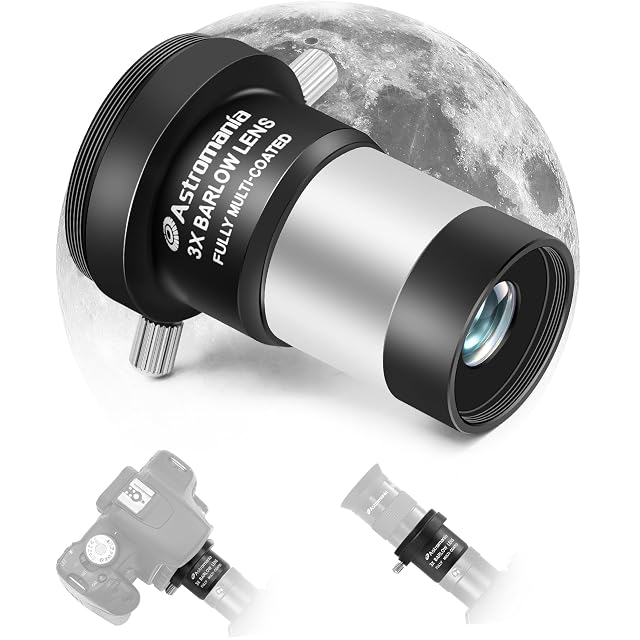
3x Barlow · 1.25 in · apochromatic glass · M42 × 0.75 male thread · 1.25 in filter thread
A short 1.25-inch 3x Barlow in CNC-machined aluminum with apochromatic glass, multi-coated optics, a 1.25-inch filter thread and an M42 × 0.75 thread that takes a camera T-ring.
Best for: A short-focus telescope that needs planetary magnification, or a camera that cannot otherwise reach focus
2x Barlow · 1.25 in · apochromatic glass · M42 × 0.75 male thread · 1.25 in filter thread
A short 1.25-inch 2x Barlow in CNC-machined aluminum with apochromatic glass, multi-coating, a filter thread and an M42 × 0.75 thread for a camera T-ring.
Best for: A first Barlow that will also carry a camera, on a telescope that struggles to reach focus
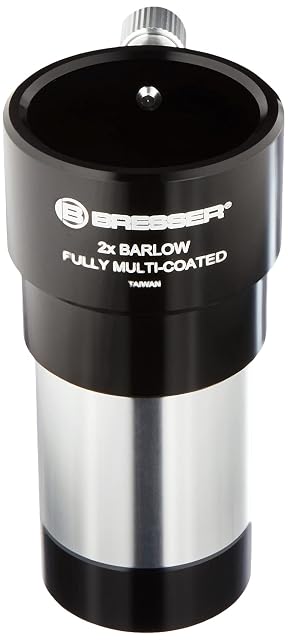
2x Barlow · 1.25 in (31.8 mm) · two-lens design · for observing and photography
Bresser's 2x Barlow in a 1.25-inch (31.8 mm) barrel, described on Amazon.com as a two-lens design for observing and photography, with a black lens cell and silver barrel.
Best for: An owner of Bresser eyepieces who wants a matching 2x and accepts a thin specification