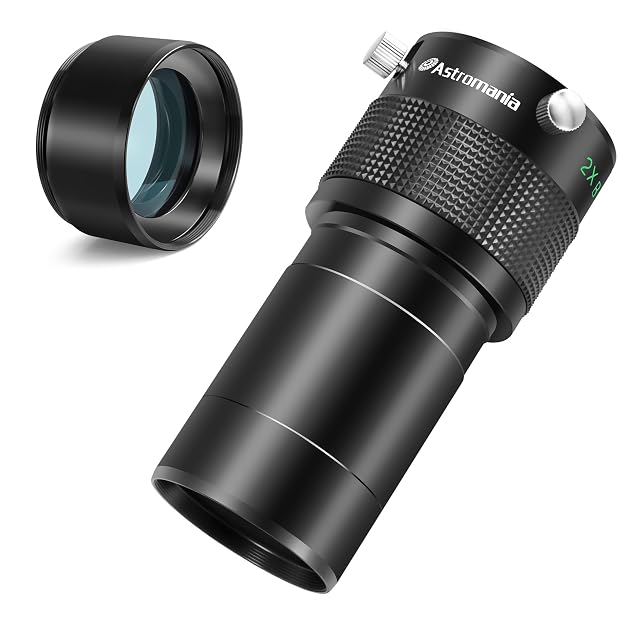
The title says 5x. The second bullet says: “5x Barlow lens has a magnification of 2.5 times in the actual measurement.” The first bullet agrees, saying it expands eyepiece magnification to 2.5 times.
The maker contradicts its product name in its own listing, and the lower figure is the one it measured. Treat it as a 2.5x Barlow.
What 2.5x means on a small telescope
On a 700 mm refractor, a 10 mm eyepiece gives 70x alone and 175x with this Barlow. On a 400 mm travel scope, 40x becomes 100x. Both are usable powers. At a true 5x, the first would be 350x, beyond what a small telescope can show.
The Moon filter
The bundle includes a Moon filter in a CNC-machined frame. A first-quarter or full Moon is dazzling in any telescope; the filter dims it so detail is easier to read. Many first telescopes ship without one.
M42, without a pitch
The listing gives an M42 thread for connecting a camera with a T-ring, but not its pitch. Standard T-rings are M42 × 0.75; check before ordering a T-ring.
What is absent
No coatings, element count or length. Amazon’s item data gives 90 g (3.2 oz).
Price and availability
On November 7, 2026, Amazon.com listed it at about $22 from a third-party seller.
Figures as Keepa reported them on the day this page was last updated. Stock and pricing shift without warning.
Prices quoted in this text were read on November 7, 2026. The live price is at the top of the page.
Its two nearest scopes on price
Same aisle, closest price — what the same spend else shows.
Moon filter included, which a first telescope needs
M42 thread for a camera
The maker states the real 2.5x factor rather than hiding it
Compromises
The 5x in the name is not the factor; the listing says 2.5x
No coatings or element count published
Thread pitch not stated
Specifications
Amplification factor
5x in the title · 2.5x "in the actual measurement", stated in the maker's own bullet
Element count
Not published by the maker.
Barrel size
1.25 in, stated to work with Celestron, Sky-Watcher, Meade, Orion and most brands
Camera thread
M42 thread (pitch not published) for a camera T-ring
Effect on eye relief
Not published by the maker.
Coatings
Not published by the maker.
Body
CNC-machined frames for the Barlow and the Moon filter, with an anti-rust surface treatment
Weight
Not published in the listing text · Amazon's item data gives 90 g (3.2 oz)
Amazon reference
B08GKM1FYJ
EAN
0753326757256
What observers ask about this one
Is it 5x or 2.5x?
2.5x. Starboosa's second bullet says the 5x Barlow "has a magnification of 2.5 times in the actual measurement", and the first bullet says it expands eyepiece magnification 2.5 times. Plan on 2.5x.
What is the Moon filter for?
A full Moon in even a small telescope is bright enough to be uncomfortable. A Moon filter screws into the eyepiece and dims the view so craters and maria are easier to study.
Will it work with my telescope?
Any telescope that takes 1.25-inch eyepieces. The listing names Celestron, Sky-Watcher, Meade and Orion.
The price on Amazon.com
This model is listed on Amazon.com, at ≈ $22 at the last reading. Listed is not the same as in stock: availability changes daily, and the buy box shows the live price.
Details checked on November 7, 2026.
This one and its buyer, among astronomy instruments
A first telescope that needs a Moon filter anyway, bought knowing the factor is 2.5x
What buyers actually choose
Amazon reports what buyers took in the month before this page was last checked: at least 50.
The figure is a floor, rounded by Amazon, and read through Keepa — it says what buyers picked, not what a maker claims.
Sources
Specifications: the manufacturer sheet for telescopes and observing optics and the matching Amazon product page. Prices and availability: Keepa. Every figure on this page names its source.
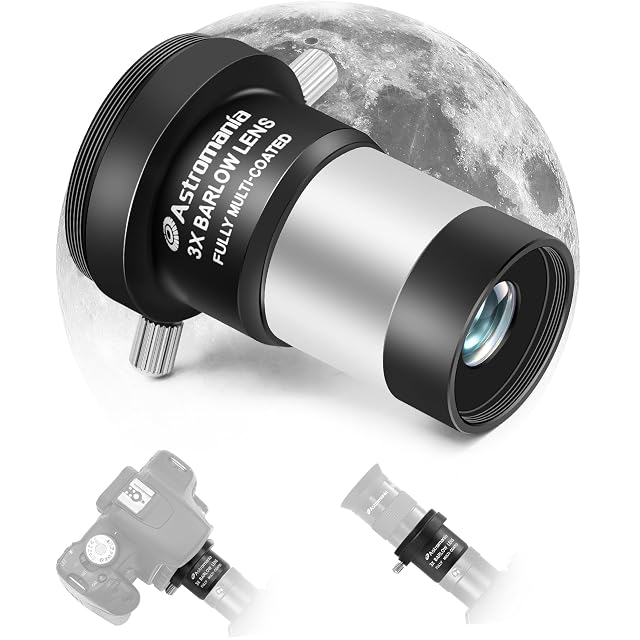
3x Barlow · 1.25 in · apochromatic glass · M42 × 0.75 male thread · 1.25 in filter thread
A short 1.25-inch 3x Barlow in CNC-machined aluminum with apochromatic glass, multi-coated optics, a 1.25-inch filter thread and an M42 × 0.75 thread that takes a camera T-ring.
Best for: A short-focus telescope that needs planetary magnification, or a camera that cannot otherwise reach focus
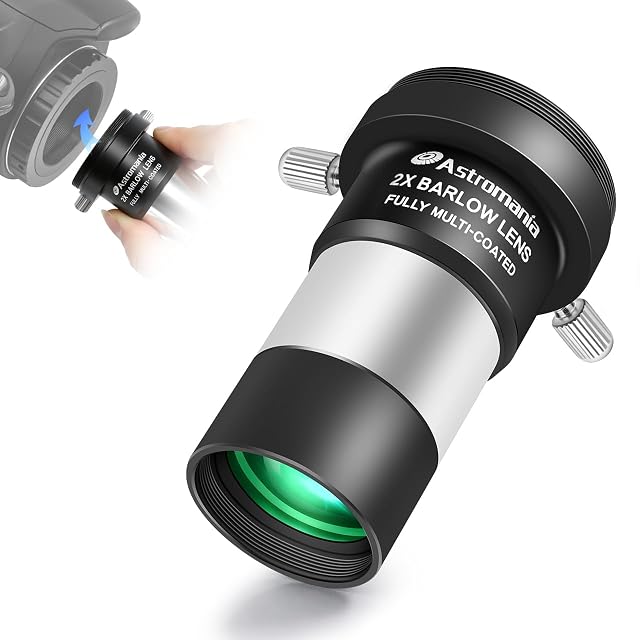
2x Barlow · 1.25 in · apochromatic glass · M42 × 0.75 male thread · 1.25 in filter thread
A short 1.25-inch 2x Barlow in CNC-machined aluminum with apochromatic glass, multi-coating, a filter thread and an M42 × 0.75 thread for a camera T-ring.
Best for: A first Barlow that will also carry a camera, on a telescope that struggles to reach focus