Skip to content

Bresser JUNIOR 70/400 vs Omegon AC 70/700 AZ-2

Same aperture, different focal length — which 70 mm refractor?

These two collect exactly the same amount of light. Everything that separates them follows from the focal length: 400 mm against 700 mm, which is f/5.7 against f/10 on the same 70 mm objective. The short one frames more sky and shows more false colour; the long one frames less and shows less. The eyepiece fitting decides the rest.

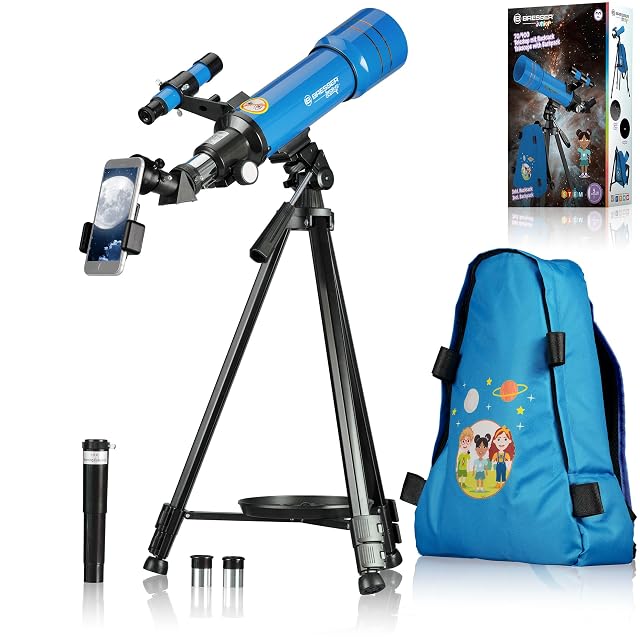
Bresser JUNIOR 70/400 refractor on its tripod with the supplied backpack

Bresser JUNIOR 70/400

Wins 2 of 8

Check price

≈ £78 / €63

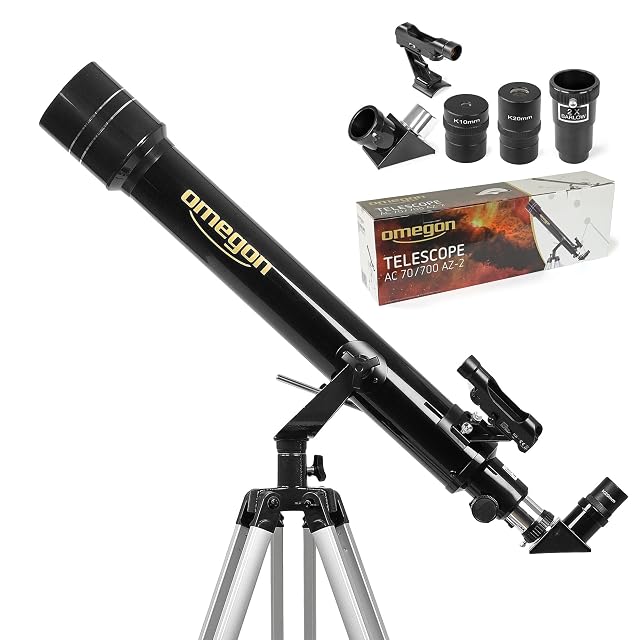
Omegon AC 70/700 achromatic refractor on its AZ-2 alt-azimuth mount

Omegon AC 70/700 AZ-2

Wins 3 of 8

Check price

≈ £94 / €90

Line by line

Compared on JUNIOR 70/400 AC 70/700 AZ-2
Aperture 70 mm (from the title) 70 mm (maker’s bullet)
Focal length 400 mm (from the title) 700 mm (maker’s bullet)
Focal ratio f/5.7, the quotient of the two figures above f/10, the quotient of the two figures above
Lens design Refractor (lens objective) Achromatic refractor
Glass type Not published by the maker. Not published by the maker.
Focuser Not published by the maker. Not published by the maker.
Eyepiece fitting 24.5 mm (0.965 in), stated in the supplied-items list Not published by the maker.
Supplied accessories Backpack, 5x24 finder, star diagonal, 1.5x erecting lens, tripod, phone holder Not published by the maker.

A tick means one listing published something the other did not, or published a better figure. It does not mean the product is better, and the column is not a score out of anything: a maker who says less loses lines here without losing a comparison. The two verdicts below are where the page is settled.

Which one, for whom

Buy the Bresser JUNIOR 70/400

The one that arrives complete. A backpack, three eyepieces, a diagonal and an erecting lens make it usable on the evening it is unpacked, and f/5.7 gives the wide low-power view a beginner actually points at things with. The 24.5 mm eyepiece fitting is the catch: it is not the 1.25 in standard, so nothing else on this site threads into it.

Buy the Omegon AC 70/700 AZ-2

The one that grows. f/10 on a 70 mm achromat is where a two-glass objective is at its best — the violet fringe that an f/5 achromat shows plainly on the Moon is barely there at f/10. It publishes less about what is in the box, and what it does publish is the optical design, which is the part that cannot be changed later.

What observers ask about these two

Does the same aperture mean the same brightness?

For an extended object at the same magnification, yes: both objectives are 70 mm, so both collect the same light. What differs is the magnification each eyepiece gives, because that is set by the focal length.

Why does the eyepiece fitting matter so much?

Because 1.25 in is the standard almost every eyepiece, filter and diagonal on this site uses. A 24.5 mm fitting limits the instrument to what came with it, unless an adapter is found.

Is f/10 always better than f/5.7?

No. f/10 controls colour better on an achromat; f/5.7 gives a wider true field at the same eyepiece. They are different instruments for different jobs, which is why neither verdict here is a ranking.

The full reviews

Any figure written into the body of this page was true on the day it was written. The amount shown next to each instrument is requested from the retailer as the page loads, and it is that amount, not the text, that stands.