A long focal length folded into a short tube · review
Bresser FirstLight 100/1400 Maksutov review
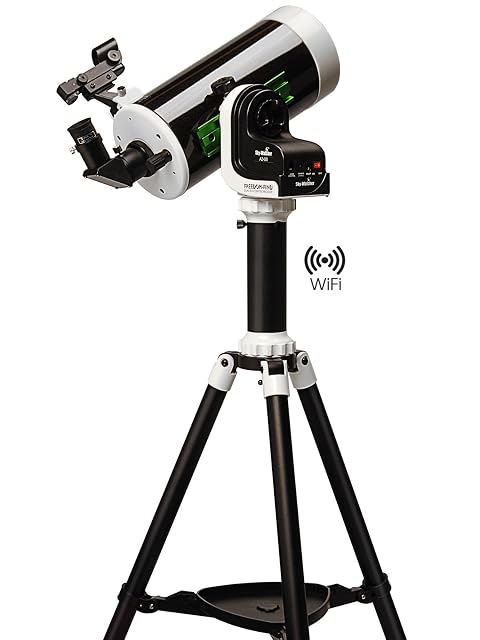
A 100/1400 Maksutov on an EQ3 equatorial mount with slow-motion controls on both axes, supplied with a 25 mm Plössl, an erecting prism and a phone holder.
The bottom line A long-ratio compact optic on a proper equatorial mount, waiting for a second eyepiece to show what it can do.
The longest ratio on this page
One hundred millimetres of aperture and fourteen hundred millimetres of focal length — f/14. Everything follows from that. Magnification comes easily, simple eyepieces work well, the field is narrow, and the instrument is at its best on the Moon, the planets and close double stars.
An equatorial mount with fine control
The EQ3 has slow-motion controls on both axes, which at f/14 is not a luxury: at high magnification the sky crosses the field quickly, and a cable in the hand is far steadier than a push on the tube.
One eyepiece is the gap
A 25 mm Plössl gives 56x. That is a fine finding power and it is nowhere near what this optic will deliver on a good night. A shorter eyepiece — or a Barlow — is the purchase that unlocks the design.
The empty fields in the listing
Dimensions and weight are printed with nothing after them. That is a gap rather than a claim, and the figures do not appear anywhere else in the advertisement.
Availability
German, French, Italian and Spanish Amazon stores ran from 336 € to 391 € on the day of the survey.
British Amazon store lists it in local currency, which the euro range above sets aside.
American Amazon catalogue holds a record for it that nobody is selling.
Figures as Keepa reported them on the day this page was last updated. Stock and pricing shift without warning.
Prices quoted in this text were read on 17 September 2026. The live price is at the top of the page.
What it publishes, and what it withholds
Strengths
f/14 is the longest ratio in this group, and it suits planetary detail
A mirror-based design has no chromatic aberration by construction
The erecting prism makes the same instrument usable for daytime viewing
Compromises
Only one eyepiece is supplied, so the magnification range is a single point out of the box
The listing leaves the dimensions and weight fields empty
At f/14 the field is narrow, and finding objects without a good finder is slow
Specifications
Aperture
100 mm (maker’s bullet)
Folded focal length and ratio
1400 mm (maker’s bullet) · f/14, the quotient of the two figures above
Corrector design
Maksutov-Cassegrain
Obstruction
Not published by the maker.
Back focus
Not published by the maker.
Cool-down guidance
Not published by the maker.
Tube weight
Not published by the maker.
Mount supplied
EQ3 equatorial with slow motion on both axes
Amazon reference
B0967Z38C8 (same reference on 6 Amazon marketplaces)
EAN
4007922071671
What observers ask about this one
What does the single 25 mm eyepiece give?
Fourteen hundred divided by twenty-five is 56x, which is the figure the maker quotes. A second, shorter eyepiece is the obvious first purchase for planetary work.
Why is there no colour fringing?
The image is formed by a mirror, and mirrors reflect all wavelengths to the same focus. The front corrector is a meniscus lens with very little power, so it contributes almost none of the colour error a refractor objective would.
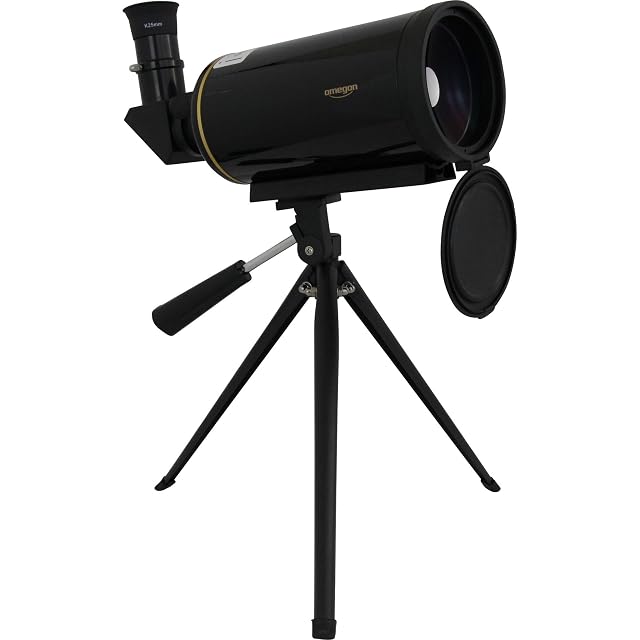
A compact 80 mm Maksutov with a coated front lens, a T-2 thread with buffer ring, a finder shoe and a GP dovetail that fits photo tripods and standard mounts.
Best for: A travel optic that doubles as a long lens on a photo tripod