A long focal length folded into a short tube · review
Sarblue Mak70 (MAK) review
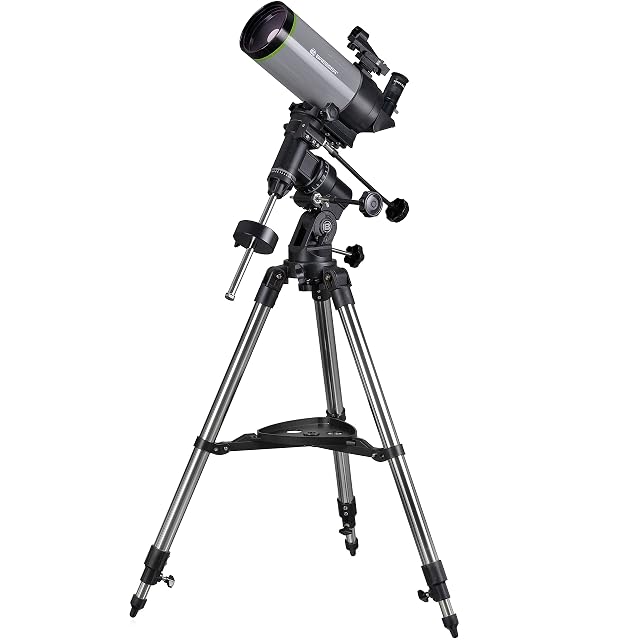
Sarblue's Mak70: a 70 mm Maksutov-Cassegrain with 1000 mm of focal length in a 210 mm aluminum tube, on a slow-motion tripod adjustable from 23 to 56 inches, with 20 mm and 10 mm eyepieces.
Seventy millimeters of aperture and 1000 mm of focal length make f/14.3, a long focal ratio. Long ratios keep simple eyepieces sharp, hide false color, and give high power without very short eyepieces: the supplied 10 mm already gives 100x.
A 210 mm tube
The Maksutov design folds that meter of focal length into a 210 mm aluminum tube, small enough for a backpack. Sarblue describes the coating as high reflectivity and not easy to oxidize.
Twenty-three inches to fifty-six
The tripod adjusts from 23 to 56 inches, from tabletop height to standing height, and has slow-motion control. Sarblue also notes that the tube fits a field tripod with a 3/8 in or 1/4-20 post.
Fifty and a hundred
The kit has two eyepieces: 20 mm (50x) and 10 mm (100x). A phone mount with a 1.5x Barlow is included for snapshots of the Moon, and an adjustable 5x24 finder for aiming.
Who it suits
The Moon, planets and double stars from a yard or a campsite. For a smaller and cheaper tabletop kit, see the Sarblue Mak60; for more aperture on a computerized mount, the NexStar 4SE.
Price and availability
On November 7, 2026, Amazon.com listed it at about $180 from a third-party seller.
Figures as Keepa reported them on the day this page was last updated. Stock and pricing shift without warning.
Prices quoted in this text were read on November 7, 2026. The live price is at the top of the page.
Its two nearest scopes on price
Same aisle, closest price — what the same spend else shows.
f/14.3: sharp, high-power views with very little false color
Slow-motion tripod with a published 23 to 56 inch height range
Two eyepieces, 50x and 100x, plus a finder
Compromises
70 mm aperture limits faint objects
5x24 finder is the small kind
No tube weight or cool-down advice
Specifications
Aperture
70 mm (2.76 in), stated
Folded focal length and ratio
1000 mm (39.4 in) · f/14.3, the quotient of the two published figures
Corrector design
Maksutov-Cassegrain · fully multi-coated · high-reflectivity coating stated not to oxidize easily
Obstruction
Not published by the maker.
Back focus
Not published by the maker.
Cool-down guidance
Not published by the maker.
Tube weight
Not published · 210 mm (8.27 in) aluminum alloy tube, stated
Mount supplied
Slow-motion tripod adjustable from 23 to 56 in · 3/8 in or 1/4-20 threaded post for a field tripod · 20 mm eyepiece (50x) · 10 mm eyepiece (100x) · phone mount with 1.5x Barlow · adjustable 5x24 finder
Amazon reference
B0B24QGDYS
EAN
0727380312850
What observers ask about this one
What magnifications do I get?
50x with the 20 mm and 100x with the 10 mm (1000 / eyepiece). A 70 mm aperture can use about 140x on a steady night; the phone mount's 1.5x Barlow takes the 10 mm to 150x for photos of the Moon.
Why does the tripod's slow motion matter?
At 100x a planet crosses the field in under a minute. A slow-motion control keeps it centered with small turns instead of nudges that overshoot.
Can I put it on a photo tripod?
Yes. Sarblue says the tube attaches to a field tripod with a 3/8 in or 1/4-20 threaded post.
The price on Amazon.com
This model is listed on Amazon.com, at ≈ $180 at the last reading. Listed is not the same as in stock: availability changes daily, and the buy box shows the live price.
Details checked on November 7, 2026.
This one and its buyer, among astronomy instruments
Lunar and planetary detail from a tripod that can be raised to standing height
Eyepieces and parts stated to fit
Listed because the eyepiece or part names this scope.
Specifications: the manufacturer sheet for telescopes and observing optics and the matching Amazon product page. Prices and availability: Keepa. Every figure on this page names its source.
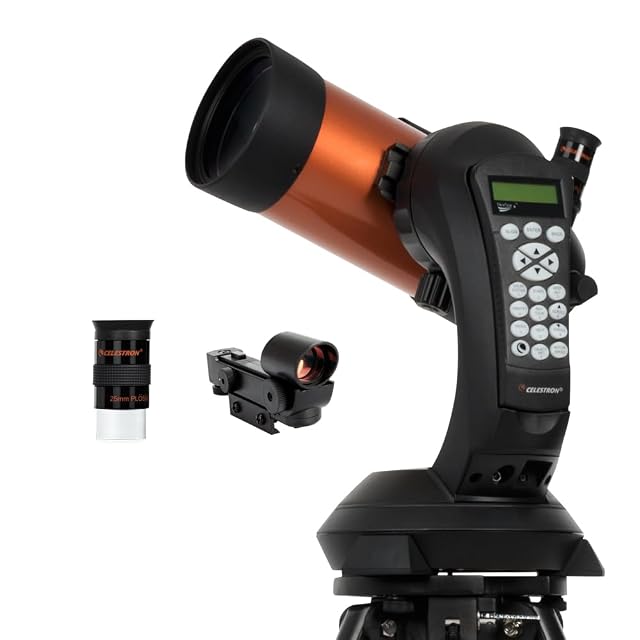
102 mm (4 in) Maksutov-Cassegrain · 1325 mm at f/13 · GoTo fork with built-in wedge · 21 lb with tripod
Celestron's NexStar 4SE: a 4-inch Maksutov-Cassegrain with StarBright XLT coatings on a computerized single-arm GoTo mount whose tripod has a built-in wedge, 21 lb with tripod.
Best for: A first computerized telescope for the Moon and planets that can also take short-exposure photos
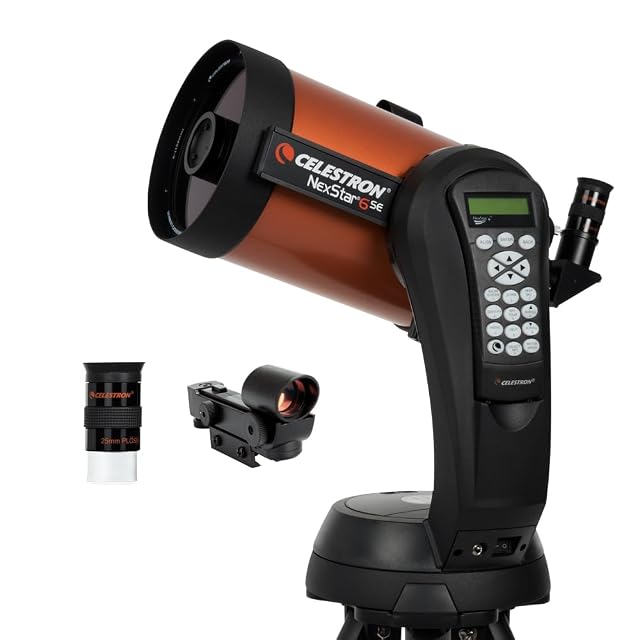
Celestron's NexStar 6SE: a 6-inch Schmidt-Cassegrain on a computerized single-arm GoTo mount with the NexStar+ hand control, a 40,000-object database and SkyAlign.
Best for: Six inches of aperture on a mount that finds things, for an observer who will look rather than photograph