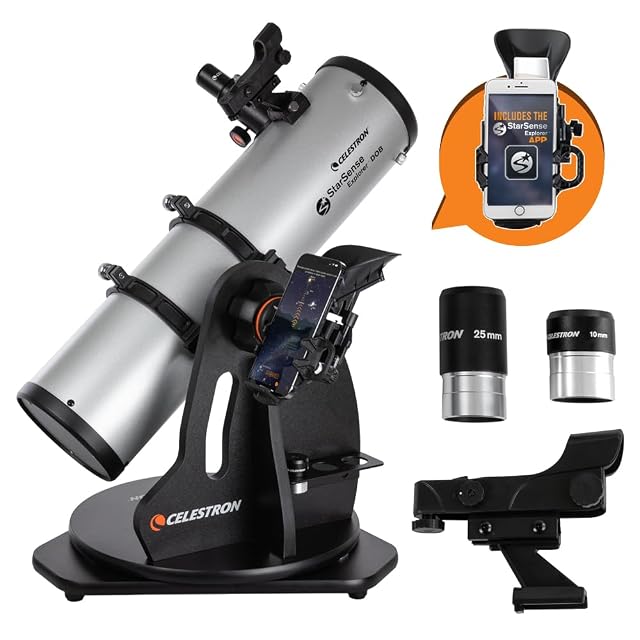
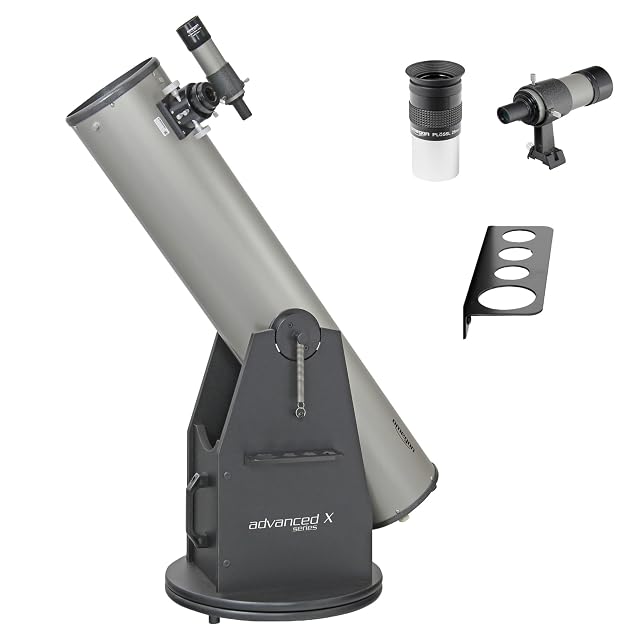
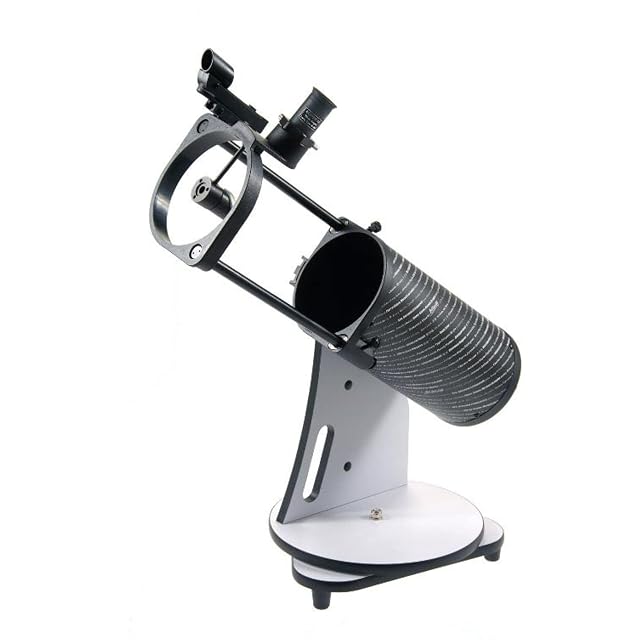
The bottom line The smallest complete instrument here — quick to start, easy to store, and asking a little more of its eyepieces than its price suggests.
A very short, very fast little mirror
Seventy-six millimetres of aperture and three hundred and fifty of focal length: f/4.6. Short tubes of this kind frame wide and store easily, and they also ask more of both eyepieces and collimation than a slow instrument does. At this aperture the practical ceiling is modest anyway.
Assembled before it arrives
The maker states that the azimuth base comes pre-assembled. For a first telescope that is worth more than another accessory: the gap between opening a box and looking at the Moon is the gap where enthusiasm is lost.
What the supplied set covers
Two eyepieces, a Barlow and a Moon filter. Together the maker quotes 18x to 117x, which is four combinations of the supplied glass. The Moon filter has no transmission figure attached, which is the norm on this shelf and worth noticing all the same.
A note on the name
The title carries National Geographic branding; the marketplace brand field reads Bresser. Both refer to the same product, and this page uses the name printed on the telescope.
Availability
French and Italian Amazon stores ran from 142 € to 170 € on the day of the survey.
British Amazon store lists it in local currency, which the euro range above sets aside.
German, American and Spanish Amazon catalogues hold a record for it that nobody is selling.
Figures as Keepa reported them on the day this page was last updated. Stock and pricing shift without warning.
Prices quoted in this text were read on 17 September 2026. The live price is at the top of the page.
What it publishes, and what it withholds
Strengths
Pre-assembled base means the first night starts within minutes of opening the box
At 350 mm long it stores on a shelf rather than in a corner
A Barlow and two eyepieces cover four magnifications from the start
Compromises
f/4.6 on a small mirror is demanding of eyepieces and of collimation
The tabletop base needs a firm surface at the right height
No transmission figure is published for the Moon filter
Specifications
Aperture
76 mm (maker’s bullet)
Focal length and ratio
350 mm (maker’s bullet) · f/4.6, the quotient of the two figures above
Base
Not published by the maker.
Bearing design
Not published by the maker.
Tube construction
Newtonian reflector on a tabletop Dobsonian base
Heaviest single part
Not published by the maker.
Eyepiece height
Pre-assembled azimuth base, per the maker
Amazon reference
B007WRYAUK (same reference on 6 Amazon marketplaces)
EAN
4007922201641
What observers ask about this one
Why does the brand differ from the seller?
The title carries National Geographic branding while the marketplace brand field reads Bresser. This page uses the name printed on the product, which is how a buyer will recognise it.
Where do 18x and 117x come from?
From 350 mm divided by the supplied eyepieces, with the Barlow applied. They describe the eyepieces, and the two figures that describe this telescope are its aperture and focal length.