The bottom line The brightest monocular in this group by its own arithmetic, and the one that publishes the figures to prove it.
Fifty-five millimetres is the differentiator
Every other 12x monocular here uses a 50 mm or 52 mm objective. Fifty-five gives a 4.6 mm exit pupil — closer to what a dark-adapted eye can use, and brighter at dusk where these instruments earn their keep.
The figures the maker publishes
Field of view at 352 feet per 1000 yards. Prism size at 20 mm. Sealing at IPX7 with a nitrogen filling. Coating as fully multi-coated. That is four real specifications, and the prism figure in particular almost never appears on this shelf.
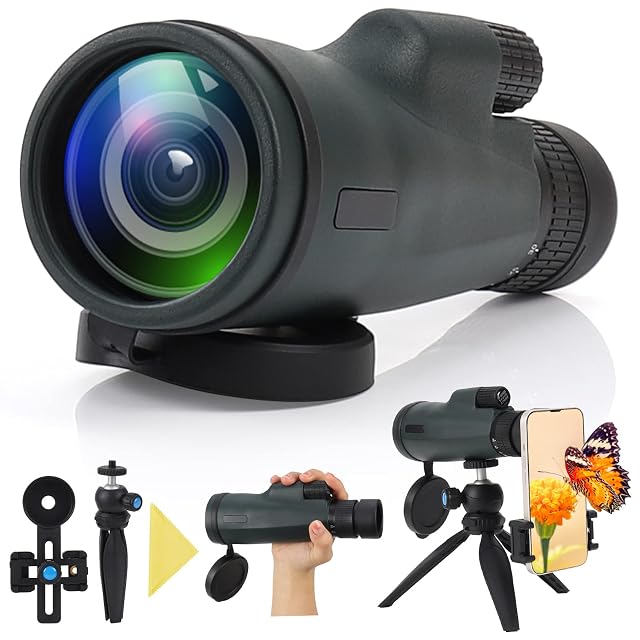
What the phone adapter does and does not do
It holds a phone in line with the eyepiece so the camera sees what the eye would. What it cannot do is remove the shake: at twelve times, a hand-held monocular with a phone hanging off it is less steady, not more. A rest of some kind is the accompanying requirement.
Where the rating stops short
IPX7 leaves the dust digit unstated. For a monocular that lives in a coat pocket alongside keys and grit, that is worth knowing — and it is a distinction the listing itself makes clearly enough to be read.
Availability
German, French, Italian and Spanish Amazon stores ran from 90 € to 120 € on the day of the survey.
American and British Amazon stores list it in local currency, which the euro range above sets aside.
Figures as Keepa reported them on the day this page was last updated. Stock and pricing shift without warning.
Prices quoted in this text were read on 17 September 2026. The live price is at the top of the page.
What it publishes, and what it withholds
Strengths
A 55 mm objective gives the largest exit pupil of any 12x monocular here
Field of view is published as a figure rather than described
The prism size is stated, which is rare and relevant to brightness
Compromises
IPX7 covers immersion but says nothing about dust, unlike IP68
No weight is published, and 55 mm of objective is not a small instrument
The phone holder helps framing and does nothing for the shake at 12x
Specifications
Aperture
55 mm
Magnification
12x, fixed by the design
Exit pupil
4.6 mm — 55 divided by 12
True field of view
352 ft at 1000 yd, as the maker publishes it
Close focus
Not published by the maker.
Prism
20 mm BAK-4, per the maker
Coatings
Fully multi-coated
Sealing
IPX7, nitrogen-filled per the maker
Weight
Not published by the maker.
Phone adapter fit
Not published by the maker.
Supplied accessories
Smartphone holder, hand strap
Amazon reference
B07B8XTS3Z (same reference on 6 Amazon marketplaces)
EAN
0607994607040
What observers ask about this one
What is 352 feet at 1000 yards in degrees?
A little over six and a half degrees — a wide field for 12x, and wide enough to sweep with. Publishing the figure at all puts this listing ahead of most of its neighbours.
How does IPX7 differ from IP68?
The X means no dust rating is stated. The 7 covers temporary immersion. IP68 claims both dust-tightness and continuous immersion to a stated depth.