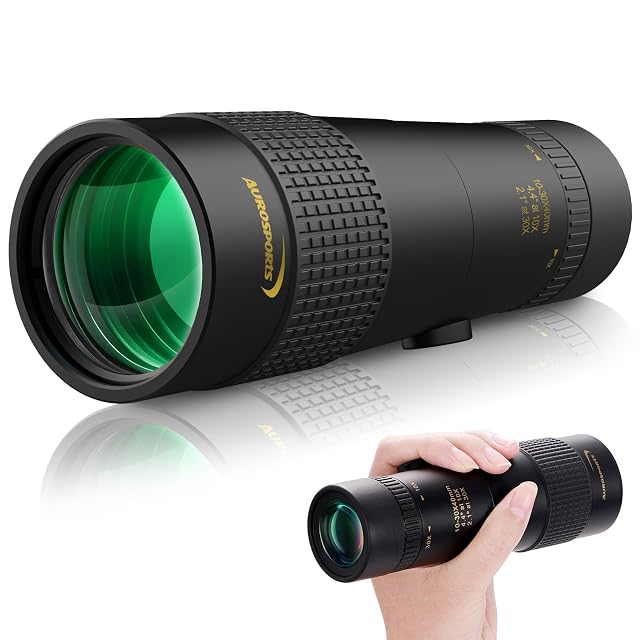
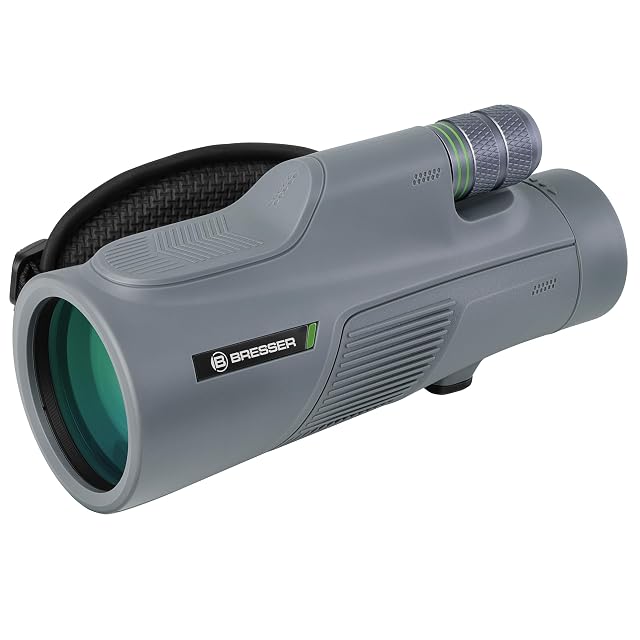
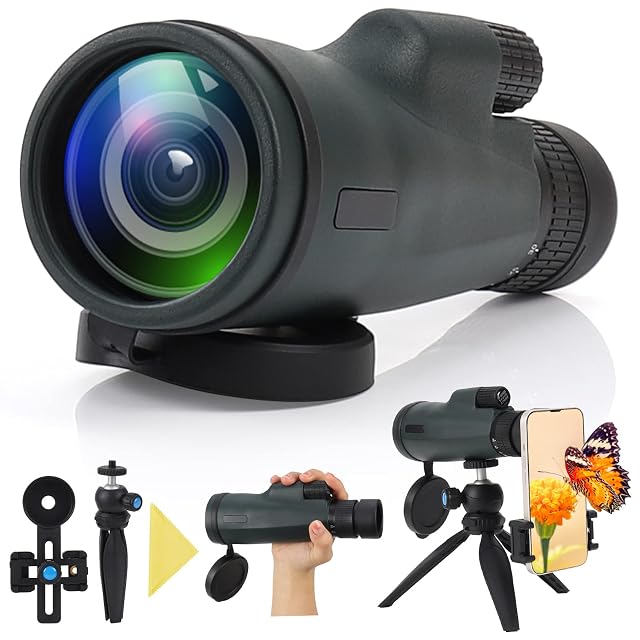
The bottom line A long-reaching pocket monocular whose exit pupil and steadiness both argue for daytime use.
The two numbers and what follows
Sixteen times magnification on a 52 mm objective. Dividing gives a 3.3 mm exit pupil, which is comfortably matched to a daylight pupil and narrow for a dark-adapted one. That single figure places this instrument: it is built for distance in daylight rather than for faint objects at night.
What is nailed down
BAK-4 prisms, which give a round exit pupil. A nitrogen filling with a sealed body, which prevents the internal fogging that ends an unsealed instrument on the first cold evening. Both are real claims.
The claim with no band behind it
Transmission of up to 99.8 %, with no waveband attached. Coating performance varies across the spectrum, and a single percentage without a band cannot be compared with anything. It is reported here because the maker publishes it.
Holding sixteen times still
This is the practical limit of the instrument. Braced against something solid, 16x shows detail that 10x does not; free-hand, the image moves enough to hide it. That is arithmetic rather than a criticism, and it applies to every monocular of this magnification.
Availability
German and French Amazon stores ran from 21 € to 32 € on the day of the survey.
American and British Amazon stores list it in local currency, which the euro range above sets aside.
Italian and Spanish Amazon stores stood above 1.6× the cheapest country. A gap that size normally means stock forwarded from abroad rather than a seller on the ground, so those figures are left out of the range above.
Figures as Keepa reported them on the day this page was last updated. Stock and pricing shift without warning.
Prices quoted in this text were read on 17 September 2026. The live price is at the top of the page.
What it publishes, and what it withholds
Strengths
Sixteen times on a 52 mm objective reaches further than most monoculars of this size
Nitrogen filling is stated, which is what stops internal fogging on a cold night
One-handed operation with a focus wheel and a twist eyecup
Compromises
A 3.3 mm exit pupil is small for a dark-adapted eye
Sixteen times hand-held is difficult to hold steady for long
The 99.8 % transmission claim names no wavelength and cannot be compared
Specifications
Aperture
52 mm
Magnification
16x, fixed by the design
Exit pupil
3.3 mm — 52 divided by 16
True field of view
Described, never quantified
Close focus
Not published by the maker.
Prism
BAK-4, per the maker
Coatings
SMC — the maker’s super multi-coating name · Up to 99.8 %, as the maker states it; no wavelength is given
Sealing
Nitrogen-filled, waterproof and anti-fogging per the maker
Weight
Not published by the maker.
Phone adapter fit
Not published by the maker.
Supplied accessories
Not published by the maker.
Amazon reference
B08FMM86JN (same reference on 6 Amazon marketplaces)
EAN
0754469219403
What observers ask about this one
Is 16x usable hand-held?
Briefly. Every tremor is magnified sixteen times, so bracing against a post or a wall changes what is visible more than any specification here does. A tripod thread would help; the listing does not mention one.
Does a monocular work for astronomy?
It works, and two eyes see more than one. A monocular earns its place by being pocketable — it is the instrument that is present, not the one that shows most.