Skip to content

Astromania UHC 1.25 in (UF1E) review

A UHC filter that explains correctly what the category does, names the nebulae it suits, and publishes no wavelength at all.

It explains the category correctly

Light pollution reduction filter, the listing says, and then what that means: transmission reduced selectively at the wavelengths artificial light produces.

That is the mechanism, stated accurately, which more than half of this shelf does not attempt.

It is also as close as the page comes to a specification.

And it says the filter is worth having under a dark sky

The sales argument for a UHC is always city sky glow. This listing makes the other case: useful at light-polluted and dark-sky sites both.

The reason it is not nonsense: a UHC removes the continuum between the emission lines, and some of that continuum is natural airglow rather than streetlights. The gain is smaller away from a city. It is not zero.

One page on either half of this shelf makes that point. This is it.

Orion, the Lagoon, the Swan

Three objects named, and all three are emission nebulae — the class where a UHC actually works.

Galaxies and star clusters radiate across the spectrum, so a filter that removes everything between the lines removes their light along with the sky glow.

Naming the right objects is a form of honesty. It is not a passband.

No wavelength, anywhere

Six filters on this shelf now carry the UHC designation. None publishes its window.

So the choice between them comes down to price and the name on the frame, which is the same position the European half of this shelf was already in.

The Explore Scientific here publishes four lines with their wavelengths, and remains the only page on this shelf to do so.

Premium anti-reflection coatings

A phrase without a count.

The ladder is coated, fully coated, multi-coated, fully multi-coated, and what separates the rungs is whether every face is treated and whether each gets one layer or several.

A filter has two faces. Naming them would have cost one word.

The transparent case

Rigid, and see-through.

That second part matters more than it sounds: a case of identical black pots in the dark is a bag of unknowns, and a filter that can be identified without being opened stays cleaner.

Availability

American Amazon store sat at about $32 on the day of the survey.

Figures as Keepa reported them on the day this page was last updated. Stock and pricing shift without warning.

Prices quoted in this text were read on October 7, 2026. The live price is at the top of the page.
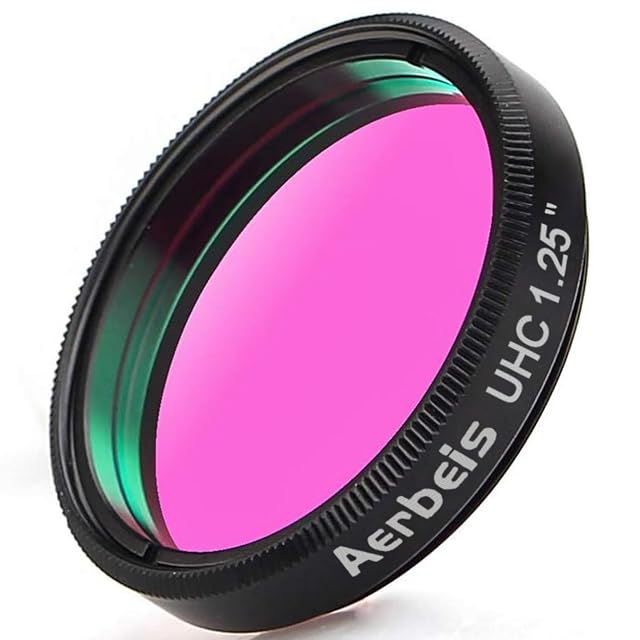
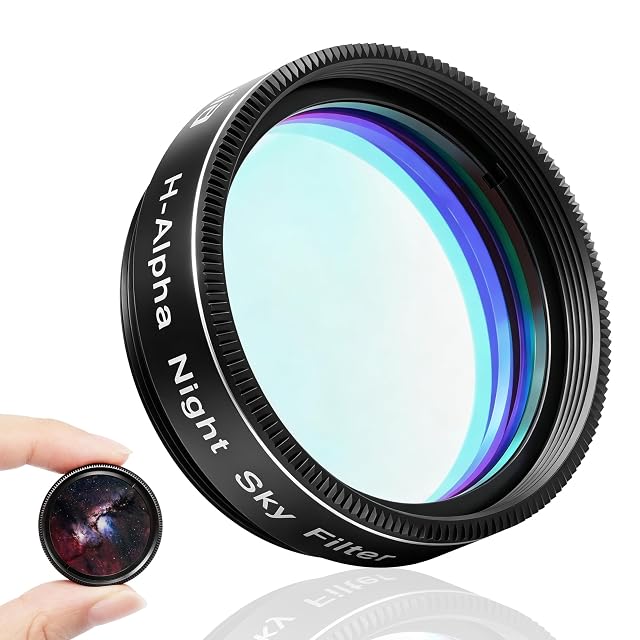
Its two nearest scopes on price

Same aisle, closest price — what the same spend else shows.

What it publishes, and what it withholds

Strengths

  • States the one thing a UHC genuinely does: raise contrast on objects radiating in lines
  • Says it works at dark sites too, which is the part most listings leave out
  • A rigid transparent case, so the filter can be identified without opening it
  • Names Orion, the Lagoon and the Swan — three objects where the effect is real

Compromises

  • No wavelength, window or bandwidth published anywhere
  • “Premium anti-reflection coatings” names neither the layer count nor the faces
  • Claims that many objects first become visible at all with the filter, which no figure supports
  • No glass flatness statement

Specifications

Bandpass and typeUHC — a market convention, not a published standard · Stated also known as a light pollution reduction filter · Stated designed to selectively reduce transmission of certain wavelengths, especially those produced by artificial light · No wavelength is given
Line transmissionNot published by the maker.
Blocking outside the bandNot published by the maker. · Stated to reduce light pollution significantly
Thread size1.25 in, with a standard filter thread stated universally compatible with refractors, reflectors and catadioptric telescopes with a 1.25 in focuser
Glass flatnessNot published by the maker.
CoatingsPremium anti-reflection coatings, as the maker words it · The number of layers and the faces treated are not given · Aluminum, with an optical glass lens, cased in a sturdy transparent case
Amazon referenceB07VCXJ9HN
EAN6971336228786

What observers ask about this one

Does a UHC filter help at a dark site?

This listing says it does, and it is nearly alone on this shelf in saying so. The usual sales argument is city sky glow, and the usual assumption is that a filter is pointless under a dark sky. It is not: a UHC raises contrast by removing the continuum between the emission lines, and some of that continuum is natural airglow rather than streetlights. The gain is smaller than in a city and it is not nothing, and this is the one page on either half of this shelf to make the point plainly.

Do objects really “first become visible at all” with one?

That is the listing’s claim and this page neither confirms nor disputes it. What can be said is what a UHC does mechanically: it passes the hydrogen and oxygen lines and blocks the rest, so an object radiating in lines keeps its light while the background loses most of its own. Whether that crosses the threshold of visibility depends on the sky, the aperture and the eye, and no listing on this shelf publishes a figure that would let the claim be tested.

What would a published passband change?

It would make two UHC filters comparable. Six filters on this shelf carry the designation, and because none publishes a window, the only way to choose between them is price and the maker’s name. The Explore Scientific on the European half publishes four lines with their wavelengths and remains the only page here to do so; the two Celestron oxygen filters publish the 496 and 501 nm pair, which is a different category of filter. For UHC, the number does not exist on this shelf.

The price on Amazon.com

This model is listed on Amazon.com, at ≈ $32 at the last reading. Listed is not the same as in stock: availability changes daily, and the buy box shows the live price.

Details checked on October 7, 2026.

This one and its buyer, among astronomy instruments

An observer in a suburban sky who wants the effect explained before buying, and will take the glass on trust

Sources

Specifications: the manufacturer sheet for telescopes and observing optics and the matching Amazon product page. Prices and availability: Keepa. Every figure on this page names its source.

The way we judge these astronomy instruments