Skip to content

Aerbeis UHC 1.25 in review

A UHC filter whose published features include a first-person account of seeing the Orion nebula — and no wavelength anywhere.

A feature that is a testimony

The sixth of eight published features, in the first person.

That the Orion nebula is visible now where it was not before. That it is very faint. That Betelgeuse is an unexpected favorite, because its color shows so much better.

It reads as a customer review set among the bullets, and it is the only text on this listing that says what looking through the filter is like.

This page prints it as a published feature and takes no position on it. No other page on either half of this shelf carries anything comparable.

M28.5 × 0.6

The thread, named rather than implied.

An inch figure describes the barrel; a thread specification describes what screws together. One and a quarter inches is 31.75 mm (1.25 in), and the thread cut inside it is M28.5 × 0.6.

On a shelf where one listing advertises stacking filters, that is the difference between two of them meeting and two of them not.

A waterproof coating

Claimed here and nowhere else on this shelf.

Filters live in cases and come out into dew. A coating that does not mark when a drop lands on it is a real thing to want, and no figure or test accompanies the claim.

“Uniform layer”, on the same line, does not say how many layers there are or which faces carry them.

Three object classes, named correctly

Emission nebulae, planetary nebulae and supernova remnants.

That is exactly the set a UHC filter helps, because those three radiate in lines rather than across the spectrum. Galaxies and star clusters do not, and a UHC removes their light along with the sky glow.

This listing names the right three. It does not name the lines it passes to do it.

And no window, in nanometers or otherwise

Six filters on this shelf now carry the UHC designation. None publishes its window.

The two that publish wavelengths — 496 and 501 nm — are oxygen narrowband filters, which is the opposite category: a slice rather than a window.

So on both halves of this shelf, UHC remains a name.

Availability

American Amazon store sat at about $23 on the day of the survey.

Figures as Keepa reported them on the day this page was last updated. Stock and pricing shift without warning.

Prices quoted in this text were read on October 7, 2026. The live price is at the top of the page.
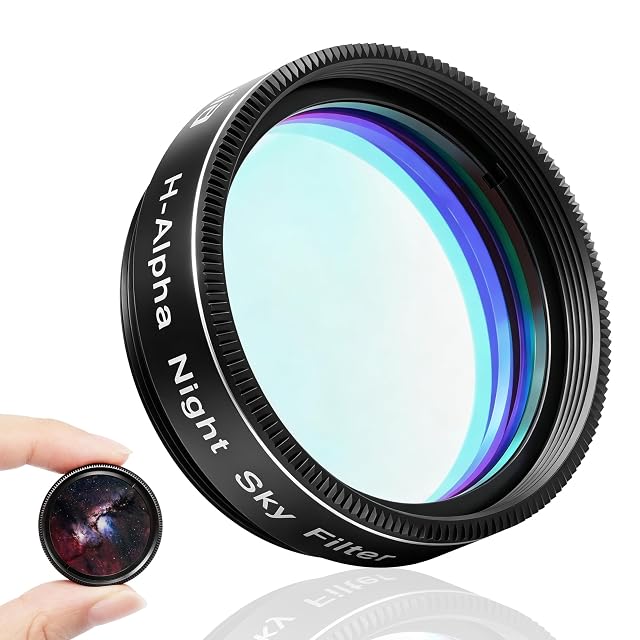
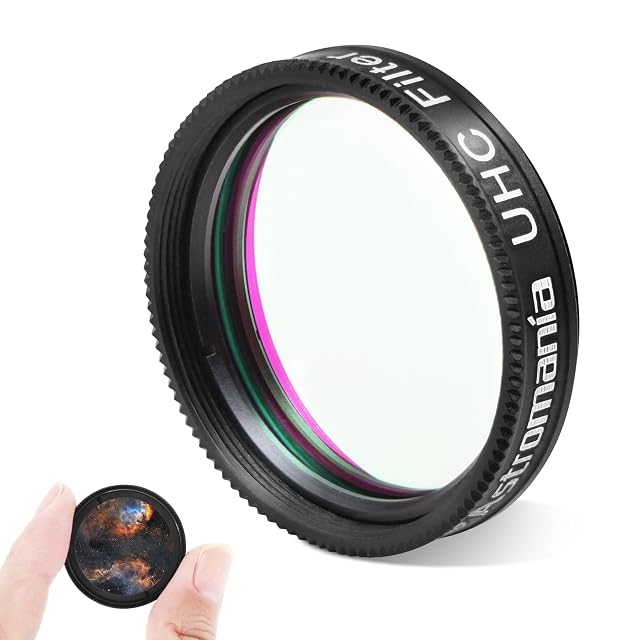
Its two nearest scopes on price

Same aisle, closest price — what the same spend else shows.

What it publishes, and what it withholds

Strengths

  • The thread is named as M28.5 × 0.6 rather than only as an inch figure
  • A waterproof coating is claimed, which no other filter on this shelf mentions
  • Names the three object classes a UHC actually helps: emission nebulae, planetary nebulae and supernova remnants
  • Among the least expensive filters on this shelf

Compromises

  • No wavelength, window or bandwidth published anywhere
  • One published feature is a first-person observing account rather than a specification
  • “High light transmittance” and “uniform layer” carry no figures
  • No glass flatness statement, which matters at high magnification

Specifications

Bandpass and typeUHC — a market convention, not a published standard · No wavelength, window or bandwidth appears anywhere on the listing · Stated to selectively reduce the transmission of certain wavelengths, especially those produced by artificial light
Line transmissionNot published by the maker. · High light transmittance is claimed without a figure
Blocking outside the bandNot published by the maker.
Thread size1.25 in, standard thread named as M28.5 × 0.6 mm (0.20 × 0.02 in), stated compatible with astronomical eyepieces and electronic eyepieces by rotary docking
Glass flatnessNot published by the maker. · High-transparency optical glass is stated
CoatingsA uniform layer, stated, with ultrasonic cleaning and dust removal and a waterproof coating · The number of layers and the faces treated are not given · Aluminum alloy, stated lightweight and durable
Amazon referenceB0D4JV2ZRQ
EAN0764126140643

What observers ask about this one

What is the observing account doing in the specifications?

It is the sixth of eight published features, written in the first person: that the Orion nebula is now visible where it was not before, that it is very faint, and that Betelgeuse is an unexpected favorite because its color shows better. It reads as a customer review placed among the bullets. This page prints it as what it is — a published feature of the listing — and takes no position on it. No other page on either half of this shelf carries anything like it, and it is the only text on this listing that describes what looking through it is like.

Does naming the thread as M28.5 × 0.6 help?

Yes, because an inch figure describes the barrel and a thread specification describes what actually screws together. One and a quarter inches is 31.75 mm (1.25 in); the thread cut inside it is M28.5 × 0.6. Three listings on this shelf name it that way and the rest give only the inch size. On a shelf where filters are stacked — one listing here advertises exactly that — knowing the thread is the difference between two filters meeting and two filters not.

What does UHC guarantee?

Nothing published. It is a market convention describing an intention: a window wide enough to take in several emission lines at once. Six filters on this shelf now carry the designation and not one of them publishes the window. The two filters here that do publish wavelengths in nanometers are both oxygen narrowband filters, which is the opposite category — a narrow slice rather than a wide window. So the designation remains, across both halves of this shelf, a name rather than a specification.

The price on Amazon.com

This model is listed on Amazon.com, at ≈ $23 at the last reading. Listed is not the same as in stock: availability changes daily, and the buy box shows the live price.

Details checked on October 7, 2026.

This one and its buyer, among astronomy instruments

A first nebula filter for a light-polluted sky, bought on price with the specification taken on trust

Sources

Specifications: the manufacturer sheet for telescopes and observing optics and the matching Amazon product page. Prices and availability: Keepa. Every figure on this page names its source.

The way we judge these astronomy instruments