The bottom line The portable half of the 80 mm class: wider framing, easier carrying, and the usual colour cost of a fast achromat.
Eighty millimetres in a short tube
The objective is 80 mm and the focal length 600 mm, which works out at f/7.5. Against the 900 mm refractors on the same shelf, this one frames wider and packs shorter; against them it also asks a little more of its eyepieces, because fast ratios are harder on simple designs.
The supplied pair, named properly
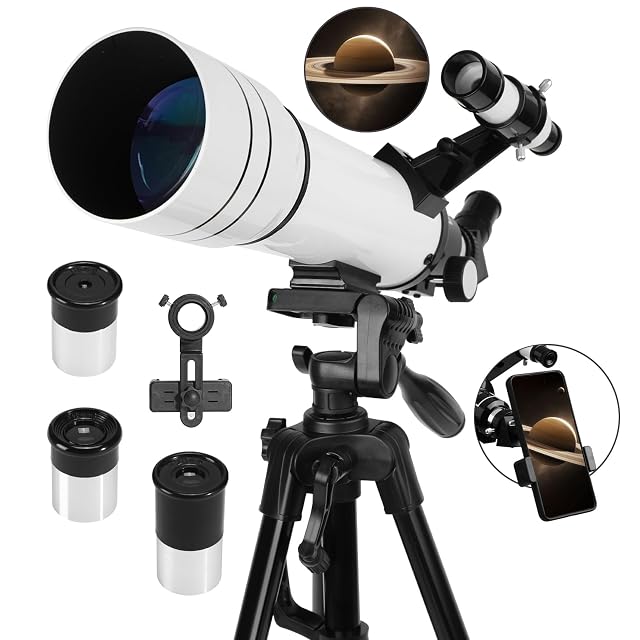
The maker’s bullet names K20 and K9 — two Kellner eyepieces. Six hundred divided by twenty and by nine gives the 30x and 66x the listing advertises. Those are the eyepieces speaking, and swapping either changes the number.
The finder is the weak link
A 5x24 has a 24 mm objective and five times magnification. It works on the Moon and on bright stars and it struggles on everything else, which is why a red dot finder is such a common first purchase for telescopes in this class.
What the backpack really buys
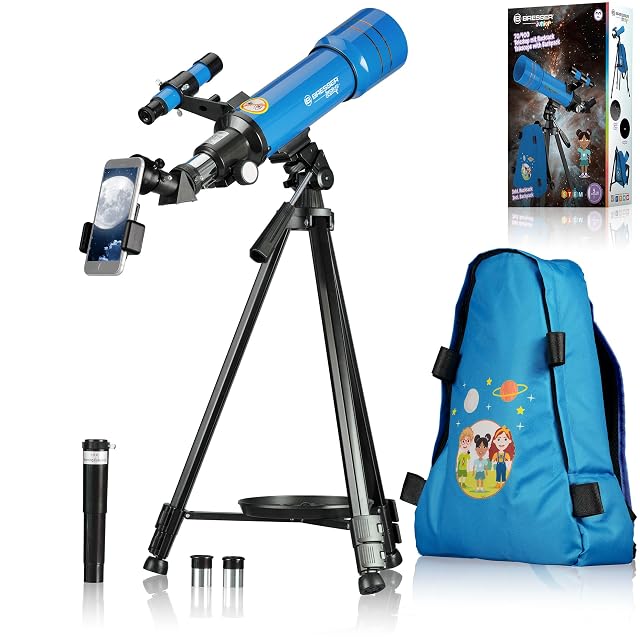
A complete 80 mm set that leaves the house. The most common reason a telescope stops being used is that setting it up is a project; a set that lives in a rucksack by the door does not have that problem.
Availability
German, French, Italian and Spanish Amazon stores sat at about 130 € on the day of the survey.
American and British Amazon stores list it in local currency, which the euro range above sets aside.
Figures as Keepa reported them on the day this page was last updated. Stock and pricing shift without warning.
Prices quoted in this text were read on 17 September 2026. The live price is at the top of the page.
What it publishes, and what it withholds
Strengths
f/7.5 on an 80 mm keeps the low-power field wide, which helps when finding things by hand
Backpack carry for a full 80 mm set is uncommon at this size
The phone adapter has marked positions for each supplied eyepiece
Compromises
A faster achromat shows more colour on bright targets than a long one does
The 5x24 finder is the small kind, with a 24 mm objective doing the work
The maker quotes 30x–66x, which is a pair of eyepiece results rather than a tube property
Specifications
Aperture
80 mm (title and bullet agree)
Focal length and ratio
600 mm (from the title) · f/7.5, the quotient of the two figures above
Lens design
Refractor, coated objective per the maker’s bullet
Glass type
Not published by the maker.
Focuser
Not published by the maker.
Drawtube
Not published by the maker.
Tube weight
Not published by the maker.
Supplied accessories
K20 and K9, named in the phone-adapter bullet · 5x24 with crosshairs · Phone adapter, backpack, adjustable tripod
Amazon reference
B08T7844LT (same reference on 6 Amazon marketplaces)
EAN
0727380312744
What observers ask about this one
How does this differ from the 900 mm refractors nearby?
Same aperture, shorter focal length. This one frames wider and is easier to carry; the long one magnifies more with the same eyepiece and tolerates simple eyepieces better.
What are K20 and K9?
Kellner-type eyepieces of 20 mm and 9 mm focal length, named in the maker’s own bullet. Dividing 600 by each gives the magnifications the listing quotes.
A 70/400 refractor sold with two eyepieces, a 5x Barlow, a phone adapter and a stainless-steel tripod — and a listing whose own bullets contradict its title.
Best for: A buyer who will check the tube’s printed figures before ordering anything else for it
A 70/400 refractor sold as a first instrument for children from eight, supplied in a backpack with three eyepieces, a star diagonal and an erecting lens.
Best for: A child from about eight who will carry the telescope themselves