No eyepiece at all — a sensor, a phone and a stack · review
FIBONAX NOVA8M review
An 8 MP electronic eyepiece camera that replaces the eyepiece in a 1.25 in focuser and streams live video to a computer over USB, with an IR-cut filter fitted.
The bottom line A competent little planetary camera filed among the smart telescopes — excellent on the Moon, and oversold on deep sky.
What it is, plainly
A camera in a 1.25 in barrel. Take the eyepiece out, put this in, focus, and the view appears on a laptop. There is no telescope here, no mount and no optics beyond the sensor window; everything depends on the instrument it is fitted to.
The fitting is named properly
M28.5 × 0.6 — the thread, not just the barrel size. That is the filter thread every 1.25 in eyepiece carries, and naming it means the supplied IR-cut filter and any other 1.25 in filter can be swapped with confidence.
Where the claims outrun the hardware
The maker’s last bullet credits the camera with capturing nebulae and galaxies clearly. A short-exposure USB camera of this class is at its best on bright targets — the Moon, the planets, double stars — where thousands of quick frames can be stacked. Faint extended objects need long exposures and cooling, and this is neither.
The number that never appears
Pixel size. It is the number that decides whether a camera suits a given focal length, and without it the sampling cannot be worked out on paper. The 8 MP count and the frame rates are published; the pixel pitch is not.
Availability
German, French, Italian and Spanish Amazon stores ran from 96 € to 106 € on the day of the survey.
American Amazon store lists it in local currency, which the euro range above sets aside.
British Amazon catalogue holds a record for it that nobody is selling.
Figures as Keepa reported them on the day this page was last updated. Stock and pricing shift without warning.
Prices quoted in this text were read on 17 September 2026. The live price is at the top of the page.
What it publishes, and what it withholds
Strengths
UVC class means it appears as a webcam, which is why no driver is needed
The filter thread is named as M28.5 × 0.6 rather than left as “1.25 inch”
At 110 g it barely disturbs the balance of a small telescope
Compromises
It is a camera and not a telescope, despite sitting in this part of the catalogue
The maker’s claim that it captures nebulae and galaxies clearly sits oddly with a short-exposure webcam-class sensor
No pixel size is published, and pixel size is what decides whether it matches a given focal length
Specifications
Aperture
Not published by the maker.
Sensor
8 MP, per the maker
Pixel size
Not published by the maker.
Field of view
Not published by the maker.
Plate-solving
Not published by the maker.
Tracking
Not published by the maker.
Stacking behaviour
1080p at 60 fps, 4K at 30 fps, as the maker states them
Battery life
Not published by the maker.
File export
USB, UVC class — no driver required per the maker · Windows 10 and 11, macOS 12 and later, Linux, as the maker lists them
Amazon reference
B0F3BXHZQP (same reference on 6 Amazon marketplaces)
EAN
0704444182307
What observers ask about this one
Does it need a laptop?
Yes. There is no screen and no card slot: the image goes out over USB to a computer running any UVC-compatible software. That is the trade for the low price and light weight.
Why does the IR-cut filter matter?
Silicon sensors see well into the infrared, where most telescope optics do not focus at the same point. Cutting it keeps the image sharp; the maker also credits it with reducing light pollution, which is a much weaker claim.
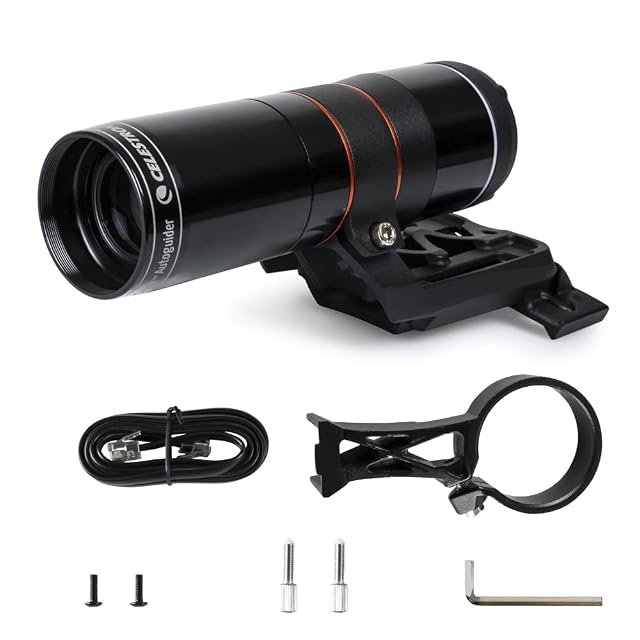
An accessory that bolts to a computerised Celestron mount and aligns it on the sky automatically in about three minutes, then improves its pointing and assists polar alignment.
Best for: An owner of a computerised Celestron mount who is tired of three-star alignments
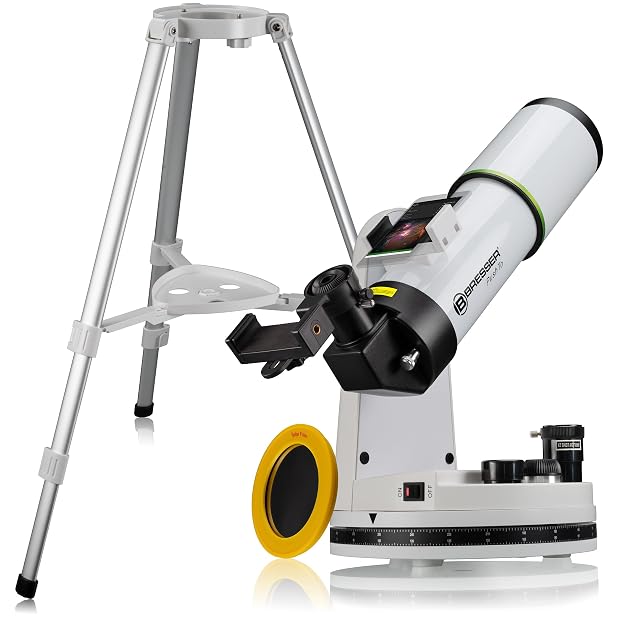
80 mm aperture · 400 mm focal length · Bluetooth PushTo
An 80/400 refractor whose built-in sensors report where it is pointing to a free phone app, which then guides the observer to a target with on-screen arrows.
Best for: A beginner who wants help finding objects without the cost or weight of a GoTo mount
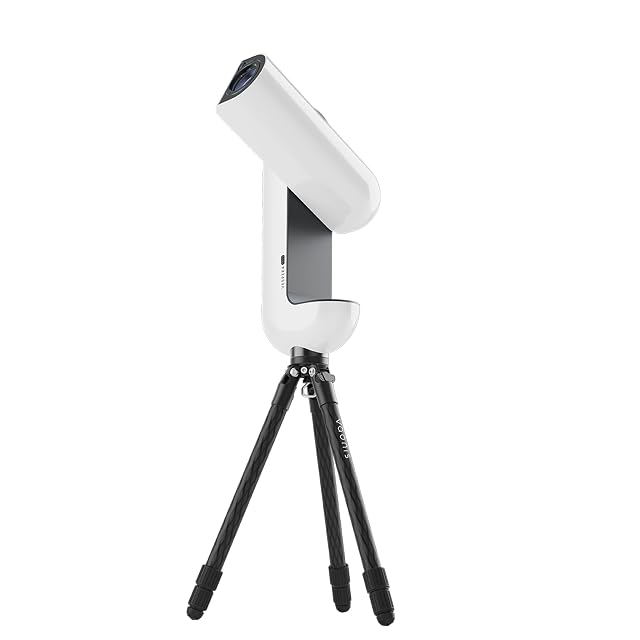
A self-contained imaging telescope with a Sony IMX676 sensor, an apochromatic flat-field quadruplet objective and an app that stacks exposures across several nights automatically.
Best for: Deep-sky imaging from a balcony or a garden, without a mount, a camera or a laptop