A camera, a lens and one motor against the rotation · review
Sky-Watcher Star Adventurer 2i Wi-Fi Photo Set review
A motorised photographic tracking mount with Wi-Fi control from a free app, an illuminated polar finder and a DSLR shutter interface for timed sequences.
The bottom line A well-equipped photographic tracker whose listing forgets to publish what it will carry.
Two ways to drive it
Physical controls on the mount, and a free app over Wi-Fi. That redundancy is worth more than it sounds: phones fail in the cold, and a mount that can only be operated from one is a mount that stops working when the battery does.
The polar finder is built in
Illuminated, integrated, and the reason this mount is usable for long exposures. Everything about tracking accuracy follows from how well the polar axis points at the pole, and a lit reticle turns that from a fiddle into a two-minute routine.
The shutter interface, and the cable that is not included
The mount can trigger a DSLR for timed sequences. The release cable is excluded — the maker says so plainly — and it is camera-specific, so it has to be chosen to match the body.
The blanks in the listing
Payload capacity and power requirements. Those two decide what lens can be fitted and how long a night can run, and neither appears in the listing.
Availability
German, Italian and Spanish Amazon stores ran from 443 € to 458 € on the day of the survey.
American, British and French Amazon catalogues hold a record for it that nobody is selling.
Figures as Keepa reported them on the day this page was last updated. Stock and pricing shift without warning.
Prices quoted in this text were read on 17 September 2026. The live price is at the top of the page.
What it publishes, and what it withholds
Strengths
An illuminated polar finder is built in rather than sold as an accessory
Both app control and physical controls, so a dead phone does not end the night
The shutter interface makes unattended exposure sequences possible
Compromises
No payload figure appears, which is the key number for a tracking mount
The shutter release cable is excluded and has to be bought to use that function
The listing’s last bullet breaks off mid-sentence
Specifications
Payload
Absent from this listing
Counterweight
Not published by the maker.
Tracking rates
Not published by the maker.
Polar alignment method
Built-in illuminated polar finder
Power source
The listing does not carry it
Weight
Not published by the maker.
Head fitting
Not published by the maker.
Amazon reference
B08JQNNX7K (same reference on 6 Amazon marketplaces)
EAN
6970456094592
What observers ask about this one
Does the app replace the controls?
No — it adds to them. The maker states the mount can be used as before or through the free app. Keeping both is the right decision for equipment used in the cold and the dark.
Why does the polar finder matter so much?
A tracker only follows the sky as well as its axis points at the pole. An illuminated reticle makes that alignment quick and repeatable, and it is the single step that decides how long an exposure can run before stars trail.
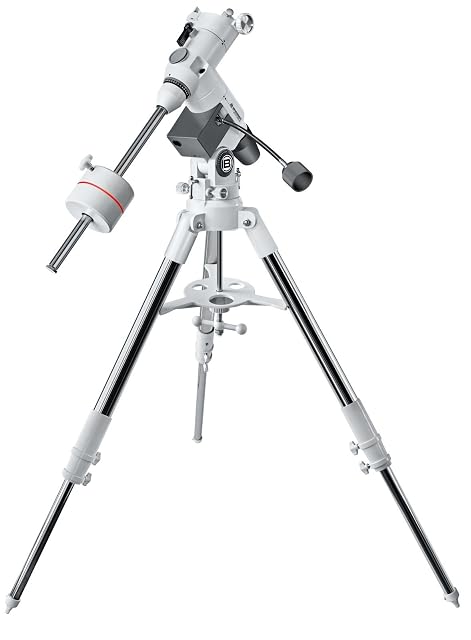
13 kg stated capacity · GP-level dovetail · 4.9 kg head
An equatorial mount head with radial ball bearings on both axes, a stated capacity of 13 kg, a polar finder and a 4.5 kg counterweight, on a height-adjustable aluminium tripod.
Best for: Carrying a serious tube steadily, with room to motorise later
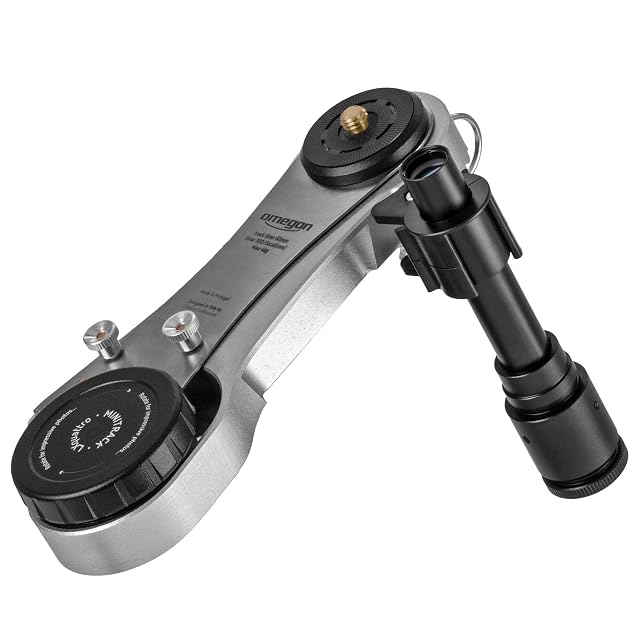
Purely mechanical tracker · 4 kg payload · no batteries
A spring-driven mechanical star tracker for cameras and light telephoto lenses, carrying up to four kilograms and running without any power source at all.
Best for: Wide-field night sky photography on foot, far from any power