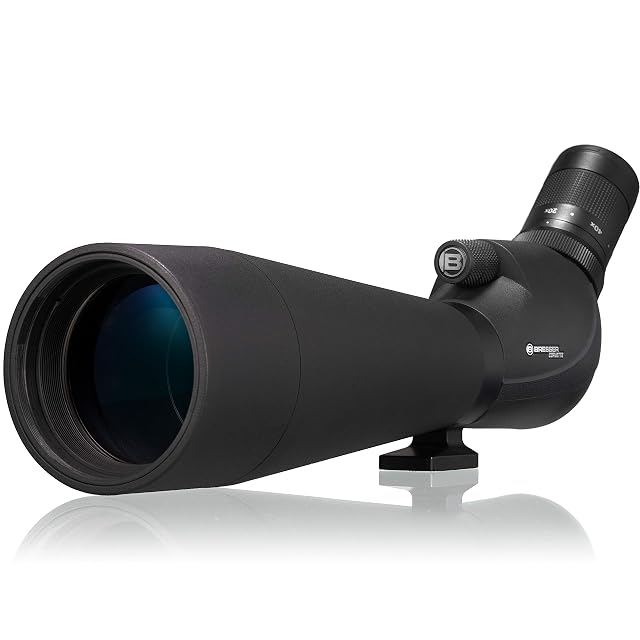
An ED-glass 20–60x80 angled spotting scope in a magnesium alloy body, with XLT coatings, dual focus, a rotating tripod collar, a 1.25 in astronomical eyepiece mount and a T-adapter ring.
The bottom line The one spotting scope here that crosses properly into astronomy, because its eyepiece comes out.
The fitting is what separates it
A standard 1.25 in eyepiece mount. Every other spotting scope on this shelf has its zoom eyepiece built in; this one accepts the whole astronomical range — a wide-field eyepiece for star clusters, a short one for the Moon, a nebula filter screwed into the barrel. That single decision turns a birding scope into a small telescope.
The glass and the body
ED objective glass to control colour fringing, XLT fully multi-coated surfaces, and a magnesium alloy housing that the maker describes as lighter than the usual aluminium. Those are three separate claims and each addresses a different problem: colour, transmission, weight.
Focusing and framing
Coarse and fine focus rings, a rotating tripod collar with detents so the eyepiece can be set where the observer is, and a sliding sunshade with a sighting line along it. The sighting line is the detail that stops a 20x scope being difficult to aim.
The blanks in the listing
Field of view, close focus and weight. For an instrument at this price those omissions are conspicuous, and this page states them rather than importing figures from elsewhere.
Availability
German, French, Italian and Spanish Amazon stores ran from 718 € to 906 € on the day of the survey.
American and British Amazon stores list it in local currency, which the euro range above sets aside.
Figures as Keepa reported them on the day this page was last updated. Stock and pricing shift without warning.
Prices quoted in this text were read on 17 September 2026. The live price is at the top of the page.
What it publishes, and what it withholds
Strengths
The 1.25 in eyepiece mount makes this the only scope here that takes astronomical eyepieces
A T-adapter ring is included, so a camera body attaches without another purchase
ED glass, a magnesium body and dual focus in one instrument
Compromises
Comfortably the most expensive scope in this group
No field of view, weight or close focus figure is published
The XLT coating is a proprietary name without a transmission figure
Specifications
Aperture
80 mm
Zoom range
20x to 60x with the supplied zoom eyepiece
Exit pupil
4 mm at 20x falling to 1.3 mm at 60x
True field of view
Not published by the maker.
Body shape
Magnesium alloy, described by the maker as lighter than aluminium
Glass type
ED — extra-low dispersion, per the maker
Coatings
XLT fully multi-coated, the maker’s own name
Close focus
Not published by the maker.
Focusing
Dual, coarse and fine
Sealing
Not published by the maker.
Weight
Not published by the maker.
Eyepiece fitting
Standard 1.25 in — astronomical eyepieces can be fitted, stated by the maker
Supplied accessories
T-adapter ring for 35 mm or DSLR photography, padded carry case · Sliding, with a sighting line
Amazon reference
B00BQ52RDQ (same reference on 6 Amazon marketplaces)
EAN
0050234523059
What observers ask about this one
What does the 1.25 in mount change?
Everything about its astronomical use. The zoom eyepiece comes out and any 1.25 in eyepiece goes in — a wide-field for sweeping, a short one for the Moon, or a nebula filter screwed into the barrel. No other scope in this group allows it.
Is the T-adapter ring the same T2 thread?
It is the same system: an M42 × 0.75 thread with a 55 mm flange distance, which a camera-specific T-ring converts to a bayonet. Supplying the ring removes one purchase from the imaging chain.
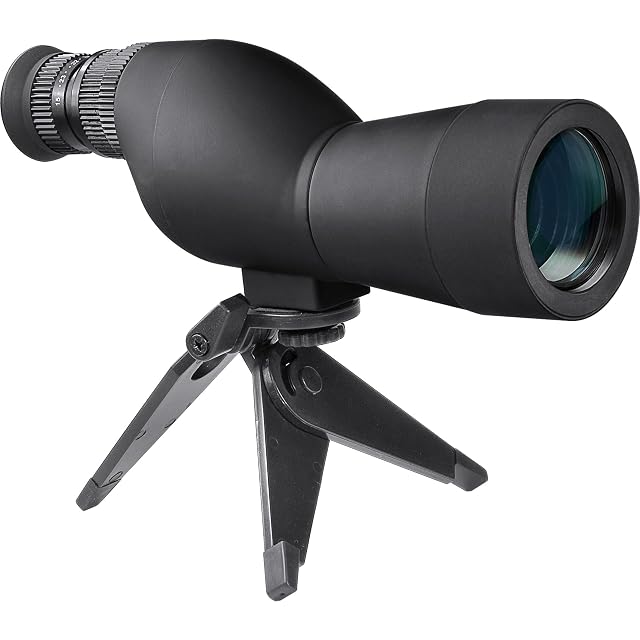
A waterproof 20–60x80 spotting scope with fully multi-coated optics, a 340° rotating body and a supplied tabletop tripod — published with its field of view, close focus, size and weight.
Best for: A buyer who wants to compare figures rather than adjectives before choosing
20–60x zoom · 80 mm objective · 4 mm to 1.3 mm exit pupil
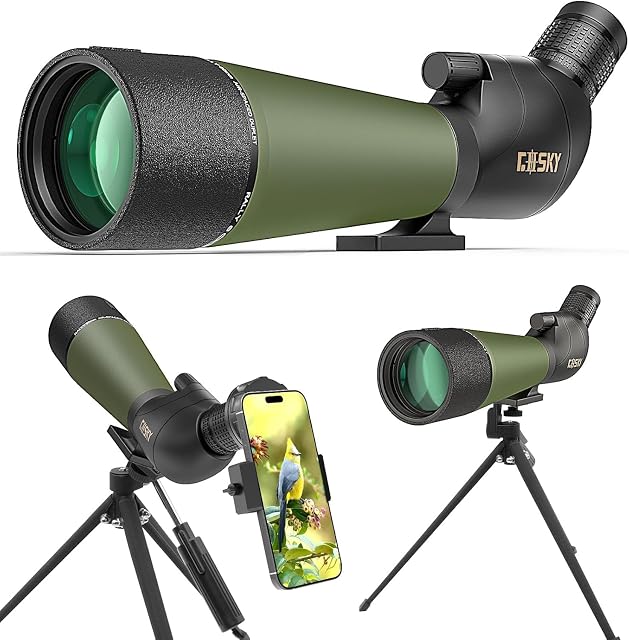
A 20–60x80 spotting scope with BAK4 porro prisms and fully multi-coated optics, supplied with a full-metal tabletop tripod, a phone adapter and a carry case.
Best for: Birds, wildlife and daytime distance work, with the Moon as a bonus