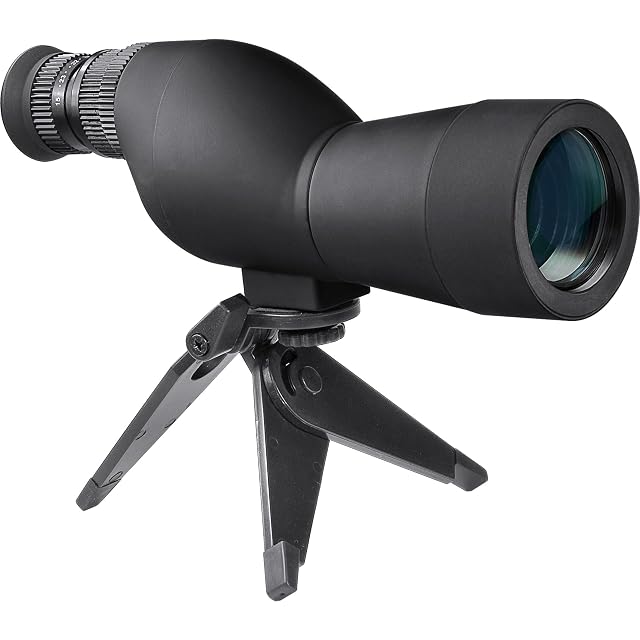
A 20–60x80 angled spotting scope with BAK4 prisms, a 21 mm eyepiece for long eye relief, a second-generation desk tripod and a universal phone adapter.
The bottom line The best-angled and best-threaded scope of the budget group, waiting for a bigger tripod than the one in the box.
The body angle is the specification that changes use
An angled eyepiece means the observer looks down into the scope rather than along it. For anything above about thirty degrees — which is most of the sky — that is the difference between comfort and a crick in the neck, and it is why almost every astronomical telescope uses a diagonal.
Eye relief and the 21 mm eyepiece
A large eyepiece lens with long eye relief suits spectacle wearers and reduces fatigue over a long session. The maker states both; neither is quantified in millimetres, which is the figure that would let it be compared.
The thread and the tripod
A UNC 1/4-20 socket is named, which is the smaller of the two threads defined by ISO 1222 for photographic tripods. The supplied desk tripod is described as second-generation and stable; an 80 mm scope at 60x will still benefit from something larger, and the thread means anything will fit.
The blanks in the listing
Field of view at either zoom setting, and weight. Those are the two figures that would place it against the Bresser scope on this shelf, which publishes both.
Availability
German, French, Italian and Spanish Amazon stores ran from 105 € to 117 € on the day of the survey.
British Amazon store lists it in local currency, which the euro range above sets aside.
American Amazon store gave no result whatever, so the buy button there opens a search rather than an empty page.
Figures as Keepa reported them on the day this page was last updated. Stock and pricing shift without warning.
Prices quoted in this text were read on 17 September 2026. The live price is at the top of the page.
What it publishes, and what it withholds
Strengths
An angled eyepiece is far more comfortable for anything above the horizon
The tripod thread is named as UNC 1/4-20, so any photo tripod fits
The phone adapter’s clamping range is published as two figures
Compromises
The supplied desk tripod is small for an 80 mm scope at 60x
No field of view figure is published at either end of the zoom
No weight appears in the listing
Specifications
Aperture
80 mm
Zoom range
20x to 60x, variable
Exit pupil
4 mm at 20x falling to 1.3 mm at 60x
True field of view
Not published by the maker.
Body shape
Not published by the maker.
Glass type
BAK4 prisms; multi-layer coating on all lenses and prisms
Coatings
Not published by the maker.
Close focus
Not published by the maker.
Focusing
Not published by the maker.
Sealing
Not published by the maker.
Weight
Not published by the maker.
Eyepiece fitting
21 mm, per the maker · Angled, described by the maker as more comfortable
Supplied accessories
UNC 1/4-20, named explicitly by the maker · Universal, for phone widths of 55–100 mm
Amazon reference
B07BL1B4CX (same reference on 5 Amazon marketplaces)
EAN
0609378743030
What observers ask about this one
Angled or straight?
Angled is easier for anything high up — including the sky — and easier to share between people of different heights. Straight is quicker to aim at something at eye level. For astronomy the angled body is the clear choice.
Why does the named tripod thread matter?
Because the supplied desk tripod will not be enough at 60x. A named UNC 1/4-20 socket means any photographic tripod or clamp will take it, and that is the upgrade that changes what this scope shows.
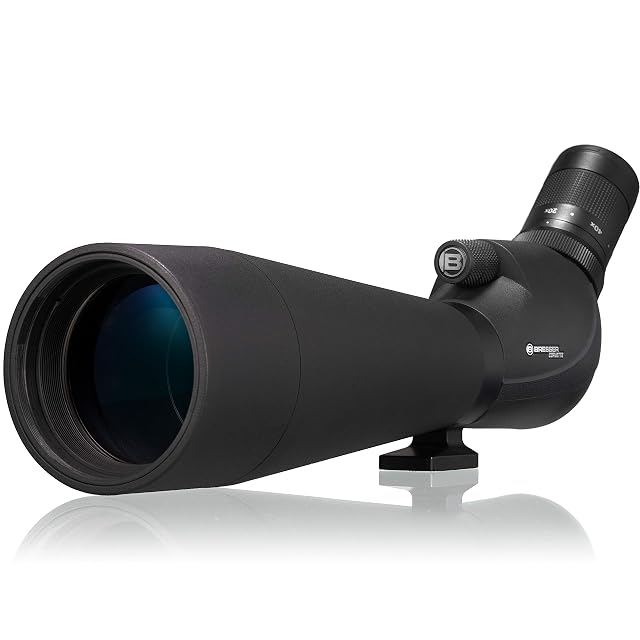
A waterproof 20–60x80 spotting scope with fully multi-coated optics, a 340° rotating body and a supplied tabletop tripod — published with its field of view, close focus, size and weight.
Best for: A buyer who wants to compare figures rather than adjectives before choosing
20–60x · 80 mm ED · 1.25 in eyepiece mount · magnesium body
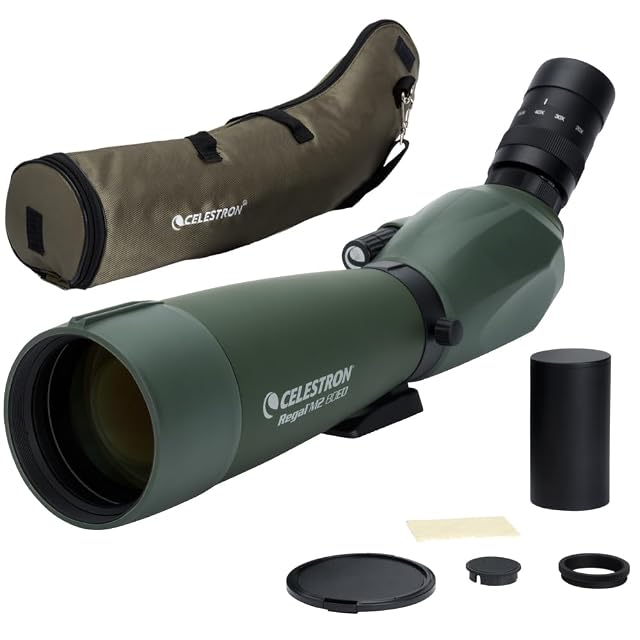
An ED-glass 20–60x80 angled spotting scope in a magnesium alloy body, with XLT coatings, dual focus, a rotating tripod collar, a 1.25 in astronomical eyepiece mount and a T-adapter ring.
Best for: The observer who wants one instrument for birds by day and the Moon and planets by night