Both Kosmos products on this site carry an ISBN rather than the marketplace reference the rest of the catalogue uses. That changes how they are searched for and how they are replaced, and each page says so.
The planisphere
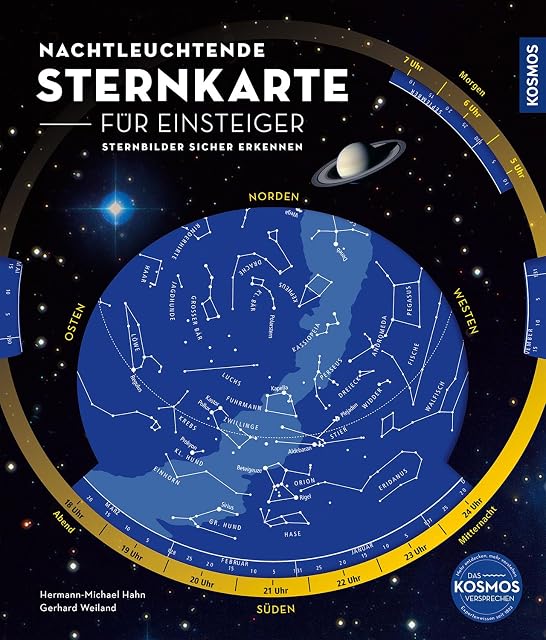
A rotating chart is judged on its latitude band before anything else: a chart cut for one latitude shows the wrong horizon at another. The glow-in-the-dark printing is a genuine feature on a shelf where reading the card at night is the entire problem.
The telescope
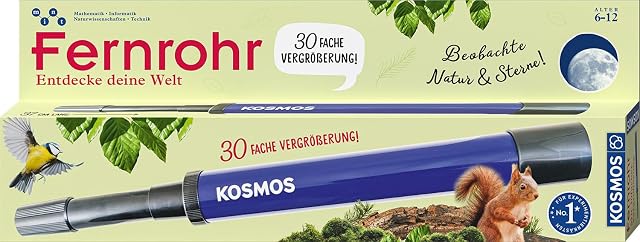
A small refractor at the introductory end, published with its aperture and focal length.
Reading a Kosmos page here
Treat the ISBN as the reference. It is how these two will still be findable when a marketplace code has moved.
A fixed 30x spyglass-style telescope in a metal tube, sold as an experiment set for children from eight with an instruction booklet explaining how a refractor works.
Best for: A child who wants something to carry on a walk and look at the Moon with
A large rotating star chart with glow-in-the-dark printing, covering the constellations visible from Germany and described by the maker as suitable for children.
Latitude band
All constellations visible from Germany, as the maker states it · Described, never quantified
Disc size
Rotating star chart — a planisphere
Readability
Luminous, so the chart can be read after exposure to light
Printed subjects
Not published by the maker.
Material
Not published by the maker.
Trade reference
Sold as a book — ISBN 978-3-440-17701-3 rather than a B0 marketplace code
Audience
Beginners; the maker states it also suits children
Amazon reference
3440177017 (same reference on 6 Amazon marketplaces)
EAN
9783440177013
Luminous printing means it can be read without a torch at all
A large format, which makes the constellation shapes legible in poor light
The latitude band is described by country rather than as a figure
Best for: A beginner at northern European latitudes learning the constellations
Any figure written into the body of this page was true on the day it was written. The amount shown next to each instrument is requested from the retailer as the page loads, and it is that amount, not the text, that stands.