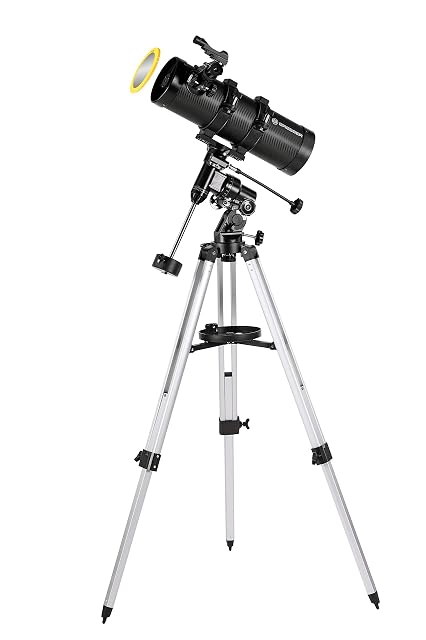
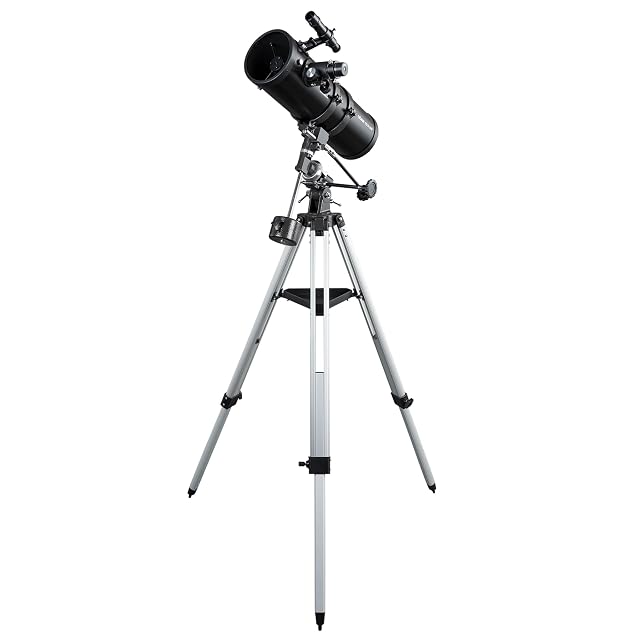
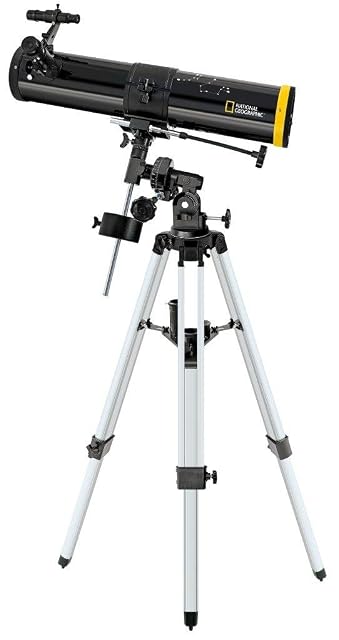
The most aperture per euro, and an alignment to keep · review
Celestron StarSense Explorer DX 130 (22461) review
A 130 mm Newtonian on a manual alt-azimuth mount whose dock and app read the star field through the phone camera and steer the observer to a target with on-screen arrows.
The bottom line A conventional 130 mm Newtonian whose value sits almost entirely in the finding system bolted to the side of it.
What the system actually does
The dock holds a phone so its camera sees the same part of the sky the telescope does. The app reads the star pattern, works out where the telescope is pointing, and draws arrows towards a chosen target. When the reticle turns green, the object should be in the eyepiece. The maker describes this as real-time sky recognition, and it is the reason to buy this model over a plain 130 mm.
The optics are the ordinary part
A 130 mm Newtonian with a coated mirror. The listing does not publish the focal length, which means the focal ratio, the magnification with either supplied eyepiece and the exit pupil all have to come from the tube rather than from the advertising.
Two eyepieces and a red dot finder
Twenty-five and ten millimetres, an erect-image diagonal and a red dot finder for use without the phone. That last item matters more than it looks: it means a flat battery ends the app, not the evening.
The cost of a bright screen
Every glance at a phone costs dark adaptation, and dark adaptation is what makes faint objects visible. Turning the screen to its dimmest and using the app in short bursts is the habit that keeps both halves of this telescope working.
Availability
German, French, Italian and Spanish Amazon stores ran from 436 € to 607 € on the day of the survey.
American and British Amazon stores list it in local currency, which the euro range above sets aside.
Figures as Keepa reported them on the day this page was last updated. Stock and pricing shift without warning.
Prices quoted in this text were read on 17 September 2026. The live price is at the top of the page.
What it publishes, and what it withholds
Strengths
The app removes the single biggest obstacle for a beginner: finding anything at all
A red dot finder is included as well, so the telescope still works without a phone
Dual-axis slow motion makes centring at magnification a controlled movement
Compromises
The listing never states the focal length, so no magnification follows from it on paper
The dock depends on a phone whose battery and screen brightness both cost dark adaptation
Manual alt-azimuth means the target drifts out of the field and has to be nudged back
Specifications
Aperture
130 mm (from the title and bullets)
Focal length and ratio
The listing does not carry it
Optical design
Newtonian reflector, high-reflectivity coating per the maker
Mirror coating
Not published by the maker.
Secondary obstruction
Not published by the maker.
Focuser type
Not published by the maker.
Tube length
Not published by the maker.
Collimation access
Not published by the maker.
Mount supplied
Manual alt-azimuth with dual-axis slow motion and a sliding rod
Supplied accessories
StarSense dock and app; the maker states iOS and Android compatibility · 25 mm and 10 mm · Erect-image diagonal, red dot finder, full-height tripod
Amazon reference
B083JRF1MH (same reference on 6 Amazon marketplaces)
EAN
0050234224611
What observers ask about this one
Does it track by itself?
No. The mount is manual: the app points you at a target and you keep it centred with the slow-motion controls. What it automates is finding, not following.
Is the phone required?
Not for observing — a red dot finder is supplied. It is required for the StarSense function, which is the reason most people choose this model.