Skip to content

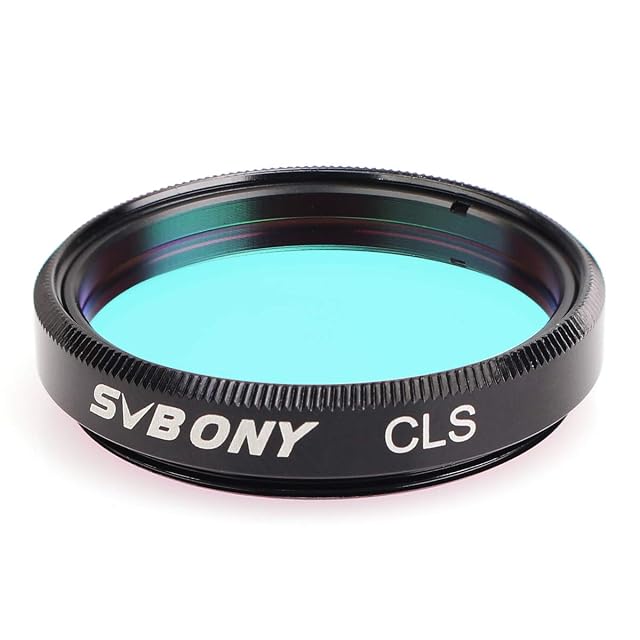
SVBONY CLS 1.25 in (FUSF9155A)

A CLS broadband filter publishing 90 per cent transmission at the hydrogen, oxygen and sulphur lines and 0.1 per cent at the sodium and mercury lines of artificial lighting.

SVBONY 1.25 inch CLS light pollution filter

SVBONY CLS 1.25 in (FUSF9155A)

A CLS broadband filter publishing 90 per cent transmission at the hydrogen, oxygen and sulphur lines and 0.1 per cent at the sodium and mercury lines of artificial lighting.

Blocked wavelengths and published curve
90 % at Hα 656 nm, O-III 496 and 500 nm, S-II 672 nm and Hβ 486 nm, as the maker publishes it
LED and sodium behaviour
0.1 %, named at Na 589 and 578 nm and Hg 435 nm
Visual or photographic design
CLS broadband filter, threaded for 1.25 in eyepieces and camera noses
Colour cast
Planetary rotation coating system, for uniformity — the maker’s own description
Thread size
Not published by the maker.
Focal ratio limits
Not published by the maker.
Amazon reference
B079BWD595 (same reference on 6 Amazon marketplaces)
EAN
0609378745577
  • The only filter on this shelf to publish both in-band and off-band transmission with named wavelengths
  • The blocked lines are named by element, which is what allows the claim to be checked against physics
  • A broadband filter helps less than a narrowband one under heavy light pollution

Best for: Imaging or observing emission nebulae from a town, with a colour camera or by eye

≈ $32 / €46
Check price on Amazon
Specifications

Blocked wavelengths and published curve
90 % at Hα 656 nm, O-III 496 and 500 nm, S-II 672 nm and Hβ 486 nm, as the maker publishes it
LED and sodium behaviour
0.1 %, named at Na 589 and 578 nm and Hg 435 nm
Visual or photographic design
CLS broadband filter, threaded for 1.25 in eyepieces and camera noses
Colour cast
Planetary rotation coating system, for uniformity — the maker’s own description
Thread size
Not published by the maker.
Focal ratio limits
Not published by the maker.
Amazon reference
B079BWD595 (same reference on 6 Amazon marketplaces)
EAN
0609378745577

Both halves of the specification

Ninety per cent at hydrogen alpha, the two oxygen lines, sulphur and hydrogen beta. Nought point one per cent at the sodium and mercury lines of street lighting. That pairing — what passes and what is rejected, each with named wavelengths — is what a filter specification ought to look like, and it is the only one on this shelf that provides it.

Why the named lamp lines matter

Sodium at 589 and 578 nanometres, mercury at 435. Those are the emissions of the lighting that produces the orange glow over a town, and a filter that rejects them specifically is doing something a broadband grey filter cannot.

What is still nowhere

Bandwidth. The transmission at each line is given; the width of the window around it is not. Two filters passing 90 per cent at 656 nm can differ considerably in how much surrounding sky they also let through.

Where it belongs

On an emission nebula, from a suburban or urban site, at low to medium magnification — or in front of an unmodified DSLR, which the maker names. On galaxies and clusters it removes as much of the object as of the sky.

Availability

German, French, Italian and Spanish Amazon stores ran from 46 € to 56 € on the day of the survey.

American Amazon store lists it in local currency, which the euro range above sets aside.

British Amazon catalogue holds a record for it that nobody is selling.

Figures as Keepa reported them on the day this page was last updated. Stock and pricing shift without warning.

Prices quoted in this text were read on 17 September 2026. The live price is at the top of the page.

What this fits

All light pollution filters