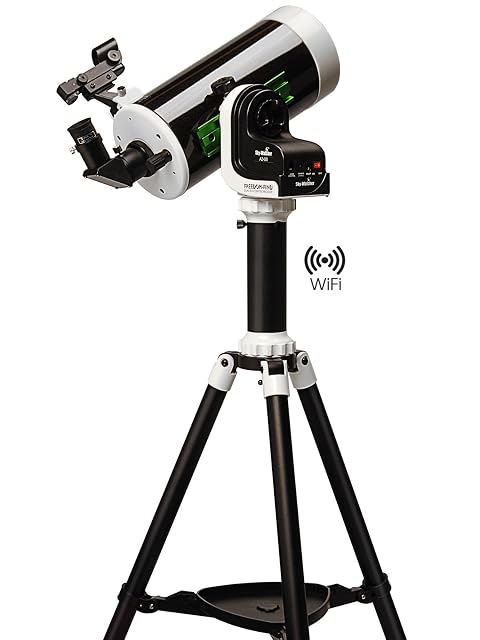
The bottom line The aperture-per-cubic-metre champion of this group, sold with a headline object count that says nothing about what it will show.
What the folded path buys
A Schmidt-Cassegrain runs the light down the tube, back to a secondary mirror, and out through the centre of the primary. The result is a long focal length inside a short tube — eight inches of aperture in something a person carries with one arm. That compactness is the entire argument for this design.
The figure the listing leaves out
Focal length. It is the number that decides magnification with any eyepiece, the focal ratio, and the exit pupil. The maker publishes it elsewhere; it is not in this advertisement, and this page will not import a figure from another source and present it as this listing’s.
SkyAlign and what it automates
The routine asks the observer to centre three bright objects and works out the rest. What it automates is pointing; it does not make an unaligned mount accurate, and an object centred on a misidentified star produces confident, consistent errors all evening.
Where it stops
For long exposures a fork mount on a tripod tracks in altitude and azimuth, which rotates the field. A wedge fixes that, and it is a separate purchase. Visually, none of this matters at all.
Availability
German, French, Italian and Spanish Amazon stores ran from 1537 € to 1961 € on the day of the survey.
American and British Amazon stores list it in local currency, which the euro range above sets aside.
Figures as Keepa reported them on the day this page was last updated. Stock and pricing shift without warning.
Prices quoted in this text were read on 17 September 2026. The live price is at the top of the page.
What it publishes, and what it withholds
Strengths
Eight inches of aperture in a tube short enough to carry in one hand
The fork breaks down into pieces one person can move separately
A folded optical path gives a long focal length without a long tube
Compromises
The listing does not publish the focal length, which is the figure every eyepiece decision needs
A catalogue of 40 000 objects counts entries this aperture cannot show from a suburban garden
Fork-mounted Schmidt-Cassegrains need an equatorial wedge before long exposures make sense
Specifications
Aperture
8 inches, as the maker writes it
Folded focal length and ratio
The listing does not carry it
Corrector design
Schmidt-Cassegrain with the maker’s XLT coating
Obstruction
Not published by the maker.
Back focus
Not published by the maker.
Cool-down guidance
Not published by the maker.
Tube weight
Not published by the maker.
Mount supplied
Single-arm computerised fork on a steel tripod
Amazon reference
B000GUFOC8 (same reference on 6 Amazon marketplaces)
EAN
0050234110693
What observers ask about this one
Why is a folded design shorter?
Light travels down the tube, back up to a secondary, and out through a hole in the primary. The optical path is folded into roughly a third of the physical length, which is what makes eight inches portable.
Does the 40 000-object database mean anything?
Very little on its own. What matters is whether the lists you actually use are quick to reach in the dark. Most of those entries are beyond this or any amateur instrument.
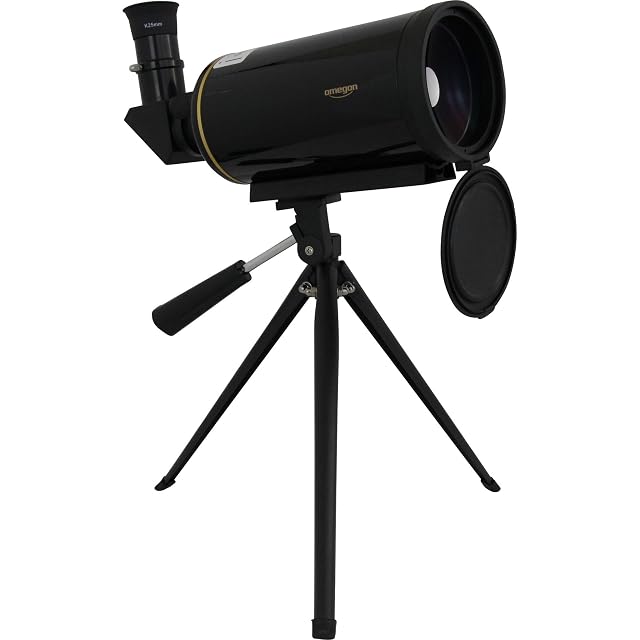
A compact 80 mm Maksutov with a coated front lens, a T-2 thread with buffer ring, a finder shoe and a GP dovetail that fits photo tripods and standard mounts.
Best for: A travel optic that doubles as a long lens on a photo tripod
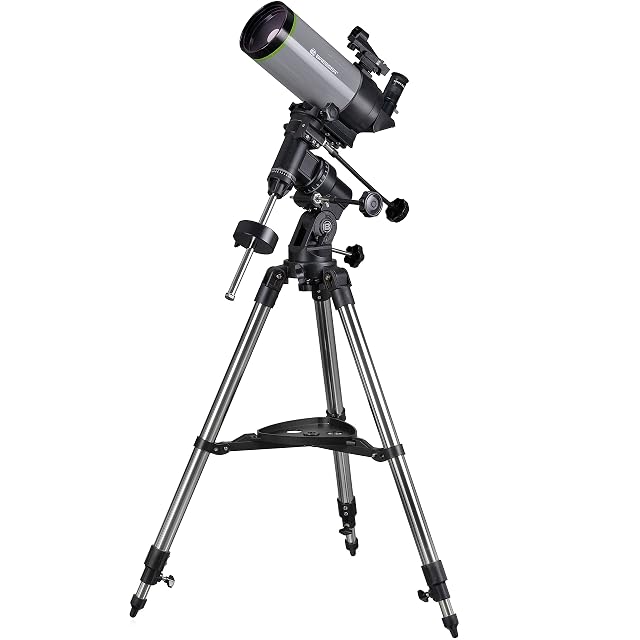
A 100/1400 Maksutov on an EQ3 equatorial mount with slow-motion controls on both axes, supplied with a 25 mm Plössl, an erecting prism and a phone holder.
Best for: A compact planetary telescope that also works on landscapes