The bottom line The most capable mount here by its published capacity, and the one whose own weight is left unstated.
Fourteen kilograms, published
That is the largest stated capacity on this shelf, and it is the figure that decides which tube can go on top. As with every mount, the number is published for observation; imaging loads a mount harder, and leaving margin is the practice that produces round stars.
Alignment without the pole in view
The mount builds its model from bright stars it can see, so a northern horizon full of buildings stops being a reason not to observe. In a town that single capability changes where a telescope can be set up.
What the listing walks past
Its own weight. For a mount described as ideal for mobile astrophotography, the figure that decides whether it goes in a car boot in one piece is absent.
The database claim
A large object database counts entries, most of which no amateur telescope will show. What matters in the dark is whether the lists you actually use are quick to reach, and no listing publishes that.
Availability
German, French, Italian and Spanish Amazon stores ran from 1199 € to 1319 € on the day of the survey.
American Amazon store lists it in local currency, which the euro range above sets aside.
British Amazon catalogue holds a record for it that nobody is selling.
Figures as Keepa reported them on the day this page was last updated. Stock and pricing shift without warning.
Prices quoted in this text were read on 17 September 2026. The live price is at the top of the page.
What it publishes, and what it withholds
Strengths
The capacity is published as a figure, and it is the largest on this shelf
Aligning without sight of Polaris solves the commonest urban problem
A mount built for imaging rather than only for pointing
Compromises
Its own weight is not published, which matters for something sold as mobile
A “large database” counts entries most telescopes cannot show
The listing runs to five short lines for a substantial instrument
Specifications
Payload
14 kg, as the maker publishes it
Counterweight
Not published by the maker.
Tracking rates
Not published by the maker.
Polar alignment method
No polar finder and no clear view of Polaris required, as the maker states it
Power source
Not published by the maker.
Weight
Absent from this listing
Head fitting
Not published by the maker.
Amazon reference
B00AYGIQDS (same reference on 6 Amazon marketplaces)
EAN
0050234915199
What observers ask about this one
How can it align without Polaris?
By modelling the sky from stars it can see: the observer centres named bright stars and the mount computes the pole’s position from them. It is the single most useful feature for anyone whose northern horizon is a wall.
What does a 14 kg capacity really mean?
It is a manufacturer’s figure for the instrument carried, and payload figures are published for observation. Imaging asks more of a mount than looking does, and experienced imagers commonly load well under the stated number.
13 kg stated capacity · GP-level dovetail · 4.9 kg head
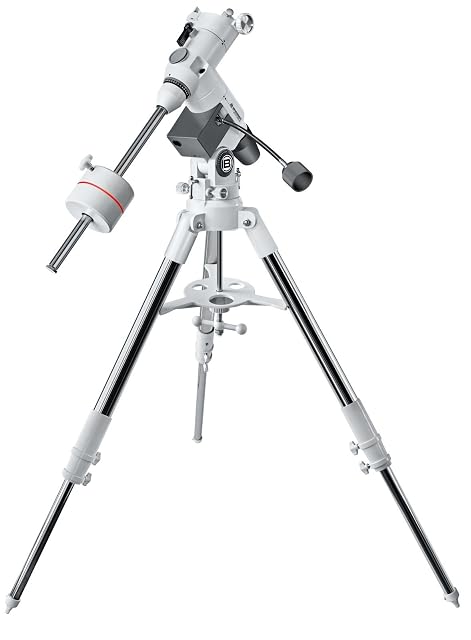
An equatorial mount head with radial ball bearings on both axes, a stated capacity of 13 kg, a polar finder and a 4.5 kg counterweight, on a height-adjustable aluminium tripod.
Best for: Carrying a serious tube steadily, with room to motorise later
Purely mechanical tracker · 4 kg payload · no batteries
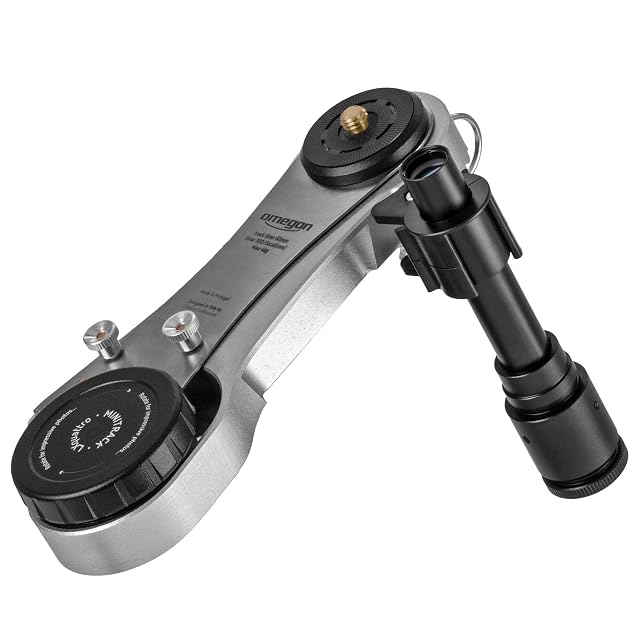
A spring-driven mechanical star tracker for cameras and light telephoto lenses, carrying up to four kilograms and running without any power source at all.
Best for: Wide-field night sky photography on foot, far from any power
Motorised tracker · Wi-Fi and manual control · illuminated polar scope
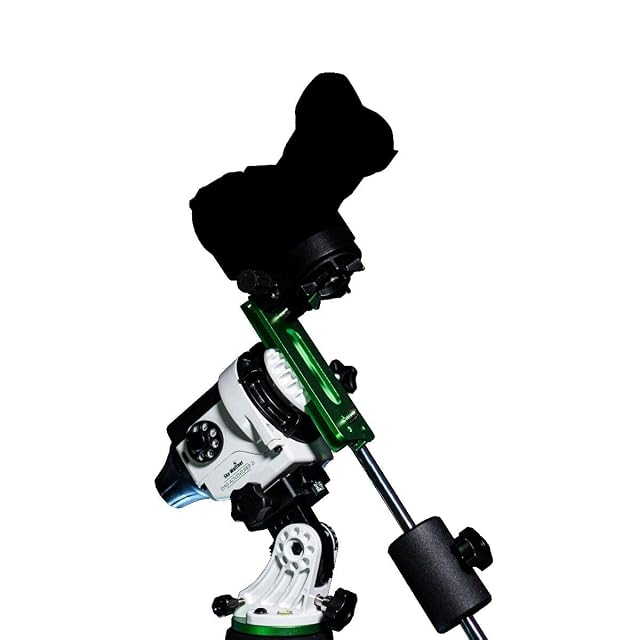
A motorised photographic tracking mount with Wi-Fi control from a free app, an illuminated polar finder and a DSLR shutter interface for timed sequences.
Best for: Camera-based night sky photography with an alignment routine that is properly supported