Skip to content

SVBONY SV106 60 mm vs Astromania GS70 70 mm

Which guide scope publishes what guiding needs?

A guide scope is judged on two things: whether it holds still relative to the main telescope, and whether the camera can be brought to focus. One of these publishes a focal length, a focus range and the rings it mounts with; the other publishes a thread.

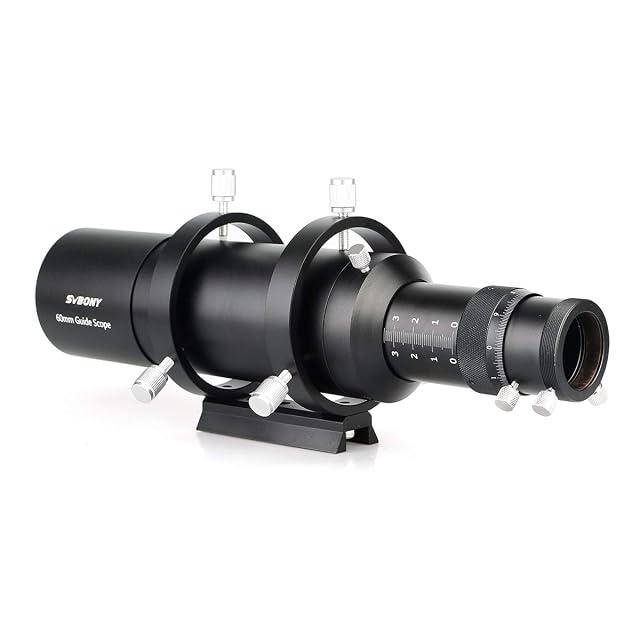
SVBONY SV106 60 mm guide scope with helical focuser

SVBONY SV106 60 mm

Wins 1 of 7

Check price

≈ $82 / £94 / €100

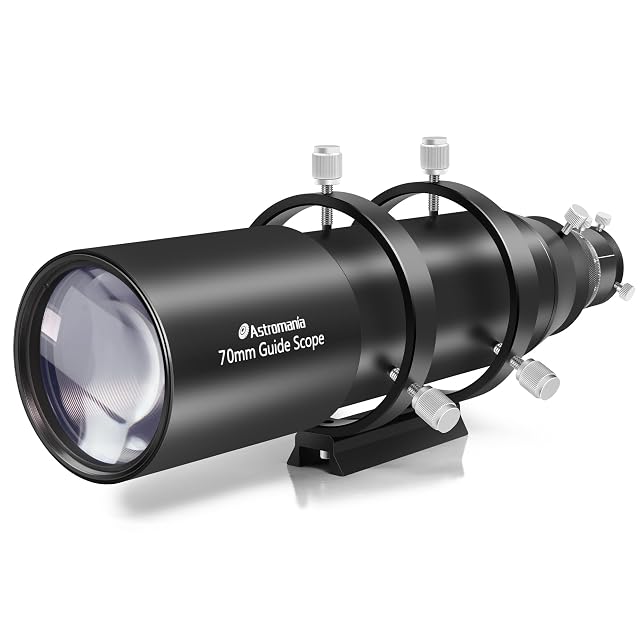
Astromania GS70 70 mm guide scope with tube rings and dovetail

Astromania GS70 70 mm

Wins 5 of 7

Check price

≈ $156 / £164 / €189

Line by line

Compared on SV106 60 mm GS70 70 mm
Aperture 60 mm (from the title and bullets) 70 mm (from the title)
Focal length Not stated directly; the maker notes that a 25 mm eyepiece makes it a 9.6x60 finder 400 mm, as the maker publishes it
Mounting method Not published by the maker. Matching tube rings, Synta mounting plate, adjustable counterweight
Flexure resistance Not published by the maker. Black anodised aluminium with milled knurled rings
Focuser type Helical and non-rotating — the maker states that guide stars do not rotate, with a male T-thread at the eyepiece collar Helical with a brass compression ring and two thumbscrews
Back focus Not published by the maker. 90 mm total, of which 10 mm is micro-focus, as the maker states it
Weight Not published by the maker. Not published by the maker.

A tick means one listing published something the other did not, or published a better figure. It does not mean the product is better, and the column is not a score out of anything: a maker who says less loses lines here without losing a comparison. The two verdicts below are where the page is settled.

Which one, for whom

Buy the SVBONY SV106 60 mm

The one with the right focuser. A non-rotating helical focuser matters specifically for guiding: if the camera turns as it focuses, the guide star moves across the sensor. The maker says so directly, and then publishes almost nothing else — no focal length, no focus range, no mounting hardware.

Buy the Astromania GS70 70 mm

The one that arrives ready to bolt on. Rings, a Synta plate and a counterweight are the parts that decide whether the guide scope holds its aim relative to the main tube, and it publishes both a focal length and 90 mm of focus range with 10 mm of micro-focus. Its helical focuser is not described as non-rotating.

What observers ask about these two

Why does the guide scope’s focal length matter?

It sets how many arcseconds a pixel covers, which is what guiding software works with. A shorter guide scope gives a coarser scale and is generally easier to keep in focus.

What is flexure and why is it the enemy?

Any bending between the guide scope and the main telescope moves the image on the main sensor without the guider seeing it. Rigid rings and a solid plate are what prevent it, which is why they are part of the specification.

What is micro-focus for?

A camera has to reach focus within a fraction of a millimetre. Ten millimetres of fine travel inside ninety millimetres of coarse travel is what makes that achievable without shifting the whole tube.

The full reviews

  • SVBONY SV106 60 mm

    60 mm aperture · helical focuser · male T-thread

    A 60 mm guide scope with a non-rotating helical focuser and a male T-thread at the eyepiece collar for screwing a guide camera on directly.

    Best for: A guide scope that will spend half its life as a finder

    ≈ $82 / £94 / €100

  • Astromania GS70 70 mm

    70 mm aperture · 400 mm focal length · 90 mm focus range

    A 70/400 guide scope with a helical focuser offering 90 mm of range including 10 mm of micro-focus, supplied with tube rings, a Synta plate and an adjustable counterweight.

    Best for: Guiding a longer main telescope, where a short guide scope would not resolve the correction

    ≈ $156 / £164 / €189

Any figure written into the body of this page was true on the day it was written. The amount shown next to each instrument is requested from the retailer as the page loads, and it is that amount, not the text, that stands.