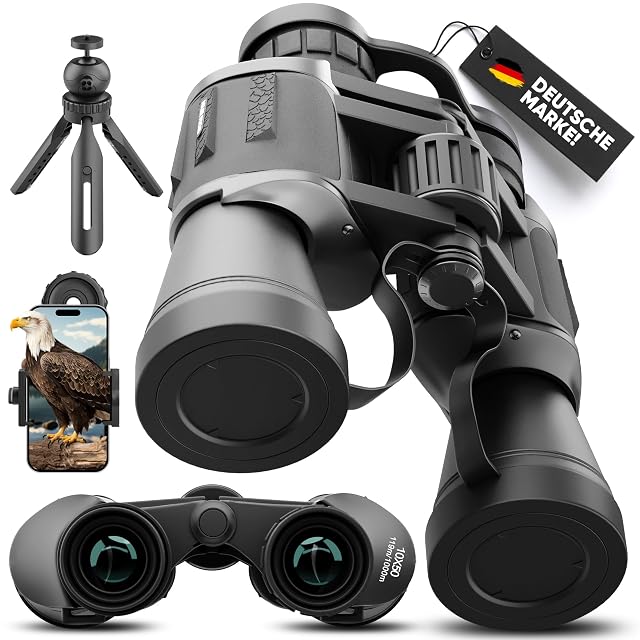
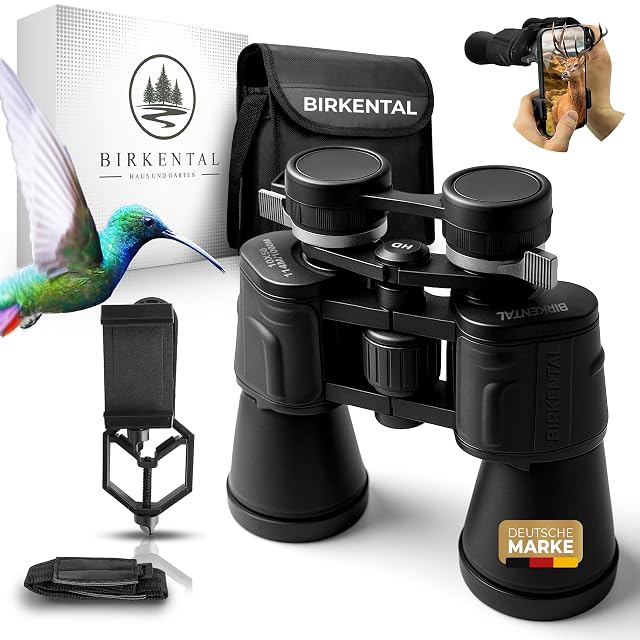
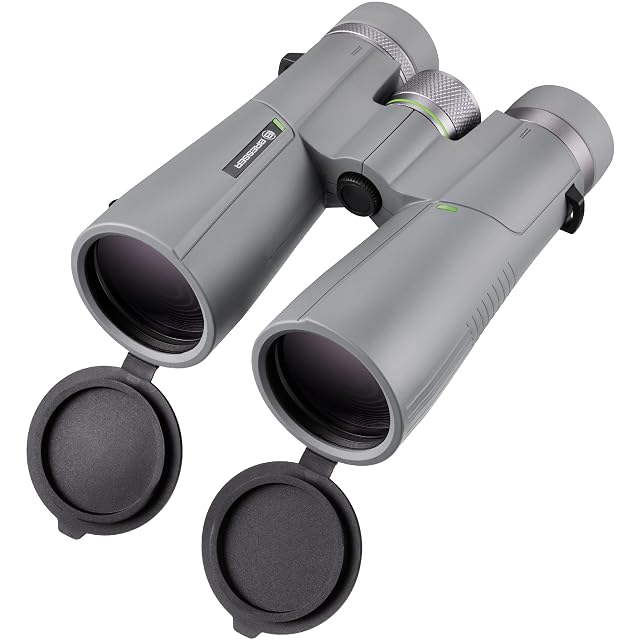
The bottom line A well-specified daytime binocular with an exit pupil that limits it under a dark sky, and a test claim with nothing behind it.
Two numbers and what they give
Twelve times magnification on 42 mm objectives. Dividing the second by the first gives a 3.5 mm exit pupil — smaller than the 5 mm a 10x50 produces, which means a dimmer image under a dark sky where the eye is wide open. In daylight, when the pupil is small anyway, that difference disappears entirely.
What the maker does specify
Magnesium body, nitrogen filling, BAK4 prisms, fully multi-coated objective, two-metre close focus. That is a decent specification list, and each item is a real claim: nitrogen prevents internal fogging, BAK4 prisms deliver a round exit pupil, and fully multi-coated means every air-to-glass surface has several layers.
The claim with nothing attached
“TESTSIEGER” and a grade of 1.1 appear without a named publication, without a date and without a comparison group. This page records that the claim is made and that nothing accompanies it.
Where it is at its best
Daytime. Twelve times on 42 mm is a wildlife and landscape specification, and it does astronomy as a secondary use — best braced, seated or on a tripod adapter.
Availability
German, French, Italian and Spanish Amazon stores ran from 130 € to 158 € on the day of the survey.
British Amazon catalogue holds a record for it that nobody is selling.
American Amazon store gave no result whatever, so the buy button there opens a search rather than an empty page.
Figures as Keepa reported them on the day this page was last updated. Stock and pricing shift without warning.
Prices quoted in this text were read on 17 September 2026. The live price is at the top of the page.
What it publishes, and what it withholds
Strengths
Nitrogen filling and a magnesium body are both stated rather than implied
Fully multi-coated is the strongest of the four coating labels, and it is claimed explicitly
Twelve times reaches further than the 10x that dominates this shelf
Compromises
A 3.5 mm exit pupil is small for astronomy: the view is dimmer than a 10x50 at the same sky
The test-winner claim names nobody, which makes it unverifiable
Twelve times hand-held is harder to hold steady than ten
Specifications
Aperture
42 mm
Magnification
12x, fixed by the design
Exit pupil
3.5 mm — 42 divided by 12
True field of view
Not published by the maker.
Prism type and coatings
BAK4 prisms, fully multi-coated objective, as the maker states them
Eye relief
Not published by the maker.
Close focus
2 m, as the maker states it
Weight
Not published by the maker.
Tripod mounting
Not published by the maker.
Supplied accessories
Not published by the maker.
Amazon reference
B0D1GC6DGZ (same reference on 5 Amazon marketplaces)
EAN
4260764710683
What observers ask about this one
Is 12x42 a good astronomy combination?
It is a compromise. The 3.5 mm exit pupil means less light reaches a dark-adapted eye than a 10x50 delivers, while the higher magnification darkens the sky background. It works; a 10x50 generally works better for faint objects.
What should be made of the test-winner claim?
It appears in the title and in the first bullet with a grade of 1.1 and no source. This site reports it as a claim made by the seller. Without a named publication and date it cannot be checked.